

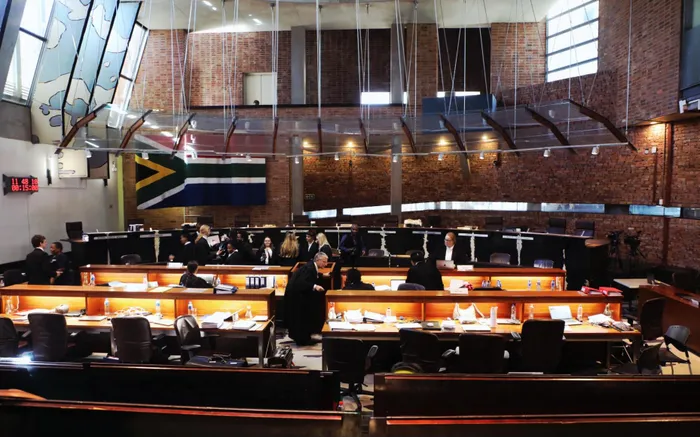
South Africa’s Constitutional Court is facing a busy week ahead, with arguments due to be heard on Monday for the recusal of Justice Sisi Khampepe from the TRC Inquiry and judgment on Tuesday in the rand fixing scandal saga.
Image: File/Timothy Bernard/Independent Newspapers
It is a busy week ahead for the Constitutional Court, which will on Monday hear arguments in former presidents Thabo Mbeki and Jacob Zuma’s legal bid to have former Justice Sisi Khampepe recuse herself from the TRC inquiry, while it will deliver judgment on Tuesday in the rand-fixing saga.
The former presidents filed an application for leave to appeal against the earlier high court judgment in which they lost their legal bid to have her removed. The high court said it did not have the jurisdiction to decide over the application for the recusal of Justice Khampepe from the TRC inquiry.
In a majority judgment consented to by two judges, the court upheld a preliminary argument by the Khampepe Commission that as Justice Khampepe is a judge, although retired, Zuma and Mbeki should have obtained prior permission to bring her before the court.
But both said this was an error in law. They hold that the majority judgment erred by not dealing with the merits of the matter. According to them, a court which decides a case on a preliminary point - as in this case - ought to also simultaneously deal with the merits so as to avoid the spectre of piecemeal litigation and appeals.
The legal issue under the spotlight will be whether section 47(1) of the Superior Court Act applies to review proceedings relating to the refusal of a judge chairing a commission of inquiry, to recuse herself.
In December last year the former presidents, who had both been summoned to appear before the Khampepe Commission, applied for her recusal. They argued a reasonable apprehension of bias against her chairing the commission, based on her history.
They pointed out that Justice Khampepe became a member of the TRC’s amnesty committee in the late 1990s. They also objected to the fact that she earlier performed duties as the Deputy National Director of Public Prosecutions.
They argued that her failure to disclose the full extent of her role as deputy years ago in the NPA as well as the role she played earlier during TRC hearings creates a reasonable apprehension of bias.
In January this year Justice Khampepe refused to recuse herself, with the two former presidents subsequently taking her decision on review. They lost that bid on a technical point as the high court maintained that it cannot hear the application as Justice Khampepe remains a judge, whether she is retired or not, and Mbeki and Zuma should have obtained permission from the Chief Justice before they could institute civil proceedings against her.
Meanwhile, on Tuesday the apex court will give its ruling in the application brought by the Competition Commission in the contentious rand-fixing saga. It is appealing the majority of the findings of the Competition Appeal Court (CAC), especially the fact that the CAC found that the commission did not have jurisdiction over the majority of the international banks involved.
Advocate Tembeka Ngcukaitobi, acting on behalf of the Competition Commission, earlier argued that there is enough evidence to establish a prima facie case that the banks were involved in the manipulation of the rand. An important issue which served before the court is the extent of the commission’s jurisdiction over the foreign banks alleged to have participated in a single overarching conspiracy (SOC).
It is alleged that these banks, together with local banks which include Standard Bank, Nedbank and First Rand Bank, have conspired to manipulate the exchange rate in respect of the US dollar and the rand. The commission argues that its terms allow enforcement action even against banks with no presence or business in South Africa.