


March and March leader Jacinta Ngobese-Zuma has announced that supporters will take to the streets every Thursday until the government takes action to remove undocumented immigrants from South Africa.
Image: Doctor Ngcobo/ANA Studio
Police say they are ready to monitor “every situation” after March and March movement leader Jacinta Ngobese-Zuma announced that they will take to the streets every Thursday until the government removes undocumented immigrants from South Africa.
The National Joint Operational and Intelligence Structure (NatJoints) made the remarks during a media briefing in Pretoria on Wednesday, following the June 30 nationwide protests.
The briefing followed the nationwide protests on Tuesday targeting undocumented foreign nationals.
More than 20 civic groups, led by the March and March movement, called for undocumented foreign nationals to leave South Africa.
Protests took place across all nine provinces, with organisers maintaining their demand that undocumented foreign nationals leave the country.
The organisers set an unofficial June 30 deadline for undocumented foreign nationals to self-deport.
Addressing protesters outside SAPS Point in Durban after thousands marched through the city on Tuesday, Ngobese-Zuma said the campaign would continue every week until the government responded to the group's demands.
"For as long as they haven't left, we are marching every Thursday," she told supporters.
She also warned that if authorities continued deploying large numbers of police officers to monitor the demonstrations, the cost to the state would continue to rise.
"We hope the government has a budget for another R600 million," she said, adding that the continued presence of undocumented immigrants would require ongoing security operations.
Ngobese-Zuma further alleged that drugs were being sold openly in some communities.
She said criminal activity linked to undocumented immigration remained a major concern for supporters of the movement.
Meanwhile, NatJoints chairperson Lieutenant General Tebello Mosikili said authorities had noted the movement's intention to continue protesting.
She said the men and women in blue, together with other law enforcement agencies, were ready to monitor the situation and maintain law and order.
Mosikili said the South African Police Service, together with other law enforcement agencies, including the South African National Defence Force (SANDF), private security companies and other stakeholders, had been working together under long-standing operational programmes.
“We have signed the MOU (Memorandum of Understanding) called Eyes and Ears, that is working with private security companies, and I want to reiterate what I said the other day, that South African police service remains in charge, it remains constitutionally mandated in terms of policing in the country.”
“Any other law enforcement that works alongside the South African police service is for the support and the supplementation as and when it is required.”
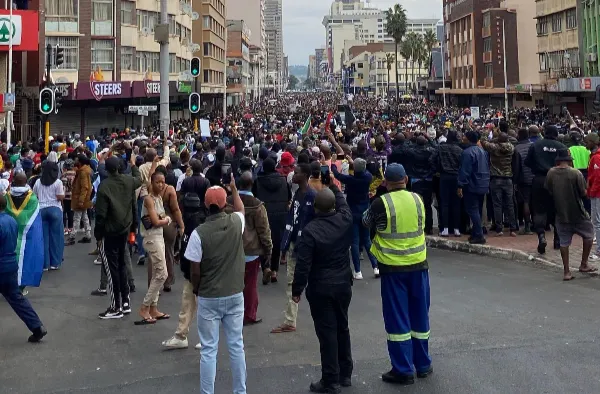
The National Joint Operational and Intelligence Structure (NatJoints) says law enforcement remains on high alert after the March and March movement vowed to continue anti-immigration protests every Thursday.
Image: Durban Metro Police
The top cop acknowledged the remarks made by the leader of the movement.
“We have noted that March and March have publicly announced that they will continue with the marches throughout, for the next six months."
“As I've indicated again, we will continue to monitor every situation and we will continue to support every individual of this country who wishes to exercise his or her right in terms of the constitution, section 16 and section 17 of the constitution when it comes to the issues of demonstrations, marches, picketing and any other activity that will be undertaken in that regard,” Mosikili said.
She said authorities would continue working with private security companies, the SANDF and the Department of Home Affairs.
“And I'm not sure why we are singling out the private security company in this case because we did not work only with a private security company yesterday. For me that is a clear definition of community policing because we police with our partners as well as the CPF as a structure,” she said.
Mosikili also confirmed that close to 1000 people were arrested during Tuesday's operations, with the majority of those arrested being illegal foreigners.
She said a total of 120 marches took place nationwide, of which 108 were peaceful while 12 required law enforcement intervention because of incidents of unrest.
The provincial breakdown is as follows:
According to Mosikili, the figures demonstrated that the overwhelming majority of South Africans chose peace over disorder.
“While the vast majority of demonstrations remained peaceful, there were individuals who sought to exploit yesterday's events to commit criminal acts.”
“Unfortunately for them, they quickly discovered that law enforcement was on their heels and ready to act decisively. Our members responded swiftly wherever incidents of looting, robbery, public violence and other criminal activities emerged.”
She confirmed that more than 900 people were arrested during the operations.
“The majority of those arrested were illegal foreigners and looting as a result of law enforcement operations conducted alongside the protests.”
Mosikili said some suspects were arrested for public violence, others for harbouring illegal immigrants, and others for business robberies at spaza shops.
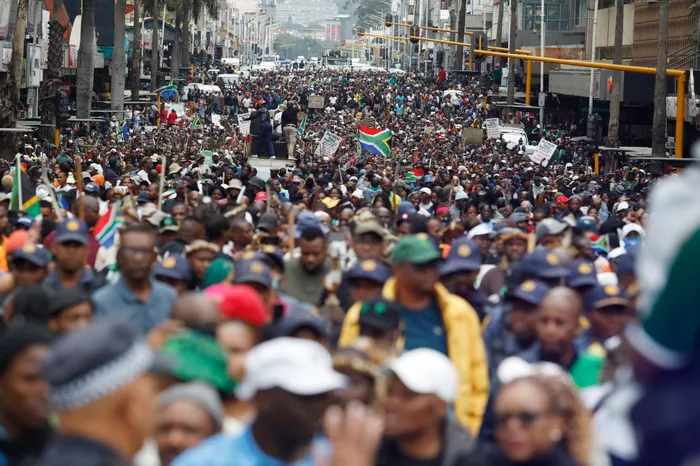
NatJoints says close to 1,000 people were arrested during the June 30 nationwide protests and has warned that law enforcement is prepared to monitor further demonstrations after organisers pledged to march every Thursday.
Image: Doctor Ngcobo
The provincial arrest breakdown is as follows:
- Western Cape: 215 arrests for various crimes, including public violence and contravention of the Immigration Act.
- Eastern Cape: 208 arrests for various crimes, including public violence, contravention of the Immigration Act, incitement to commit violence and looting.
- KwaZulu-Natal: 153 arrests for various crimes, including looting, public violence and contravention of the Immigration Act.
- Free State: 132 arrests for various crimes, including public violence, contravention of the Immigration Act, looting and business robberies.
- North West: 83 arrests for various crimes, including looting, public violence and contravention of the Immigration Act.
- Gauteng: More than 82 arrests for various crimes, including looting, public violence and contravention of the Immigration Act.
- Northern Cape: 51 arrests for various crimes, including looting, public violence and contravention of the Immigration Act.
- Limpopo: 26 arrests for various crimes, including looting, public violence and contravention of the Immigration Act.
- Mpumalanga: Seven arrests on public violence-related charges.
IOL News