

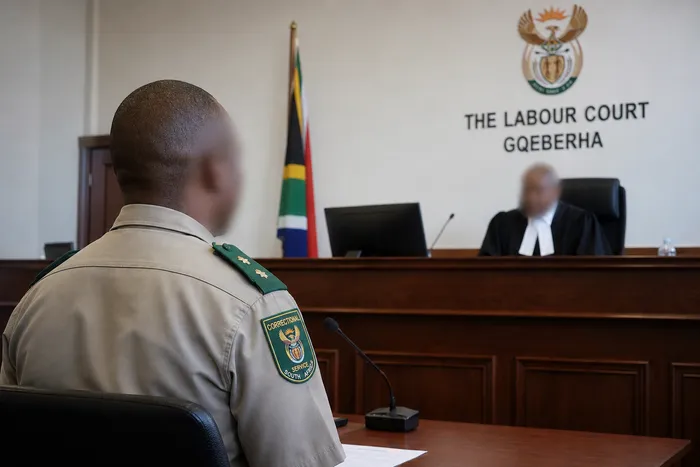
Correctional officer's dismissal upheld by Labour Court after sexual harassment incident.
Image: AI-Generated
The Labour Court in Gqeberha has upheld the dismissal of a Northern Cape correctional officer who sexually harassed a female colleague after offering to drive her home following a night shift, ruling that the misconduct was so serious that an apology could never replace formal disciplinary action.
Judge Edwin Tlhotlhalemaje dismissed an application brought by former Department of Correctional Services employee S Louw, who sought to overturn an arbitration award that had confirmed his dismissal.
Louw had been employed as a Grade 2 Correctional Officer at the De Aar Correctional Centre since 2008. He was dismissed in March 2022 after a female colleague accused him of sexual harassment following an incident that occurred on the night of February 15, 2021.
According to evidence before the Labour Court, the complainant had completed her shift and discovered that other colleagues had already left the facility. A supervisor instructed Louw to drive her home. During the journey, however, Louw allegedly deviated from the route and drove in the opposite direction.
The complainant became concerned when he failed to explain where he was going. The situation escalated when he turned onto a dark gravel road and stopped the vehicle in a secluded area behind a local high school.
The woman stated that when she questioned why he had stopped, Louw bluntly told her that he intended to have sexual intercourse with her. She refused, but he allegedly attempted to remove items from her lap, tried to touch her private parts, and attempted to pull her towards him to kiss her. He also reportedly urged her to leave the vehicle so that he could “hold and squeeze” her.
Throughout the encounter, the complainant repeatedly resisted and instructed him to stop. Eventually, Louw abandoned his efforts and drove her home. Even after the incident, he continued sending her WhatsApp messages late into the night.
The following day, the complainant reported the incident to management. Initially, she indicated that she would be satisfied with an apology, partly because she felt sorry for Louw and his family. During a meeting arranged by management, Louw apologised and the complainant accepted the apology.
However, the woman later changed her mind after concluding that the apology was not genuine. She subsequently pursued a formal complaint and later underwent psychological treatment. Evidence before the court showed that she was admitted for treatment for two weeks and required additional sick leave after her discharge.
At arbitration proceedings, Louw did not dispute that the misconduct had occurred. Instead, he argued that the matter had effectively been resolved when he apologised and that any subsequent disciplinary proceedings amounted to double jeopardy. He also relied on his 14 years of service and previously clean disciplinary record, arguing that dismissal was too harsh a sanction.
The arbitrator rejected those arguments, finding that sexual harassment is a serious offence and that the informal apology meeting could not be regarded as a formal disciplinary process. The arbitrator also concluded that dismissal was an appropriate sanction.
In reviewing the arbitration award, the Labour Court strongly condemned Louw’s conduct. Judge Tlhotlhalemaje said the officer had been entrusted with the complainant’s safety and had abused that trust in a profound manner.
The court found that Louw deliberately diverted from the route to the complainant’s home, took her to a secluded area at night, and attempted to impose himself on her despite her repeated objections. The judge noted that his conduct went beyond ordinary workplace misconduct and involved a serious violation of the complainant’s dignity, bodily integrity and sense of security.
The judgment emphasised that sexual harassment remains one of the most serious forms of workplace misconduct and cannot simply be resolved through a private apology between employees. The court held that employers have an obligation to act when such allegations arise, regardless of whether the victim initially wishes to forgive the perpetrator.
Judge Tlhotlhalemaje rejected Louw’s double jeopardy argument, finding that the informal meeting where the apology was offered was not a disciplinary hearing and could not prevent the Department from later instituting formal disciplinary proceedings.
The court also dismissed suggestions that corrective counselling should have been considered instead of dismissal. While acknowledging Louw’s lengthy service record, the judge ruled that long service does not excuse gross misconduct, particularly where trust has been irreparably damaged.
In one of the judgment’s strongest passages, the court described Louw as having acted “like a predator” by exploiting the complainant’s vulnerability while she was dependent on him for safe transport home after work.
The court further criticised the Department of Correctional Services for the lengthy delay in finalising the disciplinary process. Judge Tlhotlhalemaje questioned why it had taken approximately a year to conclude the matter and expressed concern that Louw had been permitted to continue working alongside female employees after admitting to the misconduct.
Despite those criticisms, the court held that the Department’s shortcomings did not diminish the seriousness of Louw’s actions or justify his reinstatement.
Finding no defect in the arbitration award, the Labour Court concluded that the arbitrator’s decision was reasonable and legally sound. Louw’s review application was dismissed, and the court ordered that each party should bear its own legal costs.
IOL News
Get your news on the go, click here to join the IOL News WhatsApp channel