

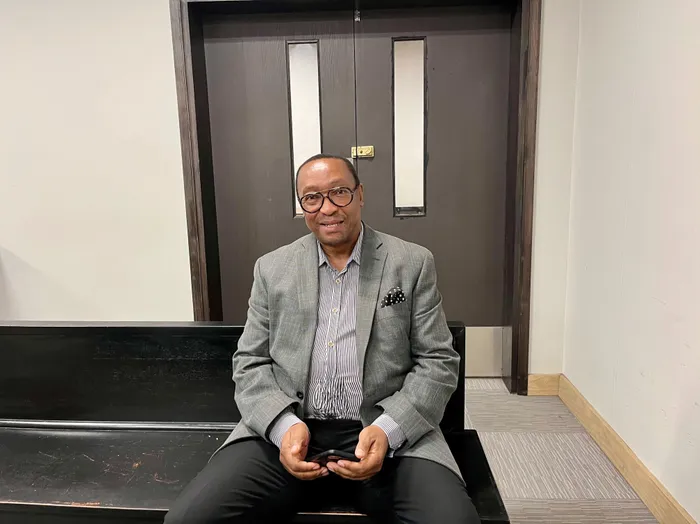
The legal team of former eThekwini city manager, Sipho Nzuza, has highlighted inconsistencies in the evidence of police officers who seized his cellphone when he was arrested for corruption.
Image: Nomonde Zondi
The defence on Monday pointed inconsistencies in the testimony of Hawks police officers regarding the seizure of former eThekwini city manager Sipho Nzuza's cellphone on the day of his arrest for corruption related to the R320 million Durban Solid Waste (DSW) tender.
This dispute has led to a trial-within-a-trial, as the State intends to use the evidence obtained from Nzuza's phone. The defence is challenging the legality of the seizure, claiming the phone was taken under false pretences and questioning why the Hawks did not obtain a search and seizure warrant when applying for Nzuza’s warrant of arrest.
Nzuza is among 21 defendants, including former eThekwini mayor Zandile Gumede , who face charges of corruption, fraud, money laundering, and racketeering relating to the DSW tender.
Central to the dispute are conflicting accounts from a retired Lieutenant Colonel (who cannot be named) and Captain Obed Lukhele, who both claim Nzuza voluntarily surrendered his phone after being informed it would be taken to Digital Forensic Investigations (DFI) for mirror imaging and downloading.
Both officers also claim Nzuza’s attorney, present at the Durban Central police station on March 10, 2020, did not object to the seizure.
During cross-examination at the Durban High Court, Advocate Griffiths Madonsela SC, representing Nzuza, asked Captain Lukhele about his evidence on where Nzuza’s attorney was. Lukhele previously told the court that when his superior, the Lieutenant Colonel, shouted and instructed him to take Nzuza’s phone, the attorney was standing next to him.
He further stated that the investigating officer of this case was also standing with the attorney. Lukhele said the attorney heard what was said to him and never objected to the seizure of the phone.
“The problem with your evidence is that the Lieutenant Colonel does not place the attorney where you are placing her. In fact, he (Lt. Colonel) says the attorney was in the vicinity and could not recall where about,” Madonsela said.
Lukhele said he disagreed with his superior. “I could see them from where I was standing.”
However, he conceded that from where his retired superior was standing at the police station, he was in a better position to say where the attorney was.
“I put it to you that the reason for the Lieutenant Colonel to say the attorney was in the vicinity is because she was not there,” the senior counsel said.
However, Lukhele maintained that the attorney was next to both his superiors. “When he shouted giving me instructions, I looked at where he was.”
Further inconsistencies were highlighted concerning where Nzuza's statement was taken. The Lieutenant Colonel previously testified that the statement was taken in the statement room, while Lukhele said the statement was taken at a table outside the holding cells.
Lukhele also agreed with Madonsela that it is now standard practice for arrested suspects to be advised to leave valuables like watches, shoelaces, and belts with their family or attorney to prevent theft or robbery in the cells.
However, Lukhele insisted that Nzuza’s phone, which he entered the cells with, was not taken for safekeeping.
The trial-within-a-trial continues.