

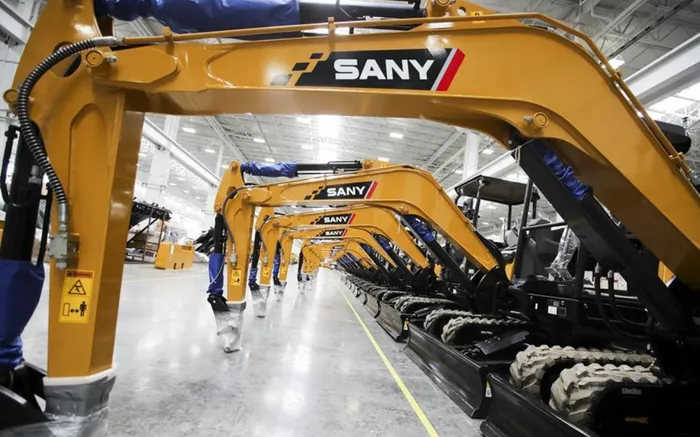
Excavators are seen at the plant of SANY America in Peachtree City, Georgia, the United States.
Image: XINHUA
Walk onto almost any groundbreaking site in American manufacturing right now and you'll find the same contradiction: investment dollars flowing in at a pace not seen in years, even as the underlying cost of doing business keeps rising. This week alone brought fresh evidence of both halves of that story, and together they explain why manufacturing leaders are simultaneously optimistic and uneasy.
Start with the investment side. Metal additive manufacturer Velo3D just announced plans for a roughly 289,000-square-foot production campus in Livermore, California, which it's positioning as its future manufacturing hub. Meanwhile, German heavy-equipment maker Goldhofer is establishing its first US facility, in Hickory, North Carolina, a $19.5 million commitment expected to create 80 jobs. Add a new power-generation venture breaking ground in Alabama and a beverage contract manufacturer's roughly 180-job facility taking shape in Indiana, and the picture is one of a sector still betting heavily on domestic capacity. None of this is charity. It reflects a structural shift: supply-chain security has become as important to corporate boards as unit cost, and reshoring is now a hedge against geopolitical risk rather than a patriotic gesture.
But the cost side of the ledger tells a tougher story. June's ISM Manufacturing Prices Index came in at 73%, according to the Institute for Supply Management, down sharply from May's 82.1%, the steepest single-month drop since 2022, but still marking the 21st consecutive month of rising raw materials prices. That combination, costs still climbing, but the rate of increase finally cooling, is exactly the kind of ambiguous signal that keeps procurement teams up at night. Is this the top, or just a pause? The honest answer is that nobody knows yet, and the Iran conflict, along with tariff volatility, has made forecasting feel more like guesswork than modeling.
Tariff policy is compounding the uncertainty. New rules now require Canadian and Mexican manufacturers to commit to verifiable US capacity expansion and keep meticulous, traceable records in order to qualify for reduced Section 232 tariffs, a bureaucratic hurdle that rewards exactly the kind of long-horizon investment Velo3D and Goldhofer are making, but punishes smaller suppliers who can't absorb the compliance overhead. Expect consolidation pressure on mid-tier North American suppliers who lack the balance sheet to play this game.
Underneath both stories is a third, quieter one: automation is no longer a nice-to-have, it's becoming the industry's answer to a labour market that refuses to loosen. Survey data from the Manufacturing Leadership Council suggests nearly a quarter of manufacturers plan to deploy "physical AI", robots with greater autonomy, within two years, more than double the share doing so today. That's a meaningful jump in a short window, and it lines up with what floor managers have been saying anecdotally for months: they can't hire their way out of the current workforce gap, so they're automating around it. The same AI infrastructure boom reshaping cloud computing is now showing up on the shop floor, from robotic sorting and installation to AI-assisted quality inspection.
The strategic read for anyone watching this sector: capital is chasing resilience, not just efficiency. Companies that can demonstrate traceable domestic capacity, absorb near-term price volatility, and layer in automation to offset labor scarcity are the ones positioned to benefit from the reshoring wave, while those still competing on cost alone may find themselves squeezed from both directions. The next PMI reading, due the first Monday of August, will show whether June's price deceleration was the start of a real cooldown or just the market catching its breath before the next shock. Given how tightly manufacturing sentiment is now tied to headlines out of the Middle East and ongoing tariff negotiations, betting on stability alone looks like the riskier strategy.
Written by:
*Chloe Maluleke
Associate at BRICS+ Consulting Group
Russia & Middle East Specialist
**The Views expressed do not necessarily reflect the views of Independent Media or IOL.
** MORE ARTICLES ON OUR WEBSITE https://bricscg.com/
** Follow @brics_daily on Twitter for daily BRICS+ updates and instagram @brics_daily