

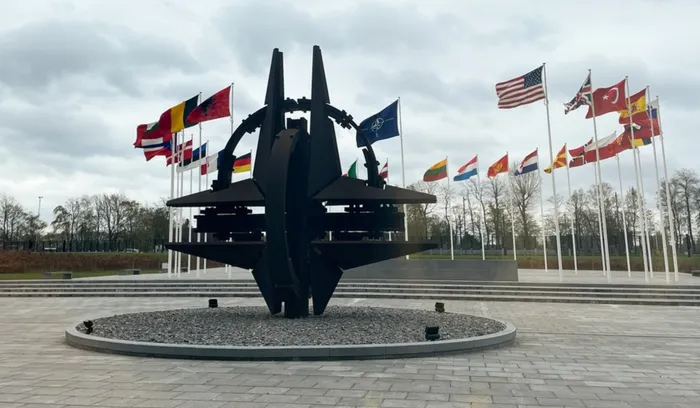
NATO leaders left Ankara this week having pledged more money, more missiles, and more unity than at almost any summit in years. On paper, that's a win for the alliance.
Image: XINHUA
NATO leaders left Ankara this week having pledged more money, more missiles, and more unity than at almost any summit in years. On paper, that's a win for the alliance. Look closer, though, and the Ankara summit didn't showcase NATO's strength so much as expose its limits, and for the BRICS+ world watching from the outside, those limits matter a great deal.
Here's the short version of how we got here. The US and Israel went to war with Iran earlier this year. A ceasefire held for a few weeks. Then, right as Donald Trump touched down in Ankara for NATO's annual summit, it fell apart. Iran hit commercial shipping in the Strait of Hormuz. The US answered with strikes on more than 80 targets inside Iran. Iran fired back at American bases in Bahrain and Kuwait. By the time the summit wrapped, Trump was telling reporters he considered the ceasefire "over" and floating a naval blockade, all while Iran was burying its Supreme Leader, who died during the fighting. Oil prices jumped. Nobody at the summit seemed entirely sure what happens next.
What makes this moment genuinely revealing isn't the war itself, it's how NATO handled being pulled into it. Iran isn't a NATO adversary in any treaty sense. The alliance exists to defend its members in the North Atlantic and Europe, not to back American military action in the Gulf. So when Washington leaned on European allies for basing rights and logistics support during the war, several governments hesitated, or limited what they'd allow. Trump didn't take that well. He told reporters at the summit he'd been "testing" whether NATO members would show loyalty, and that most of them failed. "I'm very upset with NATO," he said, adding they "didn't want to help us with the number one state sponsor of terror."
That's a striking thing for a US president to say about the alliance he's supposed to lead. It also tells you something important: the White House now treats NATO less as a mutual-defence pact with a fixed purpose and more as a loyalty test that can be applied to whatever conflict Washington is currently fighting, anywhere in the world. European leaders, for their part, mostly held the line politely. Poland's president talked up the value of American troops on Polish soil. Norway and Estonia both said, in effect, don't worry, the Americans aren't really leaving, but the fact that those reassurances needed saying at all is the story.
Where NATO did move was on the checkbook. Leaders committed to more than $50 billion in new defense procurement, covering everything from missile defense to drone systems to what the summit declaration called an "interoperable transatlantic warfighting cloud." They also reaffirmed the defense-spending targets set last year in The Hague, 3.5% of GDP on core military spending, another 1.5% on broader defense-related infrastructure like ports, rail, and bridges. The catch: only five of NATO's 32 members are actually on track to hit that 3.5% figure this year. Everyone agreed to spend more. Almost nobody is there yet.
Ukraine got a headline number too, a pledge of 70 billion euros for 2026, with a similar amount promised for next year. But dig into where that money is coming from and the picture is less impressive than the topline suggests. The US isn't contributing to it at all, and a big chunk of the total is simply repackaged from an EU loan agreed months earlier. It's real support, but it's not the kind of dramatic escalation the headline number implies.
For BRICS+ economies, the Ankara summit is worth watching closely, not because anyone expects NATO to fracture overnight, but because of what it confirms about the direction of travel. An alliance stretched thin by a war outside its own charter, a lead member openly questioning the loyalty of the rest, and a defence-spending target most countries haven't reached yet, none of that suggests an especially stable anchor for the Western-led order BRICS nations have spent the last few years trying to build alternatives to.
There's also a quieter signal in how the Gulf crisis has unfolded. Iran's ability to threaten a chokepoint as important as the Strait of Hormuz, and the visible strain that's put on transatlantic cohesion, is exactly the kind of scenario that strengthens the case BRICS institutions have been making, that trade routes, payment systems, and energy markets shouldn't be this exposed to a single alliance's internal politics. The New Development Bank's push for local-currency lending, the slow build-out of BRICS Pay, the growing interest from countries like Zimbabwe and Uzbekistan in joining BRICS-linked institutions, none of that happens in a vacuum. Every summit like Ankara, where an old alliance looks a little more brittle than it used to, is a reminder of why that diversification effort has momentum.
Whether the Iran ceasefire actually holds past this week is genuinely unclear, Trump himself seemed to change his mind twice in one press conference. What's clearer is that NATO's internal debate about who it exists to protect, and from what, isn't going away. That debate is exactly the kind of opening the BRICS+ bloc has been positioning itself to fill.
Written by:
*Dr Iqbal Survé
Past chairman of the BRICS Business Council and co-chairman of the BRICS Media Forum and the BRNN
*Chloe Maluleke
Associate at BRICS+ Consulting Group
Russia & Middle East Specialist
**The Views expressed do not necessarily reflect the views of Independent Media or IOL.
** MORE ARTICLES ON OUR WEBSITE https://bricscg.com/
** Follow @brics_daily on Twitter for daily BRICS+ updates and instagram @brics_daily