

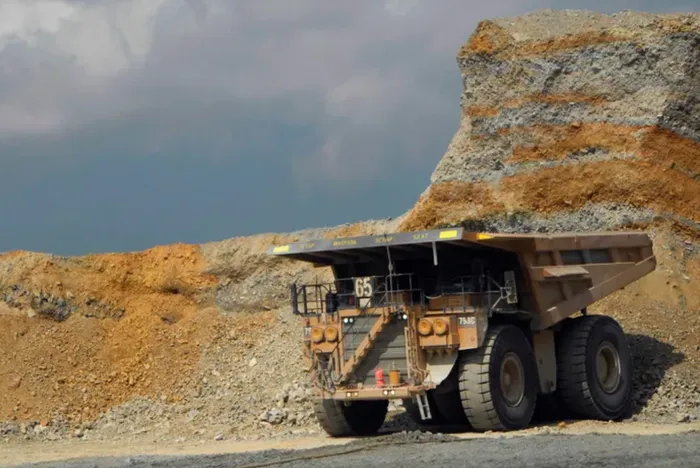
Mining's contribution to South Africa's GDP has fallen from 21% in 1980 to 8.2% in 2024, with a further contraction to 5.8% recorded in 2025.
Image: Internal
In the past eighteen months, thirteen prospecting applications have been submitted to the Department of Minerals and Petroleum Resources across a 170-kilometre stretch of KwaZulu-Natal's South Coast, eleven of them including lithium, one of the minerals most critical to the global energy transition. The trigger is SA Lithium's Highbury Mine near Umzumbe, which began development in mid-2023 and has become one of only three known lithium operations in the country. The KZN lithium rush is the clearest signal yet that South Africa's critical minerals moment has arrived. What happens next will be determined not by geology, but by the same policy architecture that has systematically undermined the sector for three decades.
The structural context is essential. Mining's contribution to South Africa's GDP has fallen from 21% in 1980 to 8.2% in 2024, with a further contraction to 5.8% recorded in 2025. Real exploration spending reached R738 million in 2025, down from a peak of R6.2 billion in 2006, a collapse of more than 85% over two decades, and the seventh consecutive annual decline. The Fraser Institute's 2025 survey placed South Africa 64th out of 68 global mining jurisdictions on policy perception, with respondents representing companies accounting for 90% of the country's annual mineral production by value.
The most analytically important data point in this picture is often overlooked. The sector's decline is driven almost entirely by the gold industry's 84% output collapse since 1994. Strip gold out, and the rest of South Africa's mining sector actually grew 41% over the same period, demonstrating that the country's mining crisis is not geological and not universal. It is a policy failure concentrated in specific sectors, while others have shown what becomes possible when conditions allow.
The KZN lithium corridor is now showing both sides of that equation simultaneously. The Highbury Mine has created more than 800 direct and indirect jobs in a region where unemployment stood at approximately 50%, a tangible benefit in one of the country's most underserved provinces. But its planned expansion, increasing the mining pit by at least five times and the waste rock area fourfold, with more than 800 residents facing potential relocation, has already generated significant community resistance and governance concerns. When Oxpeckers submitted a formal PAIA request for all prospecting licence applications and environmental assessments in the area, the department refused, citing the "huge volume of information involved" as an unreasonable diversion of resources. Opacity at the precise moment public trust most needs to be built is a pattern South Africa cannot afford to repeat.
The competitive context makes urgency inescapable. Zimbabwe has attracted approximately $2 billion in Chinese investment into lithium processing infrastructure, building a substantially larger industry than South Africa's despite a smaller and less developed mining base overall. The divergence is not geological, it is entirely a function of investment environment and regulatory speed. Meanwhile, South Africa requires approximately R12 billion annually to compete globally for exploration capital. The current combined government and Anglo American exploration fund stands at R1 billion, a funding gap exceeding 90%.
The Mineral Resources Development Bill, gazetted in May 2025 and still awaiting its revised form, was supposed to address the regulatory foundations of this gap. Its initial draft imposed BEE requirements on prospecting applications that were subsequently removed after industry engagement, a reactive correction that itself illustrated the absence of proactive investor-friendly design. Licensing timelines averaging 18 to 24 months, combined with overlapping departmental jurisdictions, mean that the typical 17-year development timeline from exploration to production is being stretched further at exactly the moment global demand for transition minerals is accelerating fastest.
South Africa's Critical Minerals and Metals Strategy, published in 2025, correctly identifies lithium, vanadium and cobalt as priority opportunities. The KZN prospecting rush validates that identification. What the strategy cannot provide on its own and what the Highbury expansion story illustrates with uncomfortable clarity, is the regulatory speed, community governance framework and transparency infrastructure needed to convert a geological asset into a functioning industry. Those are institutional questions, not mineral ones. And South Africa's record on institutional questions is precisely what the Fraser Institute rankings, the exploration spending data, and the Zimbabwe comparison are measuring. The lithium is in the ground. The global demand is real. The window is open. Whether South Africa walks through it will depend on decisions being made right now.
Written by:
*Chloe Maluleke
Associate at BRICS+ Consulting Group
Russia & Middle East Specialist
**The Views expressed do not necessarily reflect the views of Independent Media or IOL.
** MORE ARTICLES ON OUR WEBSITE https://bricscg.com/
** Follow @brics_daily on Twitter for daily BRICS+ updates and instagram @brics_daily