

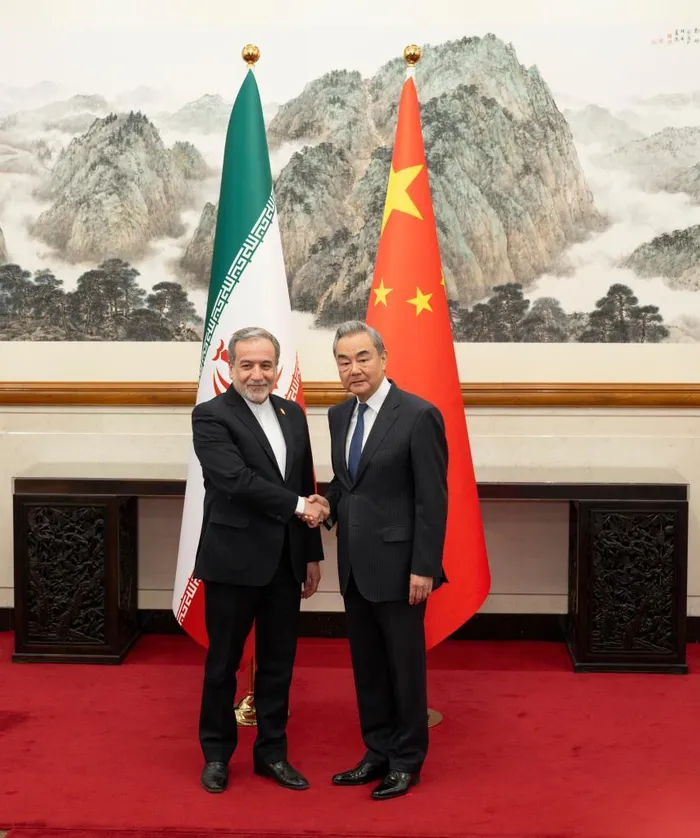
Chinese Foreign Minister Wang Yi, also a member of the Political Bureau of the Communist Party of China Central Committee, holds talks with Iranian Foreign Minister Seyyed Abbas Araghchi in Beijing, capital of China
Image: XINHUA
When Iranian Foreign Minister Abbas Araghchi landed in Beijing on Tuesday for talks with Chinese counterpart Wang Yi, the symbolism was unmistakable. It was their first in-person meeting since the United States and Israel initiated war with Iran on February 28, a conflict that has reshaped the geopolitics of the Middle East, strangled global energy markets, and placed China in an increasingly uncomfortable position between two of its most consequential relationships.
The timing of the visit could hardly be more loaded. In the run-up to Trump's widely anticipated May 14–15 visit to China, US advisors have urged Beijing to pressure Iran to restore commercial shipping through the Strait of Hormuz. Araghchi's trip to Beijing, then, is not merely a courtesy call between allied foreign ministers, it is a high-stakes diplomatic manoeuvre in the days before a summit that could determine whether the war ends or escalates further.
At the heart of the meeting lies the Strait of Hormuz, the narrow waterway through which one-fifth of the world's oil and liquefied natural gas supplies pass. Iran effectively closed the strait when the war began, and the economic shockwaves have been felt globally, pushing fuel and fertiliser prices sharply higher and stoking fears of recession. For China, the world's largest importer of crude oil, the war has put intense pressure on its economy, and Beijing has reportedly worked behind the scenes to encourage Iran to continue negotiating with the US.
Yet China's position is far from straightforward. China is Iran's largest trading partner, purchasing at least 90% of the Islamic Republic's crude oil exports. It has continued buying Iranian oil in defiance of US sanctions, while Washington tries to cut off Tehran's revenue. At the same time, Chinese leadership wants tankers moving and trade flowing out of the Persian Gulf into Asian markets, and has no appetite for the inflationary shock and potential recession that a prolonged blockade would trigger across the region, according to analyst Amir Handjani of the Quincy Institute for Responsible Statecraft. Beijing is caught between its strategic partnership with Tehran and its fundamental economic interest in open sea lanes.
For Iran, the visit serves several overlapping purposes. According to Al Jazeera's Katrina Yu, reporting from Beijing, Iran had three main goals: communicating its position on the war, reaffirming ties with China ahead of Trump's arrival, and securing continued economic and diplomatic support. For Tehran, the China visit is a way to show the US that "it isn't isolated and has friends and options," as Iranian leadership seeks to bolster its bargaining position in the standoff with Washington, according to Danny Russel of the Asia Society Policy Institute. Araghchi underlined this posture directly, describing China as a close friend and insisting that bilateral cooperation would grow stronger under present circumstances.
On the question of peace talks, Araghchi was unambiguous. He stressed that Tehran would only accept a "fair and comprehensive" agreement to end the conflict, while defending Iran's legitimate interests. Key sticking points remain: the US demands Iran halt all uranium enrichment, while Tehran insists on retaining control over the Strait of Hormuz, leverage it is clearly reluctant to surrender cheaply.
Wang Yi, for his part, extended Chinese support to Iran in safeguarding its sovereignty, while also stressing that a complete cessation of hostilities "is imperative" and that restarting the conflict "is unacceptable." Crucially, Beijing also called for the prompt resumption of shipping through the strait, a point notably absent from Iran's own readout of the meeting, hinting at the quiet friction beneath the allied optics.
What emerges from Beijing this week is a picture of two partners whose interests broadly align but do not perfectly coincide. "This meeting is deeply strategic," said Handjani. "Tehran and Beijing are aligning their interests before Trump's summit with Xi Jinping, and the timing is deliberate."
With Pakistan mediating, Trump preparing to land in Beijing, and the Strait of Hormuz still a chokepoint for the global economy, the diplomatic window is narrow. What Araghchi took away from Beijing, and what Beijing chooses to tell Washington, may prove decisive in whether the world edges toward a resolution or stumbles deeper into crisis.
Written by:
*Dr Iqbal Survé
Past chairman of the BRICS Business Council and co-chairman of the BRICS Media Forum and the BRNN
*Chloe Maluleke
Associate at BRICS+ Consulting Group
Russia & Middle East Specialist
**The Views expressed do not necessarily reflect the views of Independent Media or IOL.
** MORE ARTICLES ON OUR WEBSITE https://bricscg.com/
** Follow @brics_daily on Twitter for daily BRICS+ updates and instagram @brics_daily