

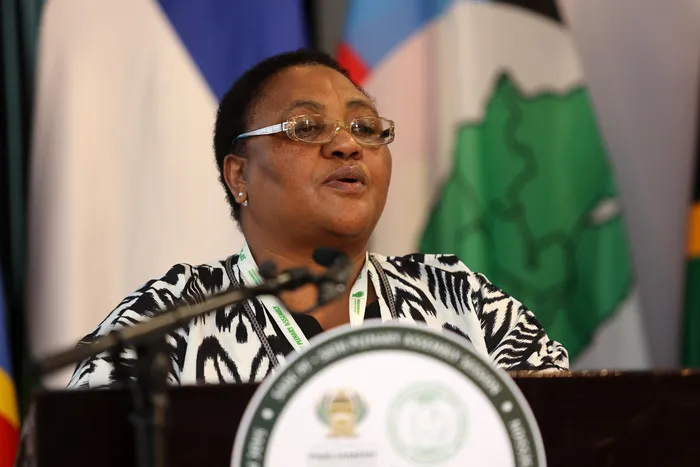
Speaker Thoko Didiza addresses the 58th Plenary Assembly of the SADC PF, highlighting South Africa’s legislative advancements.
Image: Tumi Pakkies/ Independent Newspapers
In a significant update during the 58th Plenary Assembly of the Southern African Development Community Parliamentary Forum (SADC-PF), Speaker of Parliament Thoko Didiza presented a comprehensive report detailing South Africa’s advancements following the 57th assembly’s resolutions. Didiza highlighted the strides made in various legislative areas, including the ethical deployment of Artificial Intelligence (AI), prison reform, and initiatives targeting food security and gender-based violence (GBV).
Didiza said that on the legislative front, the South African Parliament established the National Artificial Intelligence Policy Framework to balance AI benefits with ethical, social, and economic considerations.
“This framework promotes a ‘human-centred AI’ approach and is intended to lay the groundwork for future legislation. Subsequent to the publication of the policy framework, the South African Parliament received submissions from state entities, civil society and academia on digital capabilities and the use of AI to tackle socio-economic challenges,” Didiza said.
On progress on standing committee resolutions, Didiza said Parliament has integrated committee resolutions and strengthened oversight to ensure implementation aligns with executive actions, focusing on adopted resolutions for budget transparency, improved prison infrastructure, and secured access to affordable healthcare.
“I can report that extensive work has been undertaken by our Portfolio Committee on Correctional Services to improve and expand the infrastructure and conditions in correctional facilities, as well as establishing and operationalising the South African Bail Fund,” Didiza said.
“The Bail Fund was developed by the Judicial Inspectorate for Correctional Services to address the injustice faced by remand detainees who cannot afford bail amounts under R1,000. Currently, 2,613 detainees remain incarcerated due to financial constraints, worsening prison overcrowding.”
Regarding the adopted resolutions on food, agriculture, natural resources and climate action, Didiza said Parliament acknowledged the rising bread prices’ impact on citizens and prisoners’ food security.
“The Department of Correctional Services revived its bakery programme to internalise the production of bread while transferring critical skills to detainees. This has resulted in the cost savings on bread amounting to R27.4 million per annum,” Didiza said.
On the resolution to shift funding from militarisation to peacebuilding, Didiza said the Department of Defence presented its Strategic Plan 2025-2030 and Annual Performance Plan for 2025/26 to the National Assembly on June 18, 2025. The plan balances resources for disaster relief/fire prevention with those addressing climate crises, cyber threats, and regional instabilities.
“I can report that the department has put in place measures to monitor and respond to this resolution, including enhancing defence diplomacy engagements aligned with National Foreign Policy objectives as well as defence engagements with key global players,” Didiza said, in accordance with the resolution to urge SADC parliaments to support an international ban on autonomous weapons systems to prevent their development and deployment.
Highlighting resolutions relating to Gender Equality, Women Advancement and Youth Development, Didiza reported that on June 11, 2025, the Portfolio Committee on Police was briefed on executive actions aimed at combating gender-based violence (GBV) and femicide. GBV has been declared a national crisis to channel resources and raise awareness for all stakeholders to work together in fighting the scourge of GBV.
Additionally, on June 25, 2025, the Portfolio Committee on Police was briefed on the Progress Report by the South African Police Services (SAPS) on cases of violence against children and further received a presentation by the Women Empowerment Platform on violence against children. Then on June 26, 2025, Parliament’s Joint Multi-Party Women’s Caucus convened to receive briefings from SAPS and the Department of Justice and Constitutional Development on the implementation of gender-based violence and femicide measures, investigations, and challenges around protection orders and resourcing.
“The Minister of Justice and Constitutional Development focused on recent legislative reforms, particularly amendments to the Criminal Procedure Act and the strengthening of the National Register for Sex Offenders. Her department also reported on accessibility improvements in courts, expansion of sexual offences courts, and enhanced victim support,” Didiza said.
Didiza went on to say that an invitation was extended to the House of Traditional Leaders to form part of the public stakeholder engagements to involve traditional and faith leaders in the fight against GBV.