

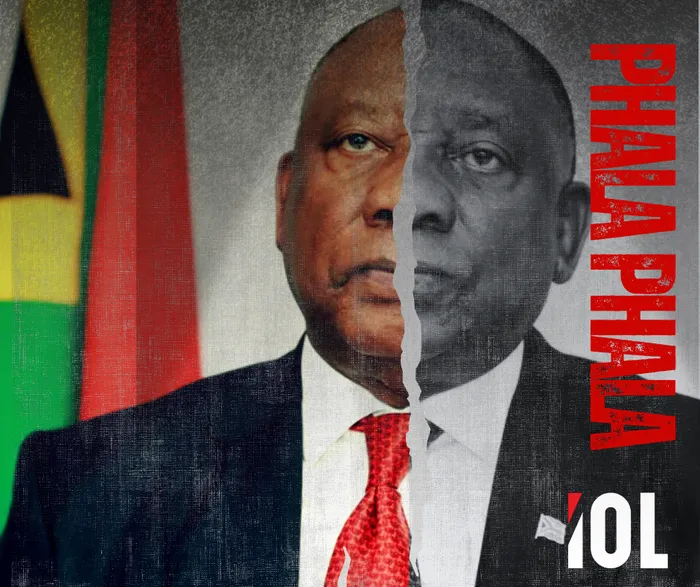
President Cyril Ramaphosa is awaiting judgment on his bid to halt Parliament's Phala Phala impeachment inquiry, but legal experts say the outcome will not necessarily end the battle.
Image: IOL Graphics
As President Cyril Ramaphosa awaits judgment on his bid to stop Parliament's impeachment inquiry into the Phala Phala scandal, the outcome may not be the end of the road, with several legal and political options still available to him.
The Western Cape High Court heard the urgent application before a full bench of judges André le Grange, Matthew Francis and Diane Davis on Wednesday and Thursday, and reserved judgment.
Judgment is expected by the end of next week.
The inquiry stemmed from the 2020 theft of more than half a million US dollars hidden at Ramaphosa's Phala Phala game farm near Bela-Bela in Limpopo.
And while the president waits, the impeachment committee is continuing its work.
Committee chairperson Makashule Gana said the committee would meet on Wednesday to consider nominations for an evidence leader submitted by political parties, and had instructed Parliament's constitutional and legal services office to begin assessing the availability of senior counsel.
"We have long said as the committee that until such a time as a competent court indicates that we must not proceed, we'll proceed," Gana said.
"In any case, we're not going to stop until the court has made a determination."
Gana said the preparatory work, including the appointment of an evidence leader, the preparation of witnesses and the finalisation of the terms of reference, was not being challenged in the president's application.
He said Parliament's recess would not stall the inquiry, with the committee expected to meet at least three times before the third term resumes next month.
Political parties made written submissions on the draft terms of reference by a July 10 deadline, and these are being consolidated ahead of the next meeting.
Experts in the legal fraternity said Ramaphosa could lodge an appeal to the Supreme Court of Appeal (SCA) if the decision does not go his way.
If the SCA upholds the decision of the Western Cape High Court, he could take the matter to the Constitutional Court.
Legal analyst Mpumelelo Zikalala explained how that process would work.
"Whoever loses this matter has the right to seek leave to appeal," Zikalala said.
"That means, in the first instance, they would have to go back to this same full bench and ask the judges for permission to take the matter further."
Should the high court refuse that permission, Zikalala said the door does not close there.
"If leave to appeal is refused by the high court, the party that lost still has a further avenue," he said.
"They can petition the SCA directly and ask that court for leave to appeal."
He said the other party in the matter could also go the same route if they were not satisfied with the court's decision.
"It is not only open to the president," Zikalala said.
"Whoever loses the matter can appeal to the SCA, and after that, the Constitutional Court."
If appeals were to be lodged by either party, this process could take up to a year, and possibly longer, before the matter is finally resolved, given the time it typically takes for the SCA and the Constitutional Court to hear and decide matters of this nature.
That means a ruling next week, in either direction, would not necessarily be the end of the interdict battle.
Advocate Anton Katz SC, for the ATM, has already argued in court that the president's own papers doomed his case, since the inquiry had technically begun in May, before Ramaphosa filed his application in June.
"Once the horse has left the stable, you can't stop the horse from leaving the stable," Katz told the court.
"That's it. That is done."
Ramaphosa's counsel Advocate Wim Trengove SC closed his argument on Thursday by telling the court his client would suffer what he called irreversible injustice if forced into public hearings while a separate challenge to the underlying report is still pending.
That separate challenge is the president's other major legal avenue, and arguably the one that matters most in the long run.
Ramaphosa is asking the same Western Cape High Court to set aside the report compiled by a panel chaired by former chief justice Sandile Ngcobo, retired judge Thokozile Masipa and advocate Mahlape Sello.
That report found in November 2022 that the president had a case to answer over the theft.
The review of that report is set down for September 2 to 4, regardless of what happens with the interdict.
Should the interdict fail and the impeachment committee begin its work, the arithmetic behind any eventual vote has shifted since Phala Phala first reached Parliament.
Political analyst Prof André Duvenhage said the numbers have changed since the ANC first killed the Ngcobo report in the National Assembly.
When MPs voted against adopting the report in December 2022, the ANC held 230 of the House's 400 seats and defeated the motion 214 votes to 148.
The 2024 election cut the ANC to 159 seats, well short of what it would need to block a two-thirds vote on its own.
Removing a president under section 89 requires the support of at least 267 of the National Assembly's 400 members, and Duvenhage said the ANC can no longer reach that number by itself, though Ramaphosa's opponents would still need backing from well beyond their own ranks to remove him.
Two opposition parties, MK and the ATM, have separately filed a motion of no confidence against the president under section 102 of the Constitution, a route that requires only a simple majority rather than the two-thirds threshold that applies to impeachment.
MK spokesperson Nhlamulo Ndhlela has written to the Speaker asking that any vote on that motion be held by secret ballot.
"In light of the constitutional importance of a motion of no confidence, as well as the considerable political pressures surrounding such proceedings, we have written to the speaker of the National Assembly requesting that the motion be conducted by secret ballot," Ndhlela said.
Presidential spokesperson Vincent Magwenya has said Ramaphosa is not considering resignation as an option, and has framed the interdict application as a matter of principle rather than self-preservation.
He told reporters this week that the president is litigating on behalf of every future occupant of the office.
"You cannot have a flawed report forming the basis for the removal of a president," Magwenya said.
"It is that simple."
For now, three dates sit on the calendar.
The Western Cape High Court is due to rule on the interdict itself by the end of next week.
Whichever side loses that round has the option, according to Zikalala, of approaching the same bench for leave to appeal, then the Supreme Court of Appeal, and ultimately the Constitutional Court.
The review of the Ngcobo panel's report, the case that could determine whether the impeachment process has any legal foundation at all, is set down for September 2 to 4.
IOL