

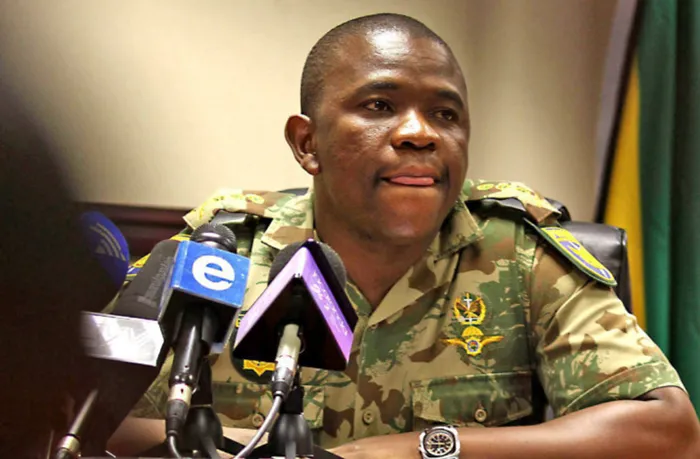
Tomorrow (Monday) marks exactly a year since KwaZulu-Natal police commissioner Lt-General Nhlanhla Mkhwanazi held explosive media briefing that led to investigation inquiries.
Image: Thobile Mathonsi / Independent Newspapers
Monday, July 6, marks exactly a year since KwaZulu-Natal provincial police commissioner Lt-Gen Nhlanhla Mkhwanazi held an explosive media briefing, where he accused top politicians and police officials, including suspended Police Minister Senzo Mchunu and deputy head Lt-Gen Shadrack Sibiya, of colluding with criminal syndicates and sabotaging police investigations into political assassinations.
During the briefing on July 6, 2025, Mkhwanazi alleged that Mchunu and Sibiya abruptly disbanded the elite Political Killings Task Team (PKTT) to halt investigations that were closing in on power syndicates.
He told journalists that sensitive case dockets, including those uncovering links between politicians, judges, prosecutors and underworld figures, were retrieved and locked away at Sibiya’s Pretoria offices.
He further accused Mchunu and his alleged associate, Brown Mogotsi, of benefiting from a lucrative R360 million SAPS tender contract awarded to controversial businessman Vusimuzi “Cat” Matlala, adding that Matlala used this money to fund Mchunu’s political events.
These allegations triggered widespread national fallout and a series of major developments.
This after President Cyril Ramaphosa announced Mchunu's immediate suspension and the establishment of the Madlanga Commission of Inquiry to investigate claims of political interference, criminal infiltration, and corruption within the South African Police Service (SAPS).
Sibiya was also placed on forced special leave.
The National Assembly also formed a special Ad Hoc Committee to probe these claims.
Both Madlanga and the Ad Hoc Committee investigations exposed deep systemic vulnerabilities within South Africa’s security, policing and justice sectors.
South Africa’s security cluster has also been rocked by high-profile arrests, a judicial inquiry, and explosive pushback.
Investigations spun off from his initial claims of institutional corruption, resulting in targeted arrests and sweeping structural probes.
Security strategist Andy Mashaile said that while the investigation has not yet caught minor offenders, the appearances of National Police Commissioner Fannie Masemola and other top officials before the Madlanga Commission proves the allegations are substantial. He added that the commission's initial report already pointed to strong prima facie evidence.
“This was also referred to the President, who requested that a special investigation task team be established. That task team further went on to do the investigations and we are beginning to see the results that come out of the process that started on the 6th of July,” he said.
He said bringing perpetrators to justice and securing convictions is essential to satisfy advocates for clean governance, adding that this will inspire a much higher degree of public trust in the criminal justice system.
Political analyst Zakhele Ndlovu said reforms are needed to fix the mess and root out the rot in the entire criminal justice system.
“First, the appointment of national commissioner of police and other top officials should not be apolitical. I mean, how did Jackie Selebi and Bheki Cele end up being police commissioners without any policing background. Second, ministerial control should be minimised and curtailed to allow the police to do their work,” he said.
Ndlovu added that he was not convinced that the NPA and the Investigating Directorate Against Corruption (IDAC) are equipped to prosecute these complex networks.
“Remember, we have not seen successful prosecutions from the Zondo Commission. And Shamila Batohi (former head of NPA) did acknowledge that there is an acute shortage of skills in the NPA and also infiltration,” he said.
So far, enforcement actions driven by the commission and its specialised task teams have resulted in several high-profile arrests across multiple major cases.
In March, 12 senior SAPS officials were arrested following investigations connected to a fraudulent R360m SAPS tender contract involving Matlala. The arrested officials ranging from Colonels to Major Generals include figures such as Major General Busisiwe Precious Temba, several Brigadiers (Kirsty Jonker, Petunia Reabetsoe Lenono, Rachel Matjeng, Alpheus Thembinkosi Ngema, Patrick Nethengwe, Onica Ofentse Tlhoale), and Colonels Nonjabulo Nomfundo Mngadi, Anton Paulsen, and Natsenge Johannes Monyai, along with Captain Brian Neville.
Matjeng was subsequently dismissed from the SAPS following an internal disciplinary hearing.
Masemola was also suspended as the National Police Commissioner after he was charged with corruption, fraud and contravening the Public Finance Management Act (PFMA).
Former SAPS special task force member Matipandile Sotheni was arrested for the murder of key whistleblower Marius van der Merwe (Witness D), who was killed in December last year.
Mogotsi, a prominent businessman and political associate, was arrested for allegedly faking an assassination attempt on his own life to mislead the commission.
Suspended Ekurhuleni Metro Police Department (EMPD) Deputy Chief Julius Mkhwanazi and Ekurhuleni Municipal Manager Kagiso Lerutla, were arrested for corruption.
Disgraced former police officer, Fannie Nkosi, was also arrested in connection with task team investigations, while suspended Deputy Crime Intelligence Head Major-General Feroz Khan was accused of defeating the ends of justice and interfering with major narcotics investigations.
Meanwhile, the commission is pushing to finalise its public hearings and draft its final report on August 31, while the Ad Hoc Committee has been deliberating on its draft preliminary report and compiling recommendations from various political parties.