

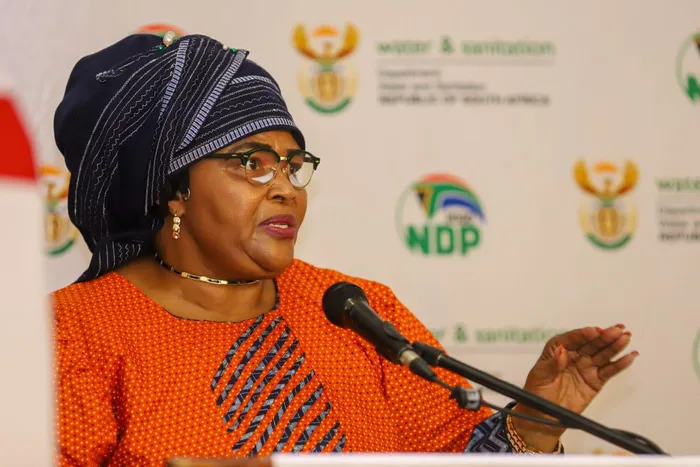
Water and sanitation minister Pemmy Majodina
Image: FILE
The net is closing on municipalities accused of pumping raw sewage into SA’s waterways, with 96 criminal cases already opened.
Water and sanitation minister Pemmy Majodina revealed this in a written reply to a question in the National Assembly.
She was responding to MK Party MP Visvin Reddy, who wanted to know whether municipal officials responsible for repeated sewage pollution had been held accountable.
The 96 cases span 53 municipalities across all nine provinces.
Majodina said the cases were opened after municipalities failed to act on notices and directives issued by her department.
“The department has been strengthening its regulatory function and making its regulatory actions more consistent," Majodina said.
"This has resulted in an increased number of civil actions and criminal charges against municipalities for sewage pollution.
“The number of criminal charges is expected to increase further.”
Of the active cases, 53 are still under investigation and 42 have been referred to the National Prosecuting Authority (NPA) for a decision on whether to prosecute.
In one matter, the investigation has been completed and the NPA has decided to prosecute, with the case set to go on trial.
The department of forestry, fisheries and the environment has opened a further 32 criminal cases.
Between them, the two departments have cases against 63 water service authorities.
“These criminal cases are laid against municipalities as the institution and are represented by the municipal managers as the accounting officer,” the minister said.
“Based on evidence collected by the departments’ environmental management inspectors, the NPA then decides on whether to pursue additional charges against officials in their personal capacity.”
Majodina said the department was amending two laws to widen accountability.
A proposed Section 156A in the National Water Amendment Bill would allow liability to be apportioned and, where possible, hold the directors of a firm or company personally liable.
A similar Section 82A in the same bill would extend personal liability to company directors and municipal managers.
“The recourse can include, inter alia, the recovery of the money lost due to contravention or an order to rehabilitate,” she said.
“These reforms will contribute to addressing the root causes of the water crisis.”
Five of the department’s cases have already been finalised, all of them through plea and sentence agreements.
Majodina said the department was monitoring compliance with the court orders.
Emalahleni local municipality was fined R650m to restore infrastructure, with R150m of the fine suspended.
Govan Mbeki local municipality was fined R200m, while Thaba Chweu and Rand West local municipalities were each fined R10m.
“The courts ordered the municipalities to allocate the fines to address the sewage pollution,” Majodina said.
IOL