

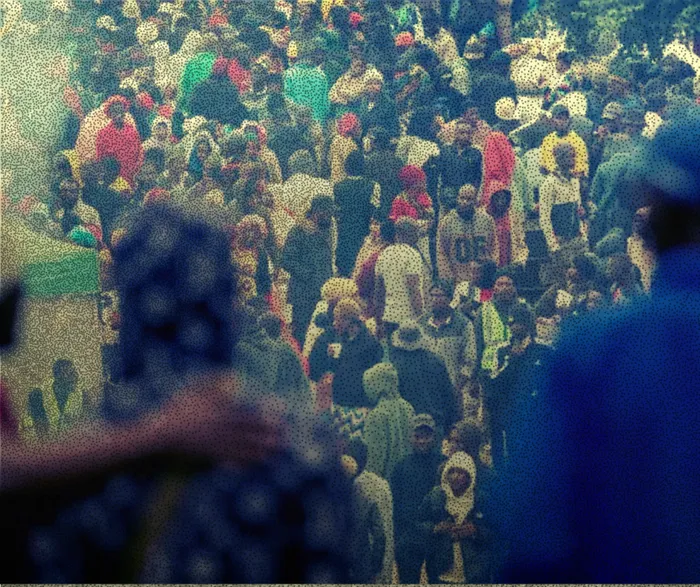
What began as a perceived place of safety for Malawian migrants fleeing fear and uncertainty rapidly evolved into a major humanitarian crisis, with overcrowding, deteriorating conditions and clashes with police placing Sherwood Hall at the centre of South Africa's migration debate.
Image: Leon Lestrade / Independent Newspapers / IOL Graphics
A quiet hall located in Sherwood, Durban turned into a large-scale holding and processing site for Malawians, with humanitarian organisations describing it as a crisis this June. IOL explores why and how this happened.
For many, the decision to go there was shaped by fear and insecurity, with some saying they had fled alleged xenophobic attacks by anti-migrants in parts of Durban and surrounding areas.
Under the visible presence of police and municipal authorities, the site quickly became a perceived place of safety, even as it rapidly transformed into a large-scale holding area.
As days passed, the sense of safety gave way to confinement and uncertainty. Migrants described being caught between the need to regularise or await repatriation and the lack of clarity over how long the process would take.
Some said they had already been at the site for up to one to one and a half weeks, sleeping in overcrowded conditions where sanitation systems were quickly overwhelmed and daily life reduced to queues for food, water and basic facilities.
KwaZulu-Natal premier Thami Ntuli estimated that there may have been over 10,000 individuals at the site.
"This situation here, unfortunately, is a crisis, which we must manage," he said. "We will produce a plan that will be taking care of this situation because, as government, we did not anticipate what is happening. Now it's happening and we must step in to ensure that there is a proper plan."
Immigration expert Craig Smith raised concerns over the situation, describing it as indicative of broader failures in South Africa's immigration enforcement and policy framework.
He said Malawian workers had historically contributed significantly to both the formal and informal economy, but that their role had not been sufficiently recognised in public administration.
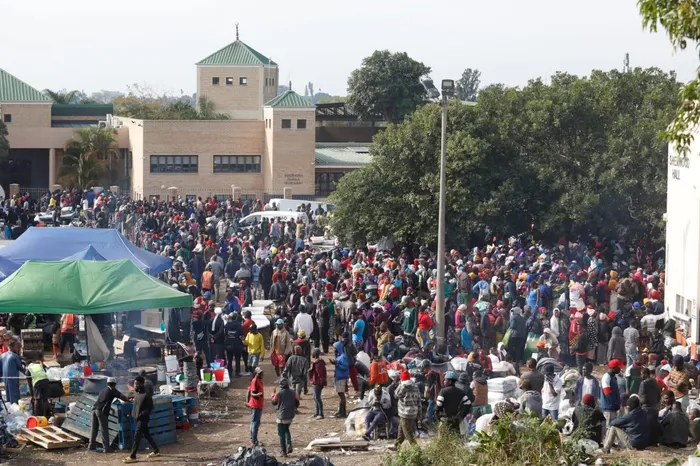
Hundreds of Malawian foreign nationals have taken refuge on the grounds at the Sherwood Hall.
Image: Doctor Ngcobo/Independent Newspapers
"The resource pool of Malawian workers is an extremely productive workforce. They are committed to work and remain loyal and conscientious members of society."
He added: "They have integrated extremely well in South Africa, whether in the informal or more formal sectors, and it is high time that their value and contribution to our economy is properly recognised by Home Affairs our government."
Smith further criticised enforcement practices, alleging procedural irregularities in deportation processes and questioning whether legal standards had been consistently applied.
"Home Affairs is flouting the immigration laws by attempting to literally 'ship out' thousands of Malawians whether through so-called rogue 'virtual priority courts' or 'herding' them up in large groups and arbitrarily coercing them to be detained and deported against their will despite their rights to contest any such conduct."
He also questioned policy consistency, arguing that other migrant groups had previously been offered regularisation pathways.
"The fundamental question is why have Malawians not been given similar treatment by Home Affairs by being offered, as in the case of other nationalities, been offered any form of amnesty to remain and work in South Africa just like the Zimbabweans, Angolans, Lesotho nationals have received over the last fifteen years," he said.
Smith continued: "It was his view that it was xenophobic on the part of Home Affairs and government not to give an amnesty, arguing that Malawians in South Africa had the same rights to lawful, reasonable and procedurally fair conduct under the Constitution."
By around June 10, the site was already under strain, with some migrants reporting that others had been present for up to one to one and a half weeks, pointing to arrivals stretching back into early June. The flow of people continued as enforcement operations expanded, turning the hall into a prolonged holding and processing site.
Conditions deteriorated as overcrowding intensified, with migrants describing long queues for food and water, strained sanitation facilities and worsening hygiene.
A 25-year-old Malawian man sheltering at the site said daily life had become increasingly difficult under these conditions. "I've been in South Africa for two years. Normally, I can say it's good, but it depends because some South Africans are good, and some are not. To me, I can say it’s 50-50 for South Africa," he said.
Although he had arrived on June 10, he said others had been there longer.
"Some people here have been here for maybe one and a half weeks," he said. "We had water and food, but there were too many people there, so when it came to sanitation, it was very poor."
He described dirty toilets, repetitive meals and worsening congestion as numbers increased.
The scale of the gathering placed severe pressure on services and infrastructure, effectively turning the hall into a mass holding site.
Tensions eventually escalated into confrontation when the migrants clashed with police on the morning of June 17, allegedly throwing stones at officers.
Police responded with stun grenades and tear gas. KwaZulu-Natal police spokesperson Colonel Robert Netshiunda said, "Police had to use minimum legal force to disperse the crowd which had become unruly. Stability and order were restored, with police continuing to monitor the situation."
Sithembiso Ngema, DA provincial leader, visited the site amid growing concerns over conditions and coordination. "We were there to conduct oversight after complaints and a number of service delivery issues in terms of assisting the people that were there," he said, adding that response efforts had been slower than expected.
EThekwini Municipality Mayor Councillor Cyril Xaba said urgent interventions had been activated.
"The interventions were intended to stabilise the situation at this site (Sherwood), reduce humanitarian and public health risks, support the ongoing processing of migrants, and expedite deportation processes," Xaba said.
By Friday, more than 20 buses were on site to ferry the migrants back.
IOL