

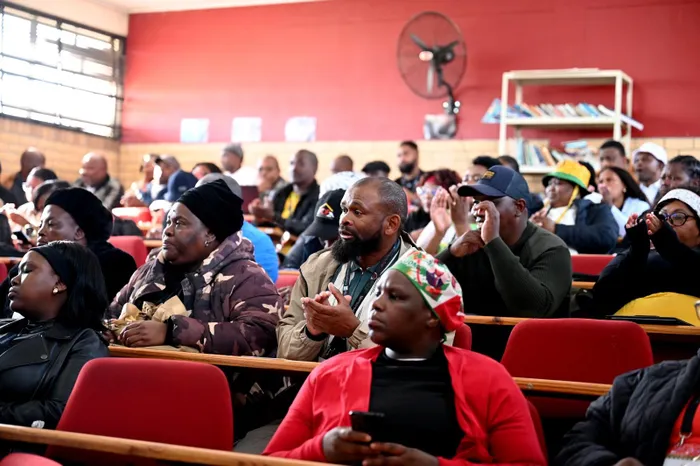
Community members and stakeholders attended the Khayelitsha Development Forum’s 2026 conference at False Bay TVET College, where delegates discussed development, safety and economic inclusion.
Image: Ayanda Ndamane / Independent Media
The Khayelitsha Development Forum has called for a renewed and united approach to development in Khayelitsha, with a focus on unemployment, crime, service delivery, economic inclusion and stronger community participation.
The call came during the KDF’s 2026 conference, held at False Bay TVET College’s Khayelitsha campus on Saturday, June 6, where delegates adopted resolutions aimed at addressing some of the township’s most pressing developmental challenges.
The conference brought together community leaders, civic organisations, political formations, faith-based groups, youth structures, business stakeholders, government representatives, development practitioners and residents.
Masizole Mnqasela, speaking on behalf of the KDF Ad Hoc Committee, said the gathering was aimed at strengthening collaboration across sectors and reaffirming the forum’s role as a platform for development, accountability and social justice in Khayelitsha.
Mnqasela said the conference convened stakeholders committed to “rebuilding and repositioning Khayelitsha as a thriving, safe, economically active, and sustainable community”.
The gathering comes as Khayelitsha continues to face major social and economic challenges, including unemployment, poverty, inequality, crime, inadequate infrastructure and barriers to economic participation.
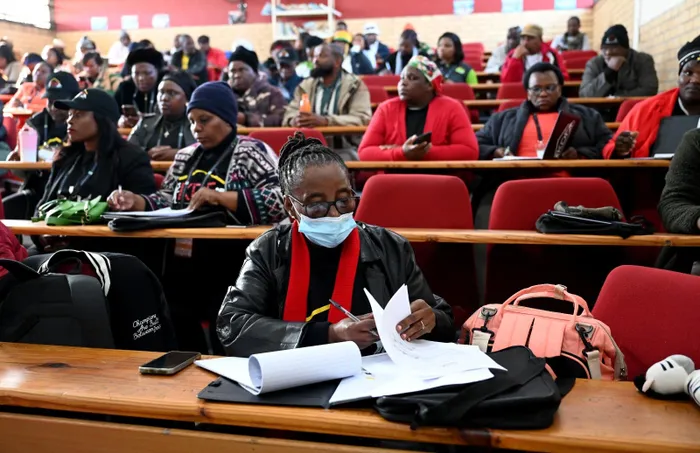
Delegates at the KDF 2026 conference adopted resolutions aimed at strengthening community participation, improving service delivery and creating economic opportunities in Khayelitsha.
Image: Ayanda Ndamane / Independent Media
Addressing delegates, newly elected KDF chairperson Mawande Jara said the gathering was about more than discussing development.
"Today, we gather not merely to discuss development, but to reimagine the future of Khayelitsha," Jara said.
He said development had often been viewed through a narrow lens, focused mainly on infrastructure, housing or service delivery. However, he said true development had to include economic opportunity, social justice, human dignity, quality services, capable leadership and active citizenship.
Jara described Khayelitsha as "one of the largest and most vibrant communities in South Africa", saying it was a place of resilience, innovation, entrepreneurship, culture and "immense human potential".
However, he said the community also continued to face deep challenges.
"The question before us is not whether these challenges exist. The question is whether we are prepared to build the partnerships and institutions necessary to overcome them," Jara said.
He said local economic development had to be placed at the centre of the township’s development agenda. This is particularly important because unemployment remains one of the biggest threats to residents, especially young people.
"We cannot speak about development while unemployment remains one of the greatest threats to the wellbeing of our people, particularly our youth," Jara said.
He said Khayelitsha needed pathways that support local enterprises, attract investment, stimulate township industries and ensure that economic growth benefits local residents.
"Development must be visible in the form of jobs, thriving businesses, and opportunities for young people to build sustainable livelihoods," he said.
He said residents had to be active participants in shaping development.
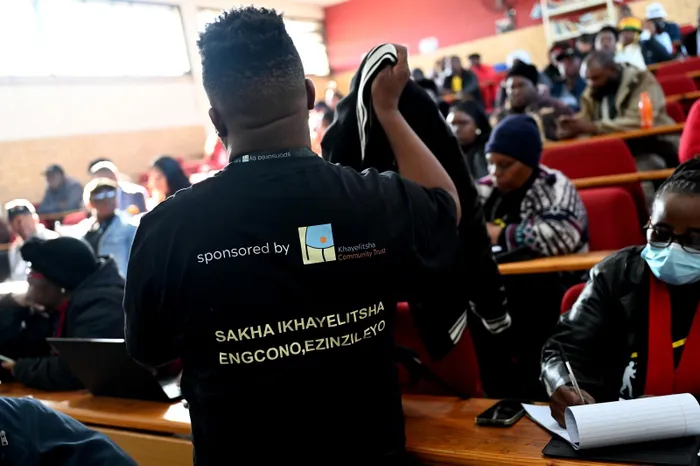
Community members attended the KDF conference under a slogan calling for the rebuilding of Khayelitsha through unity, development and community participation.
Image: Ayanda Ndamane / Independent Media
Mnqasela said delegates participated in commissions that dealt with KDF restructuring and constitutional amendments, labour, employment and poverty alleviation programmes, local economic development and investment, human settlements and infrastructure, safety and security, education, training and human capital development, and the financial sustainability of the organisation.
He said the adopted resolutions were aimed at strengthening community participation, deepening partnerships with government and the private sector, accelerating local economic opportunities, improving service delivery and fighting for a safer Khayelitsha.
Mnqasela said the resolutions would guide a programme of action focused on sustainable development, confronting extortion, social cohesion, economic inclusion and accountable leadership.
The conference also marked the end of the KDF Ad Hoc Committee’s mandate. Mnqasela said the committee, which had been in place since April 2025, had worked to stabilise, rebuild and strengthen the organisation.
"The organisation has emerged stronger, more united, and better equipped to serve the people of Khayelitsha and respond to the challenges facing our communities," Mnqasela said on behalf of the committee.
Delegates also elected a new leadership collective, largely through consensus.
The new executive leadership includes Jara as chairperson, Mbulelo Dwane as deputy chairperson, Eric Lothe as secretary, Noxolo Gabuza as first deputy secretary, Bubele Skweyiya as second deputy secretary and Mphumzi Mange as treasurer.
Additional elected members are Mavis Mpulu, Nosipho Ndyalivane, Makhaya Jezile, Athenkosi Magosa, Nokuthula Mahlati, Nonzaliseko Faku, Zukisani Kota, Malibongwe Badi and Zandile Faku.
Mnqasela said women made up 40% of the elected leadership collective, describing this as "a step in the right direction".