

SA’s arts and culture sector is facing one of its most turbulent periods in recent years, as a wave of funding cuts under sports, arts and culture minister Gayton McKenzie leaves some of the country’s most recognisable festivals and organisations scrambling to survive.
Image: IOL GRAPHICS
A year after sports, arts and culture minister Gayton McKenzie let the curtain fall on funding for some arts festivals, many are still struggling to keep their heads above water.
Barely having recovered from the impact of the Covid-19 lockdown, showbiz folk said the funding cuts could not have come at a worse time, with those already living hand to mouth now struggling even more so to put food on the table.
Since time immemorial, festivals entertained audiences and provided a stage for Mzansi's thespians, alongside seasonal work for thousands of people — an entire ecosystem that has now been pulled out from under them.
This as productions increasingly trim their casts to save money.
Adding insult to injury, McKenzie last week dissolved the board of the National Arts Council, the statutory body responsible for supporting and promoting the arts in SA.
The seeds of the crisis were sown shortly after McKenzie took office mid-2024, juxtaposing his department's treatment of the arts with its support for sport.
And while festivals such as the National Arts Festival, the Klein Karoo Nasionale Kunstefees and Cape Town International Jazz Festival struggled to keep the show on the road, McKenzie continued to back major sporting events.
He even announced on Sunday that all six players who narrowly missed out on Hugo Broos’ final 26-man Bafana Bafana squad for the 2026 FIFA World Cup will travel to Mexico to witness the team’s opening Group A match against co-hosts Mexico at the iconic Estadio Azteca on June 11.
The trip, he said, has been made possible through the "generous support" of the SA brand Old School, whose partnership will cover the full cost of travel and accommodation for Brandon Petersen, Patrick Maswanganyi, Thabiso Monyane, Thapelo Morena, Lebohang Maboe, and Brooklyn Poggenpoel.
Soon after taking office as part of the Government of National Unity, McKenzie scrapped the long-standing funding model that had supported established national arts festivals for years.
"The defunding of popular, long running arts festivals by the sports, arts, and culture department remains a matter of grave concern," Jack Devnarain, actor and SA Guild of Actors chair, said.
It is an organisation representing actors in the film, television, stage, commercials and corporate sectors.
"There has never been a satisfactory justification for this disruption, and industry bodies naturally demand answers.
"Festival administrators have worked hard at building trust in their events, and if the department seeks to implement sweeping changes, this should be done in consultation with industry bodies.
"We are the guardians of SA's cultural heritage, and we take pride in hosting festivals that showcase our depth of talent in music, literature, filmmaking, and stagecraft.
"Our creative outputs cannot be held ransom by government, while they simultaneously lavish us with praise when we win international accolades."
McKenzie last year announced, with much fanfare, that taxpayer money should not indefinitely support these events and that legacy festivals needed to learn to "stand on their own feet" and find corporate sponsors instead.
While he told organisers to apply for one-off grants through the Mzansi Golden Economy fund, this plan fell apart because the fund was never designed to handle large, multi-day festivals.
The latter is government's main funding programme for the arts, culture and heritage sector.
Launched in 2011, it was designed to treat the creative sector as SA's "new gold" by funding festivals, cultural events, touring productions and other creative projects that create jobs, support artists and stimulate economic activity.
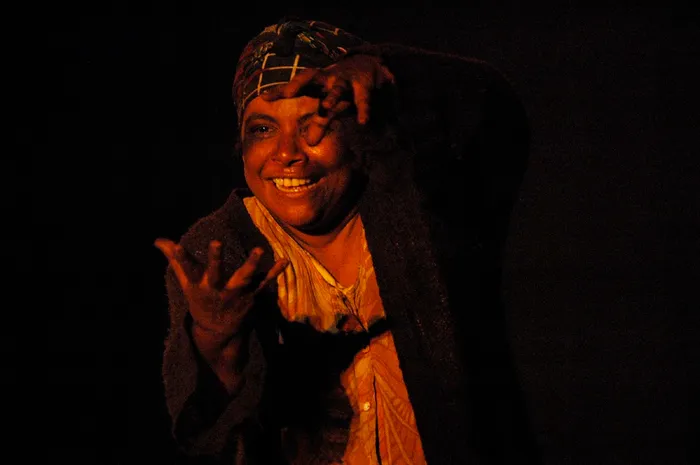
Athol Fugard's 'Boesman en Lena' at the KKNK in Oudtshoorn. Vinette Ebrahim was a cast member in this iconic production.
Image: LIZA VAN DEVENTER
Veteran television and theatre actress Vinette Ebrahim said the sudden funding cuts have put the entire creative sector into a state of panic.
"I do feel terribly sorry for the people and festivals that genuinely depend on that funding," she said.
"I think it is an absolute disaster that they are no longer going to receive funding."
Ebrahim, beloved for her role as Charmaine Meintjies in 7de Laan and now seen as Nenna Abrahams in Kelders van Geheime, did not mince her words when asked about McKenzie's handling of arts funding.
"I do not think he [McKenzie] knows what he is doing," she said.
"I think he is a very foolish man and to be quite honest, I do not have words for him.
"He is so ridiculous, a buffoon and a moron ... the festivals are really being hit hard by this."
She added: "My biggest disappointment, however, is that there is still an imbalance when it comes to funding.
"Some groups receive too much money, while others that deserve proper funding receive far too little.
"There is definitely an imbalance in the way funding is allocated."
Alexa Strachan, CEO of the Aardklop National Arts Festival, explained getting the department's ear has always been an uphill battle, especially since McKenzie took over.
Aardklop is one of SA's largest arts festivals, held annually in Potchefstroom in the North West.
She said communication with the ministry completely ground to a halt after his appointment:
"Since he was elected though as an appointed minister of our industry... I couldn't reach him and the festival couldn't get hold of him anymore," Strachan said.
Strachan also questioned why sport and arts are grouped under the same ministry.
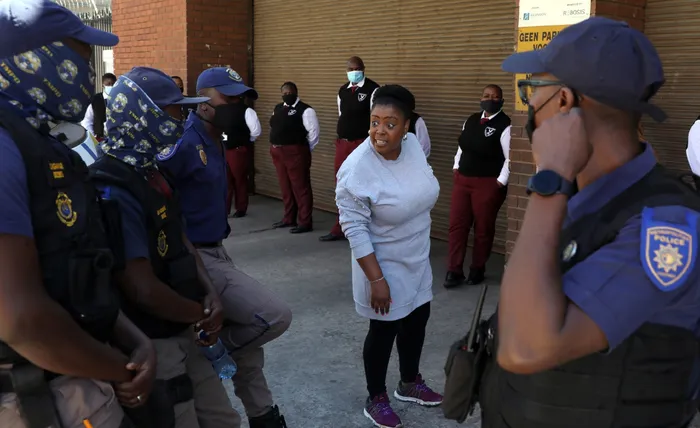
Artist Sibongile Mngoma
Image: OUPA MOKOENA
The arts sector has been crying out for help for years.
Singer Sibongile Mngoma made headlines back in 2021 with her solo protest outside the department’s offices in Pretoria.
Police tried to drag her away and even ripped her shirt off.
At the time, Mngoma said artists sent a list of questions to the late ex-sports, arts and culture minister Nathi Mthethwa with a request he make public a forensic report on the alleged abuse of funds from the Presidential Employment Stimulus Programme.
When McKenzie took the reins, hopes were high that he would breathe new life into the struggling sector.
Today, entertainers said his alleged neglect was still leaving local artists completely out in the cold.
According to figures presented to the National Assembly, the Cape Town International Jazz Festival generated around R900m for the Western Cape economy, supporting over 5,000 jobs.
Stellenbosch Woordfees reached over 250,000 schools and 270,000 learners annually.
Suidoosterfees sustained more than 4,000 jobs and hosted a junior festival for 8,000 schoolchildren.
The same was true for several other festivals.
Aardklop generated between R50m and R65m annually for the North West, Innibos injected between R80m and R90m into Mpumalanga’s economy, Vryfees generated an estimated R208m for the Free State, and the National Arts Festival in Makhanda featured 2,000 performers, attracted over 200,000 attendees, and contributed R350m annually to the local economy.
Industry leaders and watchdog groups said the festival cancellations had cost local economies close to R1bn.
They said the cancellations meant fewer tourists, less business for hotels and restaurants, and a loss of income for vendors who depended on the events just to make a living.
According to a written reply by Western Cape cultural affairs and sport MEC Ricardo Mackenzie, the provincial government financially supported this year's Klein Karoo Nasionale Kunstefees (KKNK).
Mackenzie said the festival did not receive national funding in 2025 after the application process was scrapped and restarted, leaving KKNK unable to reapply before the event took place.
Despite this, he said KKNK generated an estimated R72m to R89m for the Oudtshoorn economy and between R161m and R178m across the Western Cape.
The festival also created 781 jobs and a further 142 participation and exposure opportunities, bringing the total number of opportunities supported by the event to 923.
Strachan said many in the arts sector believed the department gave more attention to major sporting events than to local arts and cultural projects.
Speaking about funding, Strachan said Aardklop has largely operated without direct funding from the national department.
She said the festival chose not to rely on the department because of what she described as a frustrating funding application process.
However, she said independent initiatives like the Festival Enterprise Catalyst through the Jobs Fund — originally driven by former National Arts Festival CEO Monica Newton — remained a "brilliant exception" that genuinely kept local creatives employed.
"They are really great and we all benefited," she said.
Cape Town Carnival CEO Jay Douwes said the withdrawal was devastating.
"In a country grappling with unemployment, inequality, and disconnection, the Carnival provides an avenue for hope, economic impact, but most importantly social cohesion," Douwes said.
"We recognise that priorities shift, and that funding is finite.
"But we are deeply disheartened by the lack of transparency and the seeming abandonment of home-grown, community-based initiatives."
Douwes said the carnival played a major role in creating jobs and supporting small businesses.
He said the carnival:
IOL