

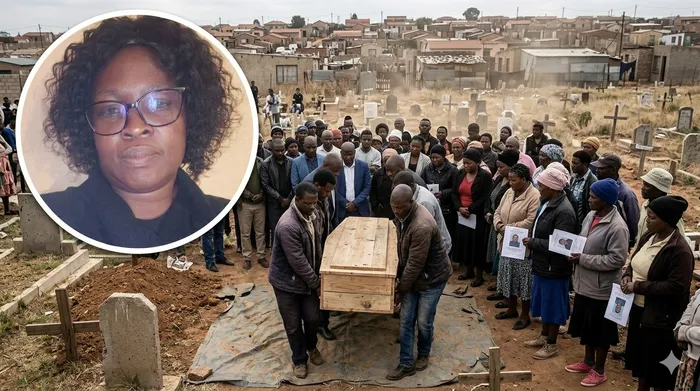
Pictured: A circular inset of Sarah Moloko, 47, of Moletjie, Limpopo. She is battling her funeral scheme to release the funds she paid.
Image: FILE
All Sarah Moloko wanted after her eldest daughter died in a fiery car crash was to lovingly lay her to rest.
Instead, the 47-year-old mother endured a hellish ordeal when the local funeral scheme she had so faithfully contributed to for years refused to pay out the full R12,000 benefit.
The scheme deducted R7,000, leaving her with just R5,000 to cover the cost of laying her beloved daughter, Lesego, to rest.
Moloko, who lives in the rural village of Moletjie in Limpopo, said 22-year-old Lesego died on impact in a car accident not far from home in April last year.
And while no mother wants to face the nightmare of losing a child, Moloko had at least comforted herself with the knowledge that she could afford a proper funeral.
“That ended up not being case," she said.
"I only had R5,000, so tell me, how do you say goodbye and bury your firstborn with R5,000?
“They withheld R7,000, and up until today I am still battling to get it back.”
Moloko’s story is one many grieving families know all too well, as they are often let down by the very people meant to help them bury their loved ones.
In another devastating case, a family in Ladysmith, KwaZulu-Natal, claim they had to pay R21,000 just to get the body of a 46-year-old father of two back after a funeral parlour allegedly held it hostage.
Dudu Kubisi
Image: SUPPLIED
Meanwhile, a family in Soshanguve is still coming to terms with the fact that the person they spent months looking for had already been given away to strangers and buried under the wrong name.
Dudu Kubisi died in a car crash in June 2023 and was taken to a state mortuary as an unknown person.
In a horrific mix-up, officials handed her body to the wrong family, who buried her thinking she was their own relative who had died at Steve Biko Academic Hospital.
The mistake was only discovered when the hospital called that family to ask why their actual relative was still lying uncollected in the morgue.
Her sister, Martha, said for months the Kubisi family searched hospitals and morgues for Kubisi, completely unaware she was already six feet under.
"Fingerprints finally confirmed her identity just days before Christmas in late 2023, but it took until July 2024 for her body to finally be exhumed," Martha told IOL this week.
"Only after the exhumation did officials attempt to locate and contact us.
"The challenge we now face is that, after her body was exhumed, I was required to undergo a DNA test to prove that I am related to her. However, the other family was not required to do the same.
"We waited for the DNA results for a very long time."
Funeral Industry Reformed Association chair Johan Rousseau said he was well aware of the two alleged extortion cases and the body mix-up incident.
He said he had launched an investigation into all three matters.
He said crooked operators took advantage of grieving families because they knew people were too heartbroken to fight back.
"Extortion is rapidly increasing in SA, especially between one funeral parlour and another funeral parlour obtaining a deceased person illegally from various networks," he said.
"And we need to understand that associations have tried to manipulate the process by having the standard rates amongst themselves, but not all associations are part of a particular association."
He said the lack of a legislative body contributed to extortion.
He said there were no guidelines in place.
"And I think it is of utmost importance that this should happen, because ultimately it is affecting the end users, especially in the township."
By the time of writing this article, there were an estimated 75,000 funeral businesses operating in SA.
Despite the size of the sector, SA does not have a single dedicated regulator overseeing funeral parlours and undertakers.
The Financial Sector Conduct Authority (FSCA) regulates funeral insurance policies and has warned that some funeral parlours sell policies without the required licences.
However, the FSCA does not regulate the day-to-day operations of funeral parlours and undertakers.
Instead, different parts of the funeral industry are overseen by various government departments, health regulations and municipal bylaws.
Meanwhile, crematoriums are completely overwhelmed by the number of bodies.
In the Western Cape, the backlog is so bad that bodies are regularly driven hundreds of kilometres to Despatch in the Eastern Cape just to be cremated.
Maitland Crematorium is one of the busiest facilities in the Western Cape and serves communities as far as Springbok and the West Coast District. It is managed by the City of Cape Town.
Cape Town's health political head Francine Highman referred IOL to the City. The health department did not immediately respond.
Its comment will be added once received.
Burial space has also become a major problem, with cemeteries bursting at the seams.
The situation is particularly dire in Paarl.
To ensure there is enough burial space for the community now and in future, Drakenstein municipality started developing the Nieuwedrift Cemetery in late 2025.
The project will be completed in phases, with attention given to environmental impact and budget management.
When it comes to the cremation backlog and bodies being sent to Despatch in Nelson Mandela Bay, Rousseau said the situation was a "disgrace".
"Families are being forced to wait weeks just to get their loved ones' ashes back," he said.
"It is completely unacceptable that bodies have to be driven across provinces just because local municipalities cannot maintain their facilities.
"It adds massive costs and unnecessary pain to families who are already broken."
Back to Moloko, she said she had for years faithfully contributed to a local burial society, a community group where members pay small monthly amounts so that when tragedy strikes, the family is supported.
“We help each other to bury during funerals,” she said.
“Every month we contribute money... it is like a stokvel.”
However, she claims that when she tried to claim her money, she was told she would not get the full payout unless she used a specific funeral parlour linked to the society.
She said that was simply impossible because other funeral parlours had already stepped in to help her family organise the burial.
“When my child died, those funeral parlours offered to help me,” she said.
"It was a casket here, funeral booklets there and so I accepted their help.”
Moloko said that decision led to the dispute.
She said the total funeral benefit was about R12,000.
Instead of receiving it, she was paid R5,000 in cash, while R7,000 was withheld.
“They deducted R7,000 because I didn’t use their funeral parlour,” she said.
“That money was meant for the burial.”
She said she was never told the payout would be reduced in that way, and she had to deal with the disagreement while still preparing to bury her daughter.
“That was not admin money,” she said. “They just kept it.”
Her daughter had been studying electrical engineering and was close to finishing her qualification.
Moloko said she was a bright, hardworking young lady.
“She was a genius with maths and science,” she said.
“She was loving. She was caring. She was like an adult already.”
Now Moloko is left raising two younger children, including a seven-year-old, while still contributing between R50 and R100 to the same burial society each month — even as the dispute remains unresolved.
But she said she continues to pay out of hope that no other grieving family is treated the way she was.
“I still pay,” she said. “I’ve been with them for a long time.”
IOL News