

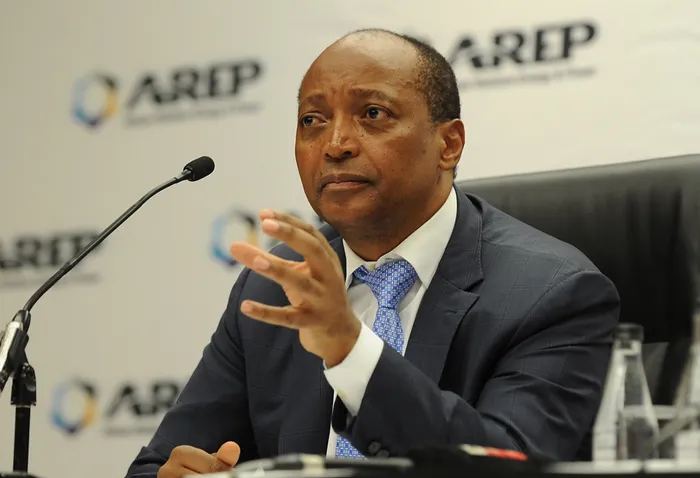
An American company has questioned the speed with which its multi-million dollar dispute with Dr. Patrice Motsepe's African Rainbow Capital was finalised by the Gauteng High Court, Johannesburg this week.
Image: Karen Sandison / Independent Newspapers
American company Pula Group has questioned the speed with which the dispute over the US$195 million (about R3.2 billion) damages claim against billionaire businessman Dr. Patrice Motsepe's African Rainbow Capital (ARC) was adjudicated in his favour.
Earlier this week, ARC succeeded in obtaining a Gauteng High Court, Johannesburg order declaring that Pula Group and its Tanzanian subsidiary Pula Graphite Partners are prevented from filing the lawsuit against ARC.
On Tuesday, Judge Leicester Adams ordered that to the extent that Pula Group is able to prove a breach of the agreement and damages arising from that breach, its contractual remedies are only against African Rainbow Minerals (ARM), one of Motsepe’s companies.
Pula Group has now filed an application for leave to appeal the high court judgment in ARC’s favour.
The company described the decision as a rushed intervention intended to give ARC leverage in the ongoing $195m damages claim proceedings before the Tanzanian Commercial Court.
The damages claim over the breach of confidentiality stems from Pula Group and Pula Graphite Partners’ accusations that ARM and its affiliates acquired confidential information from the Pula Group, which enabled them (ARM and its affiliates), to invest in an Australian company Evolution Holdings to become part and parcel of the Chilalo Graphite Project, which is a direct competitor of Pula Group and Pula Graphite Partners in Tanzania.
“The ruling was delivered less than two weeks after the hearing. Pula notes that matters of this nature typically take between three and six months to be adjudicated.
“This is important considering that the Tanzanian trial that is scheduled to commence next week in the Commercial Division of the High Court in Dar-es-Salaam,” noted the company, which is chaired by former US ambassador to Tanzania Charles R Stith.
Stith said he hopes that for the sake of South Africa that its encounters with these judges were an aberration.
“If it isn’t, the implications are profound. The signal this sends to the world is that if you do business with a South African firm, in a dispute that requires court action, the deck is stacked against you,” he claimed.
Stith added: “To Africa, it sends a message that South African courts will ‘use their discretion’ to keep their companies from being held accountable for any violations they commit elsewhere on the continent.”
He complained that for a country like South Africa, that touts itself as the gateway to Africa, this was not good.
“For a country like South Africa that should be one of the engines for growth on the continent this decision is not good,” Stith stated.
According to Stith, his companies’ case has profound implications for Tanzania and that if that country’s courts allow foreign companies to violate the rights of Tanzanian companies in developing its resources then the east African nation will never reach its full potential.
“If Tanzanian courts cede to other jurisdictions the right to make decisions in disputes about Tanzanian resources, Tanzanians will be prevented from being partners in the development of their country,” he said.