

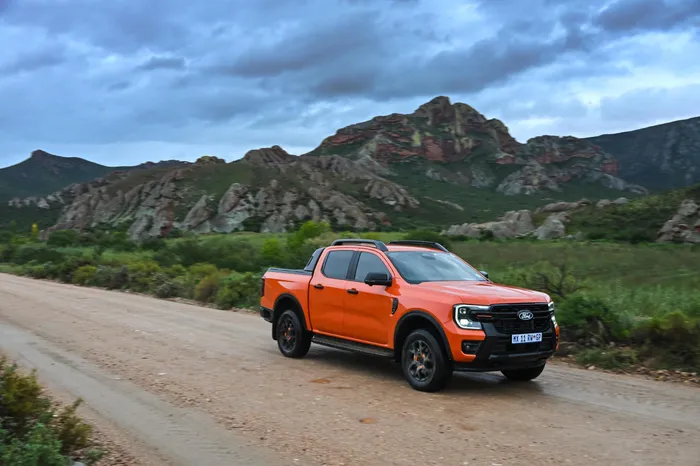
The Ranger Wildtrak remains one of the most distinctive bakkies on the road with its bold grille, C-clamp Matrix LED lighting signature and muscular bodywork.
Image: Supplied
The Ford Ranger is like an old friend that every time you see him puts a smile on your face and brings back memories of braais, drinks and long trips that mostly involve 4x4s
I’ve had a number of them as long-term test cars, and they have taken me to some of the most remote and beautiful places in the country, including the 4x4 Namaqua Trail, Die Hel, Tankwa and the Cederberg.
The latest one in the driveway is the Ranger 2.3-litre Wildtrak following Ford’s recent revamp of the range.
You may recall that the 2.0-litre Bi-Turbo diesel was phased out in favour of the 2.3-litre turbocharged EcoBoost petrol engine, with the improved 2.0-litre single turbo diesel still doing duty and more derivatives fitted with the company’s V6 diesel plant.
The Ranger Wildtrak remains one of the most distinctive bakkies on the road with its bold grille, C-clamp Matrix LED lighting signature and muscular bodywork. It has unique Wildtrak detailing including model-specific 18-inch alloys with orange accents that I’m not completely sold on.
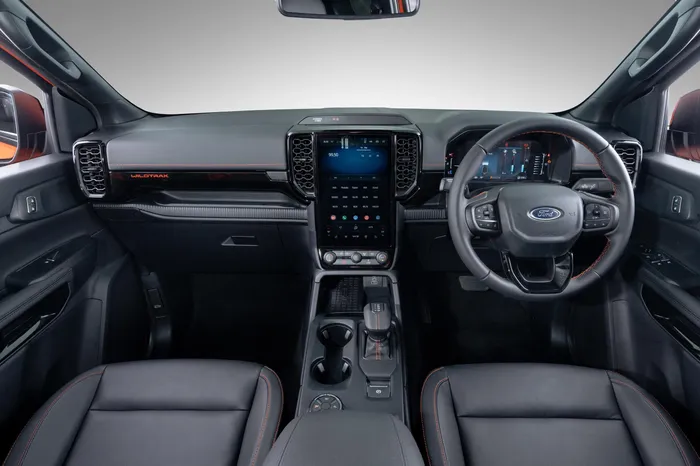
The Ranger features Wildtrak-specific trim, contrasting stitching and premium upholstery.
Image: Supplied
The new Isuzu D-Max and Toyota Hilux have now been revealed, but the inside of the Wildtrak (and the Ranger in general), in my opinion, is still very much the trend-setter in that department.
It features Wildtrak-specific trim, contrasting stitching and premium upholstery, while the dashboard adopts Ford's modern "coast-to-coast" design theme. There are generous storage spaces and comfortable seating, and it provides an air of refinement every time you get behind the wheel.
It has the 12-inch infotainment system with Ford’s Sync 4 software that very much sets the standard in the segment. Even after a week, the moment I start it up, it connects effortlessly to my phone, like that familiar old friend.
Having tested a string of new cars, many of them Chinese, one thing I am eternally grateful for is the physical buttons for sound and air conditioning.
No scrolling through sub-menus, just good old-fashioned turn, push and twist.
The 12-inch digital instrument cluster can be customised, so I have all the information I need at a glance.
Safety-wise, there’s adaptive cruise control, lane-keeping assist, blind-spot monitoring, autonomous emergency braking, rear cross-traffic alert and a 360-degree camera system.
I haven’t driven a petrol bakkie for many years; the last one was probably a V6 Land Cruiser 15 years ago, so this 2.3-litre made an interesting change.
The EcoBoost engine makes 222kW and 452Nm and has been tuned specifically for the Ranger. It drives the rear wheels exclusively via Ford’s 10-speed automatic transmission that has been calibrated specifically for the EcoBoost engine.
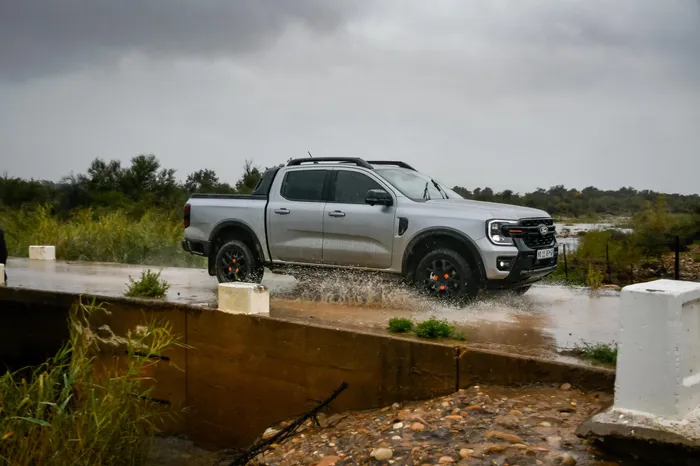
The 2.3-litre EcoBoost engine makes 222kW and 452Nm and has been tuned specifically for the Ranger.
Image: Supplied
Unlike the diesel engine with low down torque, the 2.3 petrol plant likes to be revved, and at low speeds it takes a while to pick up speed, but once it hits the 3,000rpm mark it’s a joy to drive.
It picks up speed very quickly and smoothly changes cogs while easily getting to well beyond the speed limit if needed.
Most of our driving has been commuting with occasional highway excursions, and as my partner who drives a BMW 3-Series likes to say, the driving height and size mean it is not easily intimidated.
It’s a bakkie, so it was never intended to do pin-point cornering, but considering its size and weight, it’s remarkably nimble around the bends.
On the occasional gravel road, Ford’s suspension still rules the roost, although because it’s not 4WD, you have to be a little more circumspect, and the rear will quickly get away from you and put the electronics into play.
We’ve done a few hundred kilometres with it, including a fairly long stretch with the load bay filled with my son’s university residence belongings, and fuel consumption stands at 11.5l/100km. It’s not great, but having spoken to colleagues and checked out some forums, that’s about par for the course, and it may drop a bit once it’s fully run in.
Normally, my lifestyle prefers a 4x4, but if you’re not going to do any real offroading, then the Ford Ranger Wildtrak is perfect for excursions to game reserve gravel roads, the well-maintained roads in Namibia and even farm roads.