

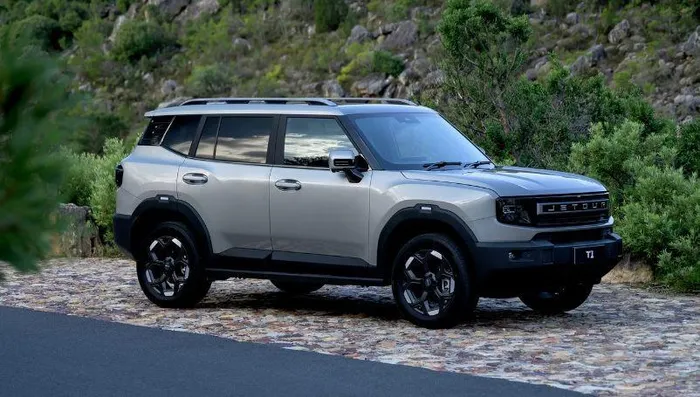
Overshadowed by its more rugged sibling, the T1 makes a quietly convincing case of its own.
Image: Supplied
There’s no denying that the Jetour T-Series has taken the South African market by storm, with monthly sales pushing past the 1,000 mark in April, and there are now even plans to build it here from late 2027.
While the Jetour T2 is leading this sales charge by quite a margin, its more urban-oriented Jetour T1 sibling remains something of a curiosity, and after receiving a unit to test recently, we were keen to get a better grasp of why it exists and how it fits in.
Pros
Cons
The Jetour T1 and T2 share the same engines and platform, riding on an identical 2,800mm wheelbase. But the T2 is somewhat more rugged-looking, with many comparing it to a Land Rover Defender. It is also slightly longer, at 4,785mm versus the T1’s 4,705mm.
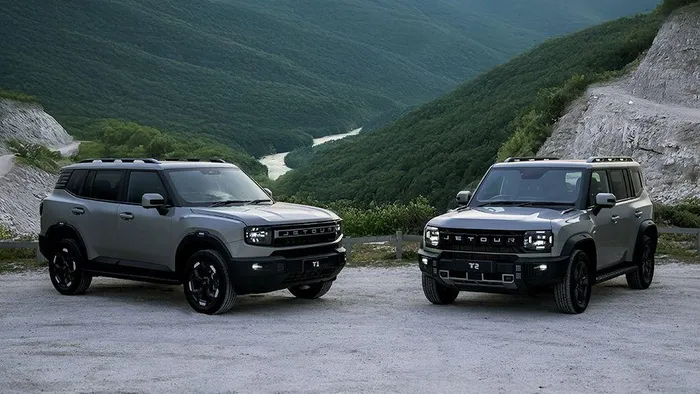
Smooth T1 (left) versus rugged T2 (right)?
Image: Supplied
In keeping with its more rugged appearance, the T2 also has a significantly higher ground clearance of 220mm, while the T1 sits 190mm above the ground.
At first, I questioned why it is necessary to have both models on sale, particularly given how South African buyers have overwhelmingly voted for the T2, but after spending some quality time with the T1, its appeal became more apparent.
For starters, it is cheaper than the T2. The T1 kicks off at R514,900 in the entry Aspire trim level, which is not available in the T2, and even the mid-spec 1.5T Aspire, at R544,900, is a good R25,000 less expensive than the equivalent T2.
In the 2.0T all-wheel-drive Odyssey model that we tested, that gap grows to R45,000, with the T1 example coming in at R634,000.
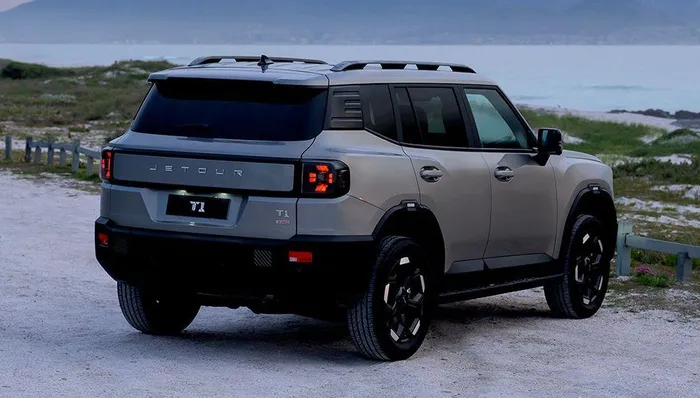
The T1’s rear is clean and understated, though some may find it a little plain compared to the T2.
Image: Supplied
While the smaller T1 doesn’t look like it’s about to go swimming with crocodiles in the Okavango Delta, its smoother lines are easier on the eye, particularly up front, although some do find it a little too bland at the rear.
Being lower to the ground, the T1 also handles better, providing superior stability at highway speeds, and if the majority of your driving is going to be within urban confines, then surely that’s a win?
I drove the T1 extensively around Joburg over the Easter weekend, and it lapped up the miles in comfort. Performance from the 2.0-litre turbopetrol engine, which produces 180kW and 375Nm, is brisk, and although the throttle calibration is not perfect, it is a meaningful improvement over earlier Jetour products. Gear changes from the seven-speed dual-clutch automatic transmission are seamless.
We weren’t impressed by the fuel consumption, however, with our unit showing 11.7 litres per 100km on the on-board readout after a week-long mix of driving conditions.
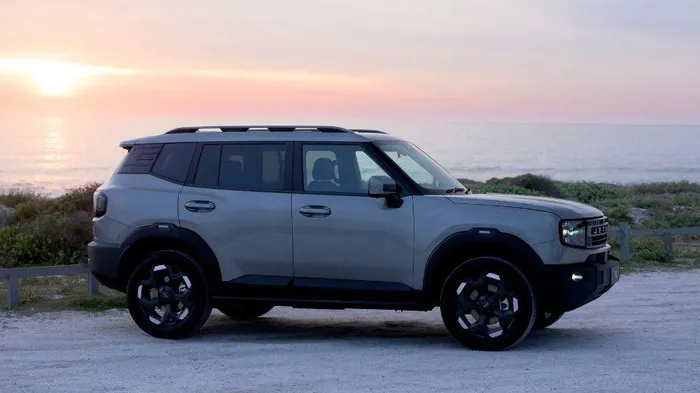
The T1 dials back the off-road theatre, opting instead for a more conventional SUV silhouette.
Image: Supplied
The vehicle does score points for driving comfort. The suspension absorbs road imperfections with ease, and the cabin is also well insulated from outside noise and road surfaces.
Although not intended as an off-roader, 2.0-litre versions of the T1 do share the T2’s XWD all-wheel-drive system, as well as its terrain select system with eight modes, including crawl control for low-speed bundu bashing. Light off-road trails should not be a problem in this vehicle, keeping in mind its lower ground clearance.
The T1 shares its basic cabin architecture with the T2, and while it is missing a few of the latter’s more colourful design options, the differences are not major.
Material quality is impressive for a vehicle at this price point, and so is the technology. Features include a 15.6-inch central infotainment screen and a 10.25-inch digital instrument cluster, while important climate functions can still be operated via physical controls located beneath the screen.
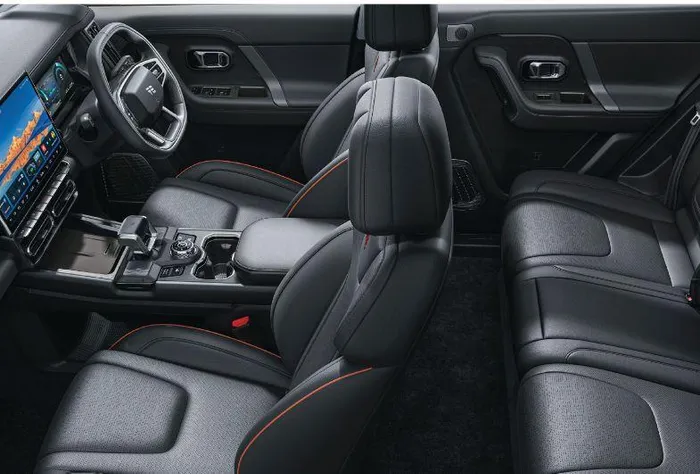
The T1’s cabin mirrors the T2’s tech-heavy layout, but with a more restrained visual approach.
Image: Supplied
The central screen is powered by a Qualcomm Snapdragon 8155 chipset, which delivers fast response times and rich graphics. The menus are reasonably easy to use, and for phone connectivity, it supports wireless Apple CarPlay and Android Auto.
The range-topping Odyssey trim comes with powered seats, a 540-degree camera system, panoramic sunroof, and the usual suite of safety systems, including adaptive cruise control and autonomous emergency braking.
Practicality is about as good as you could expect at this level, with ample legroom for rear-seat occupants and a relatively vast and deep boot, which boasts a capacity of 574 litres. Beneath it is a space-saver spare wheel.
The cabin combines soft-touch materials on the upper dash with durable lower plastics that seem better suited to outdoor adventures.
The Jetour T1 makes a strong case for itself as the more understated, road-focused alternative to the T2, offering solid comfort, impressive tech and keen pricing in a very competitive segment.
While it lacks the visual drama and off-road presence of its sibling, it arguably makes more sense for buyers who spend most of their time in the city and on the highway.
IOL Motoring