

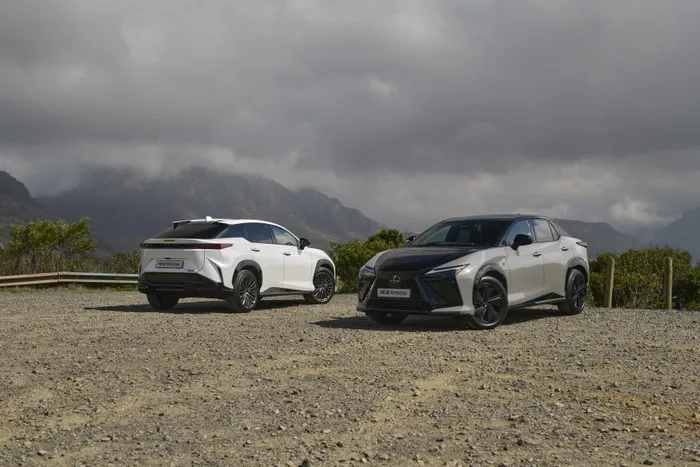
The Lexus RZ is built around a lithium-ion battery pack with two capacities depending on the derivative.
Image: Supplied
Remember when Toyota was being criticised for not drinking all the electric car Cool Aid and sticking to their guns by continuing to focus on all forms of power including ICE, hybrid, plug-in hybrid, electric and even hydrogen.
It seems the world’s largest manufacturer got it right with many competitors having considerably dialed down their fully electric expectations over the past few years.
Locally, Toyota has also taken a conservative view and it’s only now that they have released their first fully battery electric vehicle (BEV) in the form of the Lexus RZ.
Overview
The Lexus RZ is built around a lithium-ion battery pack with two capacities depending on the derivative.
The RZ 500e EX and SE use a 74.6kWh battery, while the RZ 550e F Sport receives a slightly larger 76.9kWh unit. Both configurations use dual electric motors driving all four wheels through Lexus’ DIRECT4 all-wheel drive system.
Power output in the RZ 500e EX and SE is rated at 280kW, while the RZ 550e F Sport increases output to 300kW. A water-cooling system regulates battery temperature during sustained driving or rapid charging.
All models are equipped with a 22kW onboard charger. Under suitable DC fast charging conditions, the battery can charge from 10% to 80% in approximately 30 minutes. Battery pre-conditioning prepares the battery for charging by adjusting its temperature in advance.
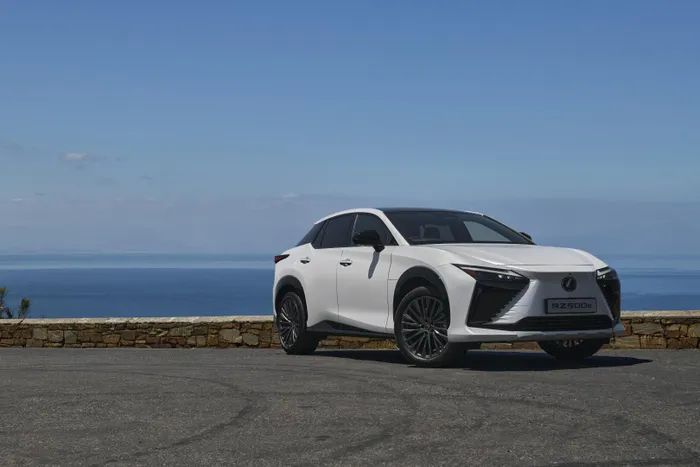
The RZ adopts Lexus’ spindle body design, adapted for an electric platform.
Image: Supplied
Exterior design and dimensions
The RZ adopts Lexus’ spindle body design, adapted for an electric platform. The absence of a conventional engine allows different proportions, with a longer wheelbase and shorter overhangs.
The RZ 500e EX rides on 18-inch alloy wheels fitted with 235/60R18 tyres. The SE and F Sport models receive larger 20-inch staggered alloy wheels, with 235/50R20 tyres at the front and wider 255/45R20 tyres at the rear.
The RZ 550e F Sport adds aerodynamic elements, including functional air ducts, revised bumper mouldings and a rear spoiler designed to improve airflow management and stability.
A high-performance RZ 600e F Sport Performance model will be introduced later, featuring additional aerodynamic components and carbon fibre body elements.
RZ 55e EX
The RZ 500e EX serves as the entry point to the range. It uses the 74.6kWh battery and produces 280kW through its dual-motor all-wheel drive system. The range is said to be 500km.
Interior trim consists of synthetic leather upholstery. Heated front seats are standard, along with a Lexus Premium Audio system with 10 speakers. Driver assistance systems include adaptive cruise control and lane trace assist.
Exterior lighting uses LED headlights with automatic high beam functionality.
RZ 500e SE
The RZ 500e SE retains the same drivetrain as the EX, with the 74.6kWh battery and 280kW output, but adds additional equipment and interior upgrades.
Wheel size increases to 20-inch staggered alloys. Interior trim is upgraded to Ultrasuede upholstery. Heated front and rear seats are standard, along with radiant heating panels integrated into the climate control system.
The SE also receives a 14-inch multimedia display and a 13-speaker Mark Levinson sound system. Additional features include a head-up display, digital rear-view mirror, adaptive high beam headlights and intelligent parking assist.
A panoramic dimming glass roof is also included, allowing adjustable transparency.
Lexus claims a range of 456km.
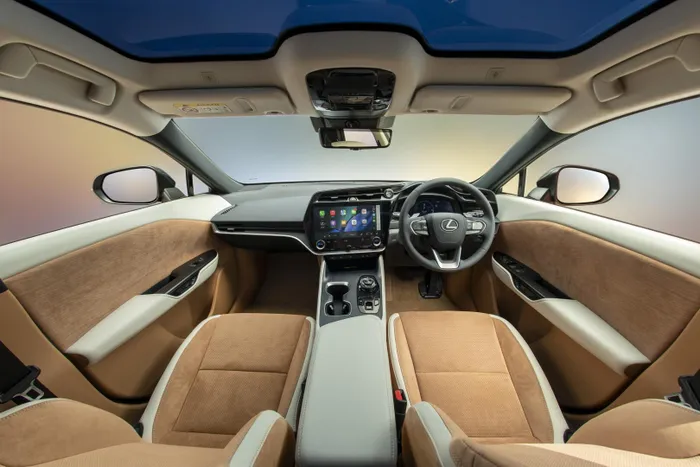
The SE has a 14-inch multimedia display and a 13-speaker Mark Levinson sound system.
Image: Supplied
RZ 550 F Sport
The RZ 550e F Sport introduces a higher-output drivetrain, with total system output increased to 300kW. It uses a larger 76.9kWh battery and retains the dual-motor all-wheel drive configuration.
It adds a performance-focused chassis and steering technologies, including Lexus’ steer-by-wire system, which electronically connects steering input to the wheels without a mechanical linkage.
An Interactive Manual Drive system simulates gear changes, allowing the driver to manually control virtual gear ratios through paddle inputs.
The suspension is revised with performance dampers to improve handling stability and cornering response.
Interior changes include Ultrasuede sport seats with additional lateral support, aluminium pedals and F Sport-specific trim elements.
Exterior changes include F Sport styling, painted brake calipers and revised aerodynamic detailing.
It has a claimed range of 450km.
Interior and technology
The RZ’s interior follows Lexus’ Tazuna cockpit layout, positioning controls and displays within the driver’s direct line of sight.
A dial-type shift-by-wire controller replaces a traditional gear lever. The dashboard integrates a large central infotainment display and digital instrumentation.
Radiant heating panels positioned in front of the driver and front passenger supplement conventional climate control, reducing energy consumption compared with traditional cabin heating systems.
Connectivity includes wireless Apple CarPlay and Android Auto, wireless charging and integrated navigation. Higher-grade models receive the Mark Levinson premium audio system and head-up display.
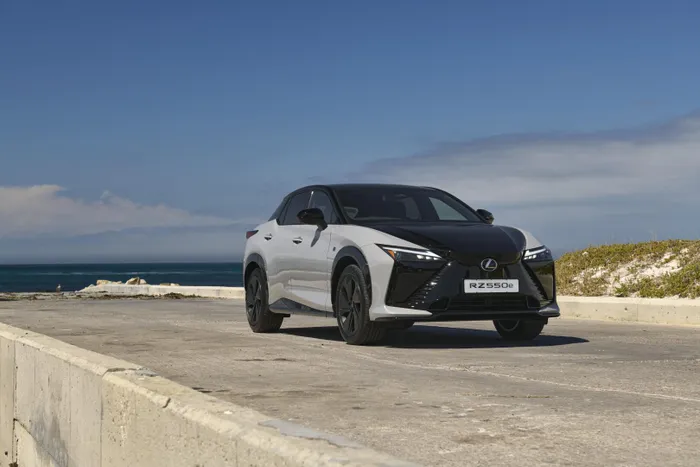
The RZ 550e F Sport introduces a higher-output drivetrain, with total system output increased to 300kW.
Image: Supplied
Driving
During the launch of the Lexus RZ we got to drive the SE and F Sport versions.
Climbing into the F Sport the Yoke steer by wire “wheel” is the first thing you notice before casting an eye over the rest of the interior.
It’s like holding the steering of a GT race car including steering-mounted paddles to move through simulated gears and takes some getting used to.
Steering is incredibly sharp and precise with a 200 degree turn from lock to lock which after a while I started to enjoy and with the chassis-mounted battery providing a low centre of gravity, it’s the kind of car you want to take out on tight, sweeping mountain passes.
One thing I found though is that the indicator and wiper stalks are stubby and close to the Yoke which owners will have to get used to.
As you would expect, acceleration is immediate and unrelenting. I found the piped high-revving engine sound unnecessary, and perhaps it’s time that manufacturers accept BEVs as stealth vehicles and just leave it at that.
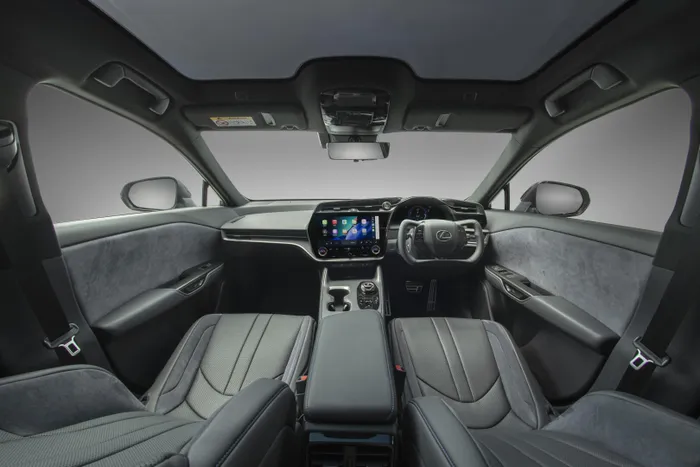
The drive by wire yoke takes a while to get used to.
Image: Supplied
The seats are comfortable providing decent support and like the rest of the cabin they’re beautifully stitched and put together.
What I also appreciated was that key vehicle functions are still adjusted by dials and switches so you don’t have to dig into various menus on the touchscreen.
My driving partner’s Apple device connected wirelessly but I had to plug in my Android phone, something that Lexus hasn’t completely mastered over the years.
Sliding in behind the more traditional wheel of the SE is like welcoming home an old friend.
It’s a spot-on Lexus drive, just a silent one.
It’s refined and easy to drive, providing an overall luxury experience.
The quality of the materials, ergonomics and understated elegance combined with an electric drive make the RZ SE a pleasure to spend time with.
It’s quick off the mark and takes care of the twisties without any drama or fanfare.
Verdict
As it is, Lexus is a niche product so the Lexus RZ is an even smaller niche which is why initially they will only be bringing in 50 units.
It’s aimed at a very specific driver who values quality, refinement and appreciates what an electric vehicle brings to car ownership.
There’s a reason why Toyota hasn’t thrown all their eggs into one basket and the RZ proves that patience does pay off.
All models include a seven-year or 105,000km maintenance plan and vehicle warranty. The battery is covered by an eight-year or 160,000km warranty.
Pricing
RZ 500e EX: R1,649,400
RZ 500e SE: R1,823,800
RZ 550e F Sport: R1,938,600