

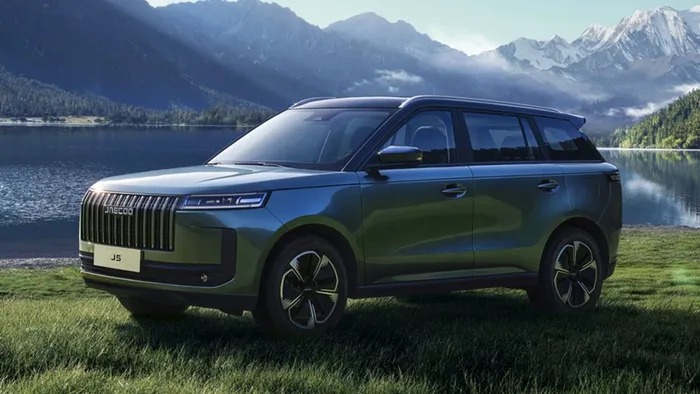
The Jaecoo J5 has been confirmed as one of the vehicles that Chery Group will build in South Africa.
Image: Supplied
As a historic chapter closes with Nissan South Africa having ended local manufacturing in May, another begins following Chery Auto’s acquisition of the Japanese carmaker’s assembly plant in Rosslyn, Gauteng.
Friday, July 3, marked a historic moment as the Chinese automaker formally inaugurated its local manufacturing operation, with a view to commencing local production from mid-2027 following a refurbishment of the plant.
In attendance were Deputy President Paul Mashatile, Gauteng Premier Panyaza Lesufi, Tshwane Executive Mayor Dr Nasiphi Moya, Chery Auto Chairman Yin Tongyue, Vice President Charlie Zhang and Chery's South African CEO Tony Liu.
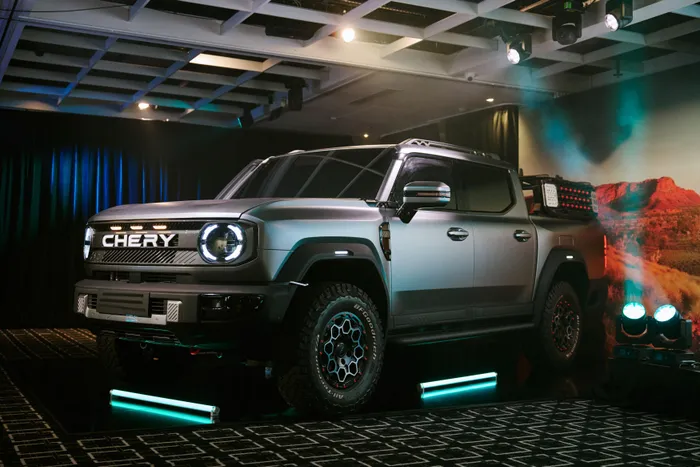
Although not officially confirmed, it is believed that the KP31 bakkie will be built locally.
Image: Sithunyelwe
Although the company did not use the occasion to reveal which products it plans to produce locally, there are strong indications of which models are set to cross the Rosslyn assembly plant in 2027. Chery brands Omoda & Jaecoo announced separately on Friday that the Jaecoo J5 will be among the models to be assembled locally. A Chery representative also confirmed to us on the sidelines that the closely related Lepas L4 and Chery Tiggo Cross will be built alongside the J5.
Furthermore, Jetour announced earlier this year that its T-Series SUV, a larger vehicle than the latter trio, is also in the running for local production.
But that's not all. A Chery representative has told IOL that the production version of the new KP31 bakkie is also under strong consideration for local production. This is the world's first bakkie to feature a diesel plug-in hybrid powertrain.
Chery Auto South Africa is aiming to produce 50,000 units per annum by financial year 2028.
The plant’s acquisition recently attained the approval of the Competition Commission.
The plant previously operated at low capacity, producing Nissan Navara bakkies for the local and other African markets. Chery Auto said it plans to upgrade the plant and its equipment with a view to returning it to full production capacity.
Chery says the investment will directly and indirectly create close to 3,000 jobs, through its manufacturing plant as well as the supply chain and related services. Furthermore, the carmaker said it will retain at least 692 of the former Nissan employees, which is most of the previous workforce, on similar packages.
At this year’s Auto China, Chery South Africa CEO Toni Liu said the company was engaging with local suppliers, but added that it would primarily rely on imported components while building local capacity.
“We will bring our own parts in CKD form, but step by step, we will set up our own supplier base,” Liu said.
The company said it is aiming for a local content level of 40% in the early phase.
Deputy President Mashatile described the investment as a vote of confidence in South Africa's people and its institutions, but he stressed the importance of achieving high local content in vehicle production and also promotes sustainable economic growth across generations."
"Assembly itself may provide shallow employment, but prospects are better with localisation because it creates significant job multipliers."
After re-entering the South African market in 2021, Chery Auto has rapidly established itself as one of the country’s leading importers by volume. In fact, when combining sales from Chery, Omoda & Jaecoo, and the separately distributed Jetour brand, the group recorded 6,072 units in June —enough to place it as the second-largest manufacturer, ahead of Suzuki on 5,689 units.
“Chery's investment in South Africa is not only an important step in the company's globalisation development, but also our long-term commitment to the economic and industrial development of South Africa,” Chery Auto’s Executive Vice President Charlie Zhang said.
IOL Motoring