

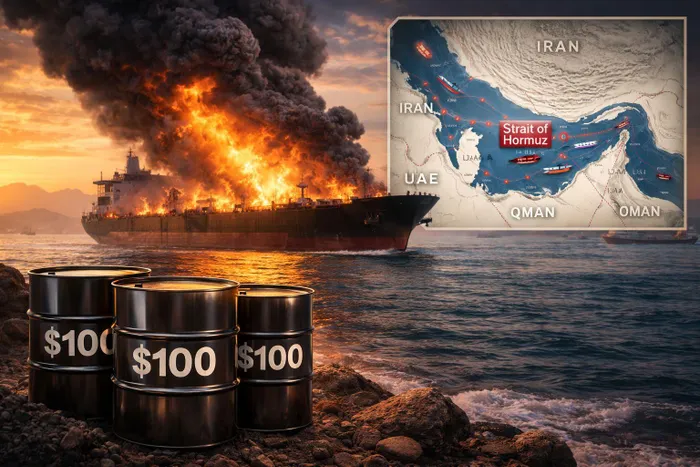
If oil stays above $100 per barrel, the resulting fuel price increases will be damaging.
Image: ChatGPT
The price of Brent Crude oil has been hovering stubbornly above the $100 mark during the latter half of this week, largely driven by fears of a prolonged war in the Middle East.
But what does this mean for your fuel budget in April? It’s really bad news.
Should this situation persist, South Africans could be facing fuel price increases that are even more damaging than originally anticipated.
Consider this for a second. South Africa’s current fuel prices, effective from March 4, are based on oil averaging $64 per barrel during the last review period. Since the beginning of March, Brent Crude has averaged $88, and that number looks set to rise even further given the aforementioned market developments.
The most recent update from the Central Energy Fund is pointing to price increases of R3.97 for 95 Unleaded petrol and R3.61 for 93 Unleaded, while diesel is looking set to rise by between R6.63, in the case of 500ppm, and R6.74 for 50ppm.
This is based on the current month-to-date average under-recovery, and could be seen as the current best-case scenario, assuming there isn't a sudden end to the war that sends oil prices plunging.
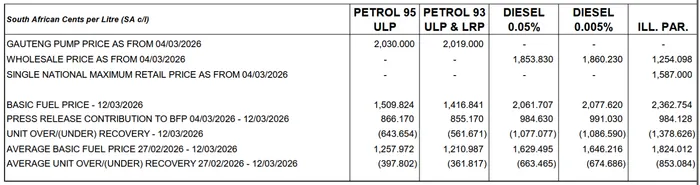
Latest daily update from the Central Energy Fund.
Image: CEF
However, the most recent daily under-recoveries stand at R6.43 for 95 ULP petrol and R10.77 for 500ppm diesel. Should this scenario persist until the end of March — that’s assuming oil stays above $100 and the rand remains at its current weak level — South Africans could be faced with a petrol increase of more than R5.20 and a diesel hike exceeding R8.80, according to our calculations.
Keep in mind that an increase in fuel taxes is also expected to take effect from April 1, with increases to the General Fuel Levy, Carbon Levy and Road Accident Fund levy collectively adding 21 cents to the tally.
ALSO READ: Fuel and RAF levy increases throw more money at a broken system, critics say
There are currently no indications of fuel shortages in South Africa, at least in the short term.
While agricultural companies in rural areas — such as OVK, NWK, and VKB — have begun limiting diesel sales and hiking prices for farmers, the Department of Mineral and Petroleum Resources (DMPR) says private motorists still have stable access to fuel, Top Auto reported.
Oil prices hit the $100 mark once again this week after Iran’s new leader, Ayatollah Mojtaba Khamenei, called for blocking the Strait of Hormuz and opening new fronts against the US and Israel, AFP reported.
Tehran has attacked ships near Iraq, fuel tanks in Bahrain, and Saudi oil fields, warning it would strike regional energy if its own facilities are targeted.
ALSO READ: Oil holds above $100, stocks fall as Iran leader targets Hormuz
The price of Brent crude has increased by 40% since the Middle East conflict began on February 28, with even the IEA’s record release of 400 million barrels failing to ease supply fears.
South Africa will face economic implications, although the extent of these remains to be seen.
The Middle East war will fuel inflation, weaken the rand, and reduce the likelihood of an interest-rate cut this month.
ALSO READ: How the Middle East conflict is driving up oil prices and threatening SA's economy
Investec chief economist Annabel Bishop said growth this year will largely depend on the conflict’s duration. Although a major economic shock is unlikely, the country may experience mild to moderate impacts, with oil and petrochemical supplies expected to remain mostly stable.
IOL Motoring