

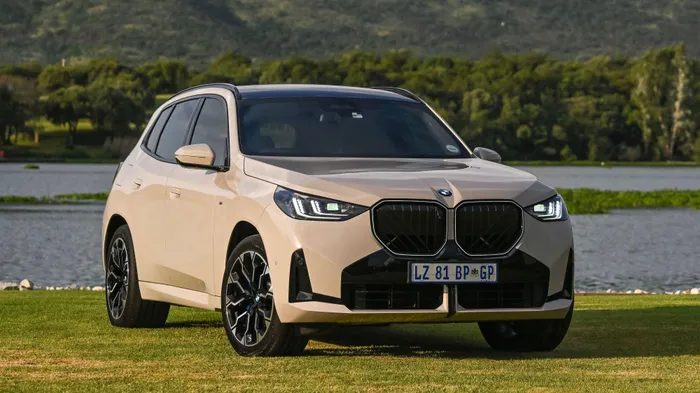
Produced at the plant in Rosslyn, Pretoria, the BMW X3 is the brand's top seller locally.
Image: Sithunyelwe
BMW Group South Africa enters 2026 with momentum across its BMW, Mini and Motorrad brands, underpinned by strong local sales growth, a diversified drivetrain strategy and a product pipeline that balances heritage with new-energy technology.
Speaking at the Start of the Year Media Engagement in Midrand, CEO of BMW Group South Africa, Peter van Binsbergen, said the group’s performance in 2025 reflected both consumer confidence in the brands and the strength of its local ecosystem.
“The plant in Rosslyn remains the cornerstone of BMW South Africa,” he said. “But our success is really built on an ecosystem - production, sales, dealers, parts availability and customer care - all working together.”
BMW brand sales grew 12% year-on-year, securing a dominant 46% share of the local premium segment. Mini grew by 4% in a competitive segment, while BMW Motorrad posted 7% growth and commanded nearly 40% of the over-250cc motorcycle segment.
“We comfortably outsold our two closest premium competitors combined,” Van Binsbergen said of the BMW brand’s performance. “That tells you the value proposition resonates.”
X3 the local hero
The heart of BMW’s success is the locally built X3, produced at Rosslyn for both domestic sale and export.
“The X3 is our local hero,” he said. “It’s built in South Africa, and it was also voted Car of the Year.”
Just as importantly, it is also BMW’s best-selling model locally. “It shows that consumer resonance is very high for it.”
BMW’s X3 range reflects the company’s broader philosophy of offering choice rather than forcing a single solution. Customers can choose between petrol, diesel, plug-in hybrid or six-cylinder M Performance derivatives.
“That flexibility is important in South Africa,” Van Binsbergen said. “One drivetrain doesn’t fit all lifestyles.”
Locally developed editions such as the Rugged and Pure Design variants further tailor the X3 to South African conditions and tastes, from gravel-road durability to urban design-led appeal.
Technology openness
BMW’s drivetrain strategy remains deliberately flexible, particularly as global EV timelines continue to shift.
“We’ve always said we won’t decide for the customer what they should drive,” Van Binsbergen said. “We invest in petrol, diesel, plug-in hybrid, battery electric and even hydrogen.”
Plug-in hybrids, he believes, remain misunderstood in South Africa.
“If you can charge overnight, you can drive 80 to 90km electrically during the week,” he noted. “You pay nothing for fuel during commuting, and on weekends you have an engine with no range anxiety.”
While plug-in hybrids account for roughly 40% of X3 production globally, local take-up is closer to 10%, reflecting the absence of consumer incentives.
“The minute incentives are introduced, new-energy vehicles take off,” he said. “Right now, what we’re seeing in South Africa is natural demand.”
Mini and Motorrad
Mini’s performance was boosted by strong interest in its electric models, which grew by more than 50%, placing it second overall in the local BEV market.
“That’s a strong result for a relatively small brand,” van Binsbergen said.
The coming year will see new John Cooper Works editions, including electrified variants, reinforcing Mini’s performance-led, playful identity.
BMW Motorrad, meanwhile, continues to benefit from South Africa’s strong adventure and touring culture.
“Motorrad is doing exceptionally well as both a lifestyle product and a riding machine.”
The arrival of the smaller GS450 will broaden access to the GS range.
“It introduces people to the GS lifestyle in a more accessible way,” Van Binsbergen commented. “I’ve already ordered one.”
Neue Klasse and beyond
The second half of 2026 will mark the local arrival of BMW’s Neue Klasse era, led by the new iX3.
“This is not just a new car, it’s a new mobility platform focused on design, electrification and digitisation.”
The iX3 will be followed by the new iX5 and an updated 7 Series, all carrying Neue Klasse DNA. More than 40 new or refreshed BMW Group models are expected globally over the next two years, many of which will reach South Africa.
BMW and South Africa
Asked why BMW continues to perform well in South Africa, Van Binsbergen pointed to heritage, product depth and ownership support.
“We have very strong South African heritage, backed by German engineering,” he said. “But it’s also about peace of mind.”
That includes a strong dealer network, high parts availability, standard motor plans, predictive servicing technology and BMW On Call roadside assistance.
“If something goes wrong, even hitting a pothole, we get the customer's mobile again.”
“That’s what we mean by ‘Relax. We Care.’”
As BMW Group South Africa looks ahead, Van Binsbergen remains confident.
“We have strong products, strong partners and loyal customers. “That’s why we’re optimistic about the year ahead and why we’ll keep sharpening our game.”