

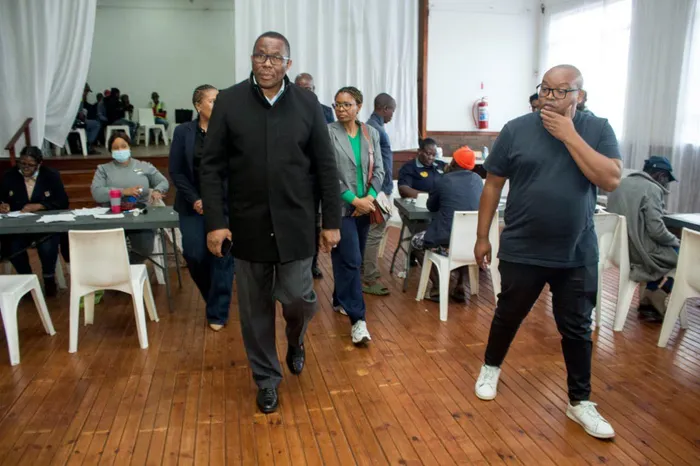
A letter writer responds to comments recently made by eThekwini mayor Cyril Xaba when addressing the situation at Sherwood Hall.
Image: Supplied
I am African. I was born on this continent, I have lived my life on it, and no office, no title, and no momentary outburst from an elected official gives anyone the standing to tell me, or any other South African, otherwise.
It is in that spirit that I write, not as a politician, but as a child of this village who believes some things are worth saying plainly. According to reporting, eThekwini Mayor Cyril Xaba, while addressing a crowd gathered amid the ongoing refugee and repatriation situation at Sherwood Park, was interrupted by civil society activist Yeshelen Govender. Visibly raising his voice, Xaba said: "Hey, I'm talking with the Africans. Shut up your mouth. I'm not talking to you," before telling him to "get out" and stating, "You're not an African." He then instructed police in attendance to remove him. Govender, as has now been confirmed, is South African.
The mayor's office has since said the remark was directed at a foreign national who was being disruptive, and that the mayor draws no distinction between South Africans on the basis of race, colour or faith. That explanation does not sit easily alongside Govender's confirmed citizenship, nor alongside the words actually used, which made the distinction explicit and personal: "I am talking to the Africans. You are not an African." Those are not the words of a slip of the tongue. They are the words of someone deciding, in that moment, who belonged and who did not.
This matters beyond the immediate incident because of who the mayor is to this city. As the first citizen of eThekwini, his conduct is not a private matter — it is watched, discussed, and, whether he intends it or not, treated by many as a standard of how public disagreement should be handled. If an ordinary resident raised their voice or refused to be quiet in a dispute and was reprimanded for it, that resident would rightly ask why the same standard does not seem to apply at the top. Several residents have asked exactly this in public response to the video, with one questioning why police acted on a politician's instruction at all, noting that SAPS members serve the public, not a party or an individual official.
Community leader Narendh Ganesh put the central question to the mayor directly, in a letter shared with the POST: what was the reason for invoking race at all? Ganesh did not dispute that Govender had interrupted the mayor, but argued that the response carried, in his words, a disturbing racial undercurrent, and called on Xaba to show contrition and offer an apology. It is a fair question, and one the mayor has not yet answered in his own words.
For his part, Govender has indicated he does not intend to litigate the matter through the media, noting that the mayor has signalled a willingness to engage him directly, and that his own priority remains the xenophobia and humanitarian crisis underlying the events at Sherwood in the first place. That restraint is worth noting, and it says something about the kind of unity Govender is asking for, even as he was the one told he did not belong.
Still, the words matter, because words like these do not stay contained to one afternoon at one park. If the mayor's intent was, as his office maintains, only to address a disruptive individual and not to question anyone's South African identity, then the simplest and most effective remedy is for him to say so himself, directly and unambiguously, rather than through a spokesperson.
A short, personal clarification — and, if warranted, an apology — would do more to settle this matter than any explanation issued on his behalf.
When a leader we placed in that position turns to a fellow citizen and says, in effect, you are not one of us, it is fair to ask the harder question in return: does he still belong to the village he was chosen to lead? I am African. So is Yeshelen Govender. So is every resident of this city who was watching, and who recognised, in that moment, how far we have drifted from the values we were raised on. But Mayor Xaba is still a son of this village, and the village forgives. It does not cast out its own.
What it does is remind him of who he is and where he comes from, and it expects him, as he alone knows best how, to set right what he has set wrong, and to find his way back into the fold he was chosen to lead. eThekwini does not need another flashpoint, and it does not need a mayor who needs reminding of who its people are. It needs leaders who choose their words, and account for their conduct, with the understanding that ubuntu UBUNTU is not a slogan reserved for ceremony — it is a daily obligation, owed first by those we have entrusted to lead us.
SANJITH HANNUMAN
Durban