

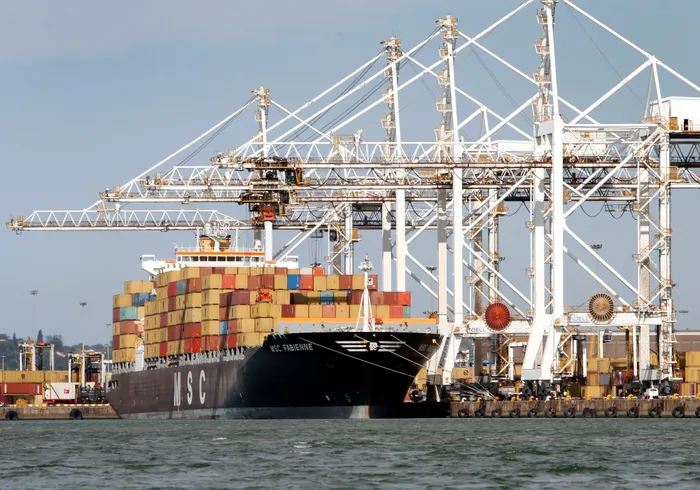
The latest container port index shows that Durban port is among the most improved in terms of vessel time in ports.
Image: Independent Newspapers Archives
The latest report ranking the performance of container ports around the world has found that Durban port is the most improved. The The World Bank 2025 Container Port Performance Index (CPPI) was released a few days ago, revealing that the Durban port has improved from its performance in 2024.
The Mercury reported last year on the 2024 report, which painted a troubling picture of the Port of Durban’s performance, ranking it as the 403rd busiest port globally and placing it among the worst performers in the world.
The report for the 2025 year, which is a product of the World Bank, lists Durban and Coega port in the Eastern Cape as having improved compared to their performance in the previous year.
This edition of the Container Port Performance Index (CPPI) marks the sixth consecutive year of publication. The CPPI was established to measure container port performance, focusing on vessel time in port as an objective and comparable indicator.
The report said this year’s edition is particularly timely, as global supply chains remain exposed to repeated shocks, including geopolitical tensions, climate-related disruptions, and continued volatility in shipping networks. “It is noted that this year’s report focuses explicitly on the mutual relationship between vessel time in port and supply chain stress, both globally and at the individual port level.
“In this context, the time vessels spend in port has become even more central to the functioning and resilience of international trade. Efficient ports are not only a source of competitiveness but also a key determinant of how well supply chains absorb and recover from disruptions,” it said.
The report stated that ports in Sub-Saharan Africa generally recorded longer vessel times in port, often linked to import-dominated trade structures, capacity constraints, and limited competition.
On Durban, it said, “Durban recorded a notable improvement in vessel turnaround time in 2025, despite continued volatility in global supply chain conditions. Reduced waiting times from 20 vessels to zero, compared to earlier peak-congestion years, point to gradual operational stabilisation and the initial impacts of equipment recovery and management reforms.
“This improvement coincided with a pronounced rise in berth utilisation, as the share of time spent at berth increased from about 52 percent in 2024 to around 76 percent in 2025, indicating a shift away from anchorage and pre-berth delay toward productive operations.
“The operational gains have been supported by new investments and increased private sector participation. “The most structurally significant development is the December 2025 awarding of a 25-year concession to ICTSI (International Container Terminal Services, Inc) to modernise Durban Container Terminal Pier 2, with capacity targeted to increase from 2 million to 2.8 million TEUs (Twenty-foot Equivalent Unit. It is the standard unit of measurement in global shipping used to calculate cargo capacity, vessel sizes, and port throughput.) from 2026. While absolute ship time in port remains long, the CPPI improvement signals recovery momentum,” it said.
Economist Dawie Roodt said the improvement was most welcome, “I’ve got a suspicion that Durban improved because of the private sector participation. The port's collapse and the railway's collapse were a major drag on the South African economy, so this is good news. Let’s keep this going and get more private sector participation.”
Dr Ntokozo Nzimande from the UKZN Macro-economics Research Unit stated that while the improvement must be celebrated, the port of Durban is still not where it should be. He noted that among the identifiable changes leading to the improvement are the decline in strikes and go-slows that often led to ships not being attended to while they were already in the port.
Additionally, there has been a decline in equipment breakdowns, which means that there is no delay in attending to a ship because of a breakdown, and no time is wasted waiting for new equipment to be brought in. “If you look at the report, yes, we are the most improved, but that is because we were among the worst in 2023. We are still performing poorly, but there has been some improvement. We should always applaud improvement, but we are still not at the level we want to be to compete in the global market. We are still seeing congestion; we are not better than what we were in 2021. We still have not achieved the level of performance we should be grateful for,” he said.
For more stories from The Mercury, click the link THE MERCURY