

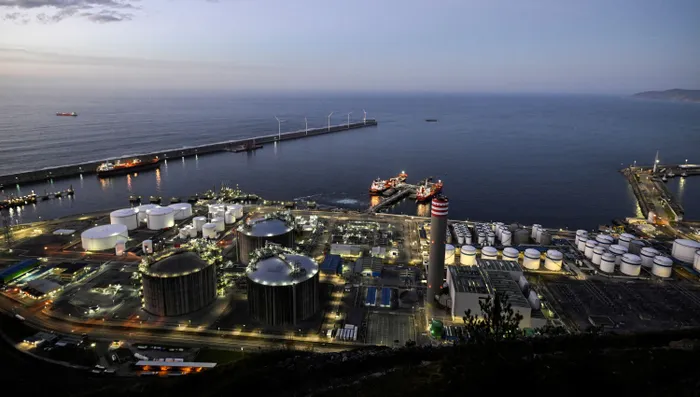
Global financial markets face renewed challenges as US-Iran tensions escalate, pushing Brent crude prices above $85 per barrel and raising concerns over the repo rate.
Image: Ander Gillenea / AFP
It seems it was more of the same on global financial markets last week. The war between the US and Iran in the Strait of Hormuz continues, and the chances of a renewed ceasefire are slim, driving Brent crude prices up by 12% to more than $85 per barrel on Friday.
The sudden disruption in oil supplies and the subsequent impact on financial markets have manifested in several ways.
With up to 20% of global oil and liquefied natural gas passing through the Strait, energy traders are highly alert. Global inventories are depleted, making the system incredibly sensitive to the resumption of the US blockade and Iranian attacks on shipping.
The geopolitical shockwave has heavily weighed on broader market indices and the tech sector, while energy related stocks have provided relative resilience. Major indices, including the Dow Jones, have experienced downward pressure and high volatility amid fears of wider economic fallout.
Middle Eastern equities have seen uneven reactions, with financial, real estate and consumer discretionary sectors in countries such as Qatar, the UAE and Egypt recording the largest declines. As the Strait remains heavily restricted, experts note that the global market has been slightly cushioned by producers rerouting shipments through pipelines in Saudi Arabia and the UAE to the Red Sea, although these alternative buffers are running thin.
South African financial markets, especially the rand, are under immense pressure.
The ongoing attacks between the US and Iran continue, with no peace talks or ceasefire prospects in sight. The US demands free, unimpeded global transit, while Tehran asserts its sovereign right to control routes and levy tolls on commercial vessels. These two points of dispute are wiping out the chances of a new agreement any time soon.
In reaction, the rand came under severe pressure last week.
The currency depreciated by 20 cents, from R16.32/$ the previous Friday to R16.52/$ at the close of the JSE last Friday. The currency also depreciated by 25 cents against the euro to R18.88/€ and by 32 cents against the UK pound to R22.19/£ over the week.
On the JSE, equity prices remained bearish, with big losses across all the various indices. The precious metals and minerals index, in particular, tumbled by 3.6% as the prices of gold, platinum and palladium remained under pressure.
The price of gold traded below $4 000 several times during the week.
The ALSI decreased by 0.7% but is now 18 885 points lower than the record level of 128 455 reached on Friday, 28 February, the day before the US, Israel and Iran attacks. This represents a decline of 14.70%.
The over recovery in the diesel price vanished quickly last week and, by Thursday, the diesel price had become under recovered by around 2 cents per litre, meaning that motorists can expect to pay more for diesel at the beginning of August. This was at a rand exchange rate of R16.34/$.
Given that the rand depreciated further to R16.50/$ and the oil price moved above $86 per barrel on Friday, the under recovery is expected to widen further this coming week. At one stage during the first week in July, the over recovery for diesel exceeded R5.00 per litre. Currently, the price of 95 ULP petrol is still over recovered by R1.02 per litre.
This coming week, the domestic financial markets await the release of South Africa's inflation rate for June 2026 on Wednesday.
Expectations are that the CPI increased to an annual rate of 4.7%, compared with the annual inflation rate of 4.5% in May 2026.
The Monetary Policy Committee will meet this week from Tuesday, with its interest rate decision to be announced on Thursday. Expectations are that the committee may decide to increase the repo rate by 25 basis points to 10.75%. Retail sales for May 2026 will also be announced by Stats SA on Wednesday.
Chris Harmse is the consulting economist at Sequoia Investment Solutions and a senior lecturer at STADIO Higher Education.

Chris Harmse is the consulting economist of Sequoia Capital Management and a senior lecturer at Stadio Higher Education.
Image: Supplied
Follow Business Report on Facebook, X and on LinkedIn for the latest Business and tech news.