

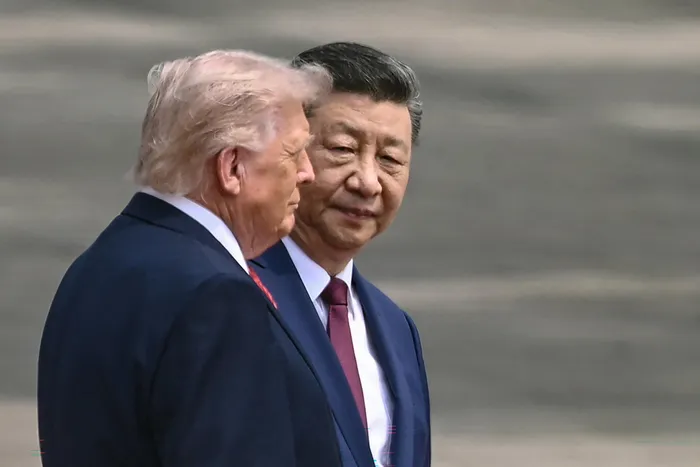
China's President Xi Jinping looks at US President Donald Trump during a welcome ceremony at the Great Hall of the People in Beijing on May 14.
Image: Brendan Smialowski / AFP
Financial markets across the globe got some bloody noses after a 'cold' meeting between the United States (US) President Donald Trump and the Chinese leader President Xi Jinping.
Trump went to China with big expectations, mostly that he himself created, from which a lot did not materialise.
Trump claimed he struck 'fantastic trade deals' - asserting that China agreed to buy 200 Boeing jets (not 500 as Trump had claimed), US oil, and agricultural products, but Chinese ministries sidestepped confirming specific contracts.
Boeing’s share price dropped by more than 4% on Friday.
After the public flattery between the two subsided, official White House and Beijing readouts revealed deep divides on critical global security items.
Top of the agenda was the Taiwan Warning. Xi drew the 'land in the sand' regarding claims over Taiwan, warning Trump that mishandling China's claims could trigger dangerous clashes and direct conflict.
From his side again Trump stated he has made no immediate commitment regarding a pending $14 billion US arms sale package to the island.
The ongoing war involving Iran heavily shadowed the summit.
The US claimed Xi expressed opposition to the militarisation or tolling of the Strait of Hormuz and pledged to withhold military equipment from Tehran.
However, Chinese state media omitted these specific commitments entirely from their readouts.
Tension flared behind the scenes, including an incident where a White House aide was knocked down by rushing media, and Chinese officials briefly refused to permit an armed Secret Service agent into a secure area at the Temple of Heaven.
These forward and backward issues between the two countries were not taken good by financial markets across the globe and almost all international share indices took a big hiding on Friday.
On Wall Street all three major indices pulled back sharply on Friday after a week of good performances.
In China, the Shanghai index on Friday lost 1.0% and the Hang Seng in Hong Kong traded by 1.7%.
In Japan, the Nikkei lost 2.0%. In Europe, the UK FTSE traded down by -1.6%, the German DAX by -2.10% and the French SAC by 1.64%.
On the JSE almost all indices not only took a big fall on Friday, but ended for the week, one of the worst movements since the 28 February 2026 US/Israel attack on Iran.
The ALSI traded on Friday, down by -2.40%, losing for the week -2.8%.
The Metals and Mining index on Friday tumbled by 7.0%, and experienced a decline of -9.9% for the week.
This was due to the sharp fall in the prices of Gold of -2.44%, down by -3.11% over the week.
The Platinum price followed suite, declining by -4.3% on Friday and by -3.4% the last five days.
This pushed the Resources 10 index down by -6,1 on Friday and by -6.7% for the week.
The oil price also contributed much to the pullback in share prices last week.
Brent oil, after a strong decline the previous week by $12 per barrel, shot up again by $8 per barrel last week.
The Rand exchange rate could not be spared by these uncertainties over the geopolitical factors around the world.
Against the USD dollar, the Rand depreciated last week by 29 cents from R16.39/$ to R16.68/$, as investors used the Dollar as a safe haven, especially on Friday.
Against the Pound, the Rand gained 10 cents last week to close at R22.21/£ and against the Euro the currency lost 7 cents to R19.37/€.
Despite the sharp increase in the Brent oil price last week, the stronger Rand/$ since the last fuel price determination by the Central Energy Fund on 30 April, and even a lower average oil price since then the price for diesel was over recovered R4.41 cents per liter by last Thursday 14 June.
However, the price of petrol was under recovered by 19 cents per liter.
The strong increase in the Brent oil price on Friday and the much weaker Rand may affect these recovered prices strongly this coming week and the outcome on fuel prices remain worrying.
Once again, the same tendency in financial markets since the Iran attack by the US will dominate the movements on global financial markets this coming week.
The sudden strong increase in the US inflation rate to 3.8% in April 2026, the highest since May 2023, and compared to 3.3% in March, is expected to be echoed in South Africa when STATS SA release the inflation rate on Wednesday.
It is expected that the annual CPI increased from 3.1% in March to 4.3% a month ago.
Chris Harmse is the consulting economist of Sequoia Capital Management and a senior lecturer at Stadio Higher Education.

Chris Harmse is the consulting economist of Sequoia Capital Management and a senior lecturer at Stadio Higher Education.
Image: Supplied
Follow Business Report on Facebook, X and on LinkedIn for the latest Business and tech news.