

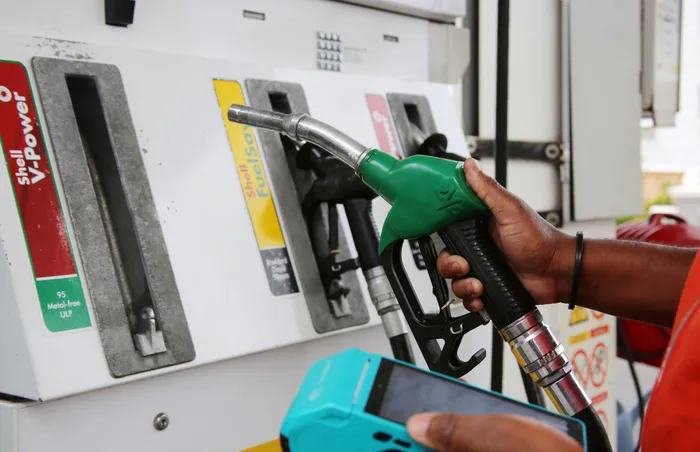
As the Iranian conflict escalates, global fuel prices surge. Will the recent ceasefire signal a return to stability, or are we facing further economic turmoil?
Image: Tumi Pakkies / Independent Newspapers
The author argued in the market report during the beginning of March 2026 that the Iranian conflict not only intensified, but the embargo on oil tankers also moving through the Strait of Hormuz had led to the fourth black swan movement over the last five years after the sudden attack of US and Israel on Iran on the Saturday, 28 February 2026.
A black swan event is an unpredictable, rare occurrence with a severe, widespread impact that is often wrongly rationalised in hindsight as having been foreseeable.
As a result, over the last seven weeks the world experienced a very sharp increase in oil prices of around 70%, the loss of lives and the destruction of billions in infrastructure.
Not only did equity markets over the globe suffer a massive pullback, economists and the IMF forecasted that the global economy may move into a recession over the next two quarters with inflation rates in most countries to accelerate beyond levels where central banks would have no other choice than to increase their lending rates.
South Africa followed suit as the Rand exchange rate depreciated strongly from $15.95/$ to as high as R17.18/$ during the first month of the Iranian conflict on 30 Marh 2026.
The ALSI on the JSE lost 17 883 points or14.0% from its record level of 128 455 within the first 20 days. falling as low as 1.4%.
The petrol price over the same period was under-recovered by more than R6.00 per litre and diesel more than R10 per litre.
The government had to lower the fuel levy by R3.00 per litre to help motorists at the beginning of April.
The Reserve Bank’s Monetary Policy Committee at their meeting in March warned that interest rates may increase in months to come against the previous expectations of possible two cuts of 25 basis points each in 2026. The MPC indicated that the inflation rate may jump quickly from 3.0% in January to 5.0% if the conflict continues.
The dramatic turnaround: The ALSI is now 4.7% higher for the year
Since the announcement of a ceasefire between the US and Iran on 6 April (how vulnerable it may seem) markets and economic prospects started to recover quickly.
This was emphasised on Friday after the announcement by the Minister for Foreign Affairs of Iran, Abbas Araghchi, that the Strait of Hormuz is "completely open" in line with the ceasefire in Lebanon.
On the JSE share prices recovered sharply after the beginning of the siege fire on 6 April.
At the close on Friday the ALSI gained 9 472 points or 9.5%, from its lowest point in March to close on 121 249.
This is 4.7% up for the year to date. Precious metals prices also recovered sharply.
The gold price improved by $454 or 10.4% from its level of $4 380 at the end of March to $4 834 on Friday.
The platinum price recovered by 17.8% over the last three weeks.
The Precious metals and mining index jumped by 23.7% since 23 March 2026.
The Rand exchange rate appreciated stronger over the last month from levels around R17.18/$ to as low as R16.16/$ in intra-day trade on Friday, but close in New York on R16.30/$ on Friday evening.
This is now only 32 cents per dollar higher than the R15/98/$ at the end of February 2026 when the Iran attacks started.
Given the free movement of oil tankers in the Middle east again the oil price came down sharply last week, especially on Friday to levels of under $90 per barrel.
It is still noticeable higher than the $70 per barrel for brent oil the day when the US-Iran conflict started, but it is expected that prices may recovered in weeks to come.
These events, together with the continuous appreciation of the Rand led to a dramatical decline in the under-recovering in fuel prices since 27 March when the Minister of Energy Affairs set the last fuel prices.
The price of petrol was under-recovered by R7.56 per litre at the end of March and that for diesel by R17.56 per litre. This change dramatically to R2.63 for petrol and R8.06 for diesel by Thursday.
Given the sharp decrease in the oil price and the much stronger Rand on Friday, it is expected that motorists may experience only a marginal increase if at all in fuel prices at the beginning of May.
This coming week financial markets will nervously look at the ceasefire between the US and Iran and between Israel and Lebanon.
On the economic front, the US will release its retail sales for March on Tuesday and will reflect some effects of the higher fuel prices.
The UK is releasing its inflation rate for March on Wednesday.
Domestically everyone awaits the announcement by Statistics South Africa (Stats SA) on Wednesday of South Africa’s inflation rate for March.
It is expected that the CPI had increased to 4.1% over a year ago.
This is a strong increase from the 3.0% recorded in February 2026 and outside the upper level of 4.0% announced as the new target for the country.
It is expected that the stronger Rand and possible lower fuel prices during the next few months that the inflation rate may stabilize at levels lower than 4.0% and may avoid any increases in the repo rate.
Chris Harmse is the consulting economist of Sequoia Capital Management and a senior lecturer at Stadio Higher Education.

Chris Harmse is the consulting economist of Sequoia Capital Management and a senior lecturer at Stadio Higher Education.
Image: Supplied
Follow Business Report on Facebook, X and on LinkedIn for the latest Business and tech news.