

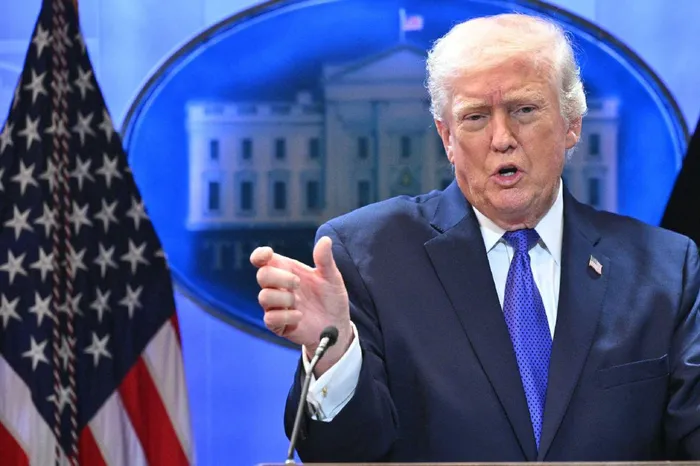
US President Donald Trump. With a fragile US-Iran truce in place, the stakes for global markets and the South African economy rise dramatically. Will the diplomats secure peace, or will violence escalate anew?
Image: Mandel Ngan / AFP
On 7 April, a tenuous ceasefire was announced by US President Donald Trump in a bid to halt 40 days of escalating military action between the US, Israel, and Iran.
Hours before an impending deadline, Trump paused military strikes to allow Iran to restructure its engagement through the vital Strait of Hormuz.
Mediated by Pakistani Prime Minister Shehbaz Sharif and Army Chief General Asim Munir, the ceasefire, while boosting oil and equity markets, is already showing signs of strain.
Central to the negotiations is Iran's 10-point proposal, which outlines stringent demands including a US commitment to non-aggression, full reparations for war damages, and an end to all sanctions.
“This is a workable basis on which to negotiate,” Trump remarked, although he clarified that only a condensed form of the proposal constituted the basis for talks slated to commence on 10 April in Islamabad.
However, within hours of the ceasefire's initiation, accusations of violation resounded across the region.
Iranian Parliamentary Speaker Mohammad Bagher Ghalibaf claimed Israeli military activities in Lebanon breached agreement conditions, while Iran-aligned forces retaliated with drone strikes across multiple Gulf states.
Despite reports of a ceasefire holding, both sides are entrapped in a web of accusations and counteractions that threaten the fragile peace.
There's a pressing case for a deal; rising petrol prices in the US coupled with an impending midterm election loom large for Trump, while Tehran seeks relief from the substantial infrastructure damage inflicted during the hostilities.
Both parties have framed the ceasefire as a tactical victory, with Iranian leaders hailing it as a defeat for Washington and Trump terming it a total victory.
Yet, hurdles abound.
Uranium enrichment remains a significant sticking point.
While the US remains firm that no enrichment will be permitted, Iran categorically insists on its right to enrich uranium.
Further complicating matters, Lebanon's situation injects another layer of tension; an Israeli military campaign is perceived by Iran as a potential deal-breaker.
For financial markets, the implications are significant. Brent crude oil prices initially plummeted by over 13% following the ceasefire announcement, with the Dow Jones Industrial Average climbing more than 1,300 points, achieving its best trading session in a year. However, since exchanges have opened again amid renewed tensions, oil prices have rebounded slightly to $97.71 per barrel.
As geopolitical uncertainty persists, the global economy teeters precariously on the ceasefire's durability.
The backlog of oil in the Gulf continues to build, and escalation of hostilities could send prices soaring back above $110 per barrel, which may spur further inflationary pressures worldwide. Market reactions will be closely monitored, especially in South Africa, where economic vulnerability coincides with oil price fluctuations impacting fuel and import costs.
Bianca Botes, Managing Director at Citadel Global, highlighted that even a phased deal could spur South African economic recovery.
“If a deal materialises, a gradual return to pre-war oil price levels could alleviate domestic pressures and bolster local economic stability,” she noted.
As tense talks commence, the world watches with bated breath.
The next two weeks will be a defining period for the region's prospects and the broader international economic landscape, with the ceasefire serving as a critical barometer of both peace and potential upheaval.
Follow Business Report on Facebook, X and on LinkedIn for the latest Business and tech news.