

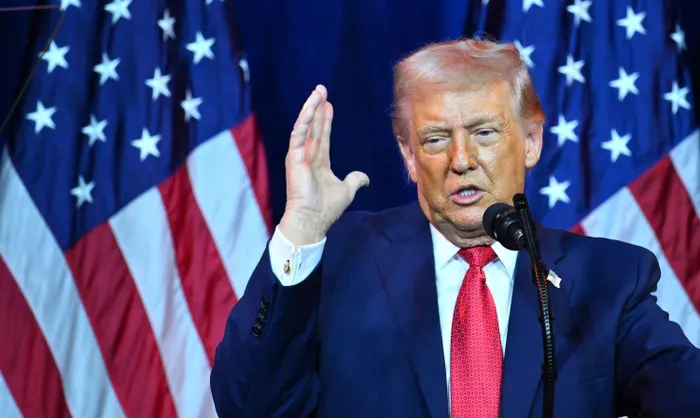
US President Donald Trump As global markets react to shifting tides, investors are left wondering whether the current relief is merely a temporary illusion or the start of a more stable phase in energy and equity markets following the US-Iran ceasefire.
Image: Mandel Ngan / AFP
A significant relief rally has gripped global markets following President Donald Trump’s suspension of military action against Iran, a move that has alleviated immediate fears concerning oil supply disruptions through the strategic Strait of Hormuz.
However, according to Nigel Green, CEO of the deVere Group, oil prices are expected to remain structurally high despite this temporary reprieve.
In the wake of the announcement, US stock futures surged dramatically, with the Dow Jones Industrial Average experiencing sharp increases.
The S&P 500 and Nasdaq 100 both reported gains exceeding 2%, signalling a vigorous rebound in investor risk appetite. This bullish shift in equities comes in direct response to diminishing geopolitical tensions that had previously driven oil prices skyward amid supply fears.
"Markets have been primed for this moment," Green said, observing that investor positioning had turned defensive and market volatility had reached significant levels. The anticipation of a prolonged blockade greatly heightened energy prices, compelling traders to react quickly as the immediate risk began to lift.
The relief rally, according to Green, reflects a pent-up demand for risk assets.
“Investors were bracing for a situation that could have potentially choked off a fifth of global oil supply,” he explained. “With a portion of that threat now alleviated, capital is quickly flowing back into equities.”
Before this announcement, equity markets had already shown signs of stability despite ongoing tensions. This latest development underscores that investors are highly attuned to geopolitical signals and are prepared to shift rapidly as narratives evolve.
Green suggested that technology stocks are likely to lead the rebound, primarily because they were hit hardest by rising yields and risk aversion.
Lower energy prices can help reduce inflation expectations, which in turn boosts valuations for tech companies.
Additionally, consumer discretionary sectors, including airlines, travel, and retail, are poised to benefit significantly from lower fuel costs and improved market sentiment.
On the financial front, banks are expected to partake in the upswing as market stability typically fosters deal activity and risk-taking, essential components for bank profitability.
"Banks perform better in environments where uncertainty declines," Green added.
In contrast, energy stocks face a more complicated outlook. Although crude prices have pulled back, the fundamental backdrop remains tenuous. “A two-week pause does not remediate supply constraints or geopolitical fragmentation,” Green cautioned, indicating that the geopolitical premium on oil is likely to remain palpable.
However, central to the market’s future trajectory is the credibility of Trump’s two-week window of suspension.
“Investors have seen similar timelines in the past. A short-term pause can lead to relief, but it simultaneously introduces a countdown,” Green warned.
Market participants will need to closely monitor compliance with ceasefire terms and any diplomatic signals regarding shipping routes through the Strait of Hormuz.
If tangible progress towards a more enduring agreement is made, the current rally could broaden and extend.
“Industrial stocks, emerging markets, and cyclicals would then have the opportunity to catch up,” Green added. Conversely, a failure to move towards a more comprehensive framework could see volatility return, pushing oil prices up once again and erasing gains in equity markets.
As the dust settles on this short-lived pause, investors are left walking a fine line between opportunity and caution.
“This is a powerful rebound driven by the removal of immediate fear, yet the underlying challenges remain unresolved,” concludes Green, positioning investors to seize potential upside while remaining acutely aware of the delicate geopolitical landscape.
“Investors were bracing for a situation that could have potentially choked off a fifth of global oil supply,” he explained.
“With a portion of that threat now alleviated, capital is quickly flowing back into equities.”
Before this announcement, equity markets had already shown signs of stability despite ongoing tensions. This latest development underscores that investors are highly attuned to geopolitical signals and are prepared to shift rapidly as narratives evolve.
Green suggested that technology stocks are likely to lead the rebound, primarily because they were hit hardest by rising yields and risk aversion.
Lower energy prices can help reduce inflation expectations, which in turn boosts valuations for tech companies.
Additionally, consumer discretionary sectors, including airlines, travel, and retail, are poised to benefit significantly from lower fuel costs and improved market sentiment.
On the financial front, banks are expected to partake in the upswing as market stability typically fosters deal activity and risk-taking, essential components for bank profitability.
"Banks perform better in environments where uncertainty declines," Green added.
In contrast, energy stocks face a more complicated outlook. Although crude prices have pulled back, the fundamental backdrop remains tenuous.
“A two-week pause does not remediate supply constraints or geopolitical fragmentation,” Green cautioned, indicating that the geopolitical premium on oil is likely to remain palpable.
However, central to the market’s future trajectory is the credibility of Trump’s two-week window of suspension. “Investors have seen similar timelines in the past. A short-term pause can lead to relief, but it simultaneously introduces a countdown,” Green warned. Market participants will need to closely monitor compliance with ceasefire terms and any diplomatic signals regarding shipping routes through the Strait of Hormuz.
If tangible progress towards a more enduring agreement is made, the current rally could broaden and extend.
“Industrial stocks, emerging markets, and cyclicals would then have the opportunity to catch up,” Green added. Conversely, a failure to move towards a more comprehensive framework could see volatility return, pushing oil prices up once again and erasing gains in equity markets.
As the dust settles on this short-lived pause, investors are left walking a fine line between opportunity and caution.
“This is a powerful rebound driven by the removal of immediate fear, yet the underlying challenges remain unresolved,” concludes Green, positioning investors to seize potential upside while remaining acutely aware of the delicate geopolitical landscape.
Follow Business Report on Facebook, X and on LinkedIn for the latest Business and tech news.