

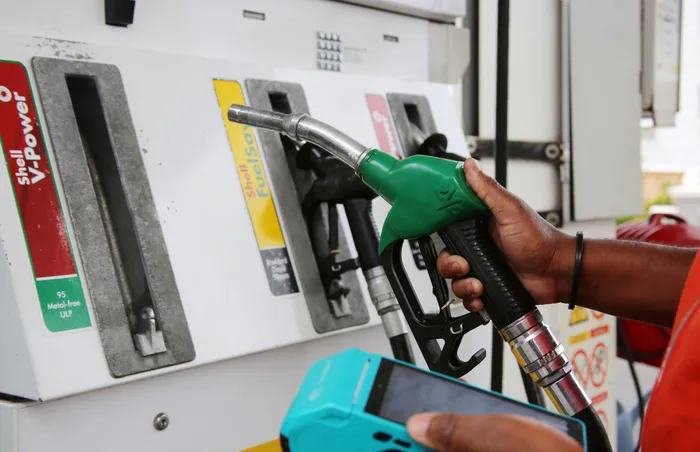
March saw a dramatic decline in global financial markets, with indices plummeting over 10% following geopolitical tensions. As fuel prices soar, the economic outlook remains uncertain, leaving investors questioning the future.
Image: Tumi Pakkies / Independent Newspapers
Financial markets across the globe had a devastating month with share indices falling in most cases with more than 10.0% during the first week in March, after the first attack on Iran by US/ Israel forces on 28 February 2026.
The world MSCI index lost 8.6% up to 30 March, after starting to recover with 3.7% up to last Friday 2 April 2026.
On the JSE the same trend was playing out last month.
The ALSI, after reaching a record high level of 128 655 on 27 February 2026, share prices tumbled by 14.0% during the first three weeks in March in reaction on the sharp increase in the oil price by $48 per barrel (pb) from $70pb to $118pb, while the Rand exchange rate depreciated from R15.94/$ to R17.18/$ on 30 March 2026.
Since 20 March 2026, the ALSI started to recover as the index grew by more than 4.0% at the close last Friday on 116 123, or 9.6% from its level at the end of February.
At the same time the Rand exchange rate recovered to levels lower than R17.00/$ to R16.83/$ last Thursday but closed again higher on R16.99/$ on Saturday, as President Trump’s claims on negotiating a peace treaty with Iran, ending the war seems to be a fallacy.
Given the sharp increase in the Brent oil price and the sharp depreciation in the Rand/$ exchange rate, the price for petrol was under recovered by R7.88 per liter and that of diesel by R17.48 per liter.
The Minister of Energy affairs, however, made an announcement on the change in fuel prices from 1 April 2026 based on the under recovery in on 25 March. At that stage, the under recovery on petrol was R5,76 per liter and that of diesel (0.05%) R9.86 per liter.
The Minister, however, decided not to increase the fuel levy by 5 cents per liter for petrol and 6 cents per liter for diesel, but rather to decrease the fuel levy by 300 cents for both diesel and petrol on 1 April.
This meant that the price of petrol increased by only R3.06 per liter and the prescribed increased by 0.05% diesel by R7.37 per liter.
Note that the prices for all diesel formats are not fixed but also prescribed, and at some petrol stations in the country owners had taken some changes and lifted diesel prices by more than R10 per liter.
If the reduction of R3 per liter in the fuel levy will continue over the next months will be a question going on over the next few months.
On Friday 2 April 2026, the prices for fuel since the previous setting of the prices from 1 April were already under recovered by R5.55 for petrol and R14.08 for 0.05% diesel.
This dire strait situation will place pressure on especially diesel as garage owners will tend to increase their prices during April by more than the prescribed price increase of R7.37 per liter.
This devastating situation will continue if the oil price, which closed on Friday at $109.3 per liter and the Rand exchange rate, which tends to move again above R17.00/$ continues.
This coming week financial markets will keep an eye on the events of the ongoing conflict in the Middle East.
Although major indices posted weekly gains for the first time in six weeks, even though the Iran war persists, the question remains if this is just an oversold technical bounce, or the start of a more sustained recovery?
Uncertainty remains high. Investors still are left with several unanswered questions:
How long will the war last? Will oil prices surge further and for how long? Will the deadline of 6 April that was set by President Trump be met by Iran to prevent the U.S. attack Iran's energy infrastructure.
Will the U.S. send in ground forces? and, what will be the net effect to global economic growth and corporate earnings growth?
The world hopes for a peaceful solution soon with minimal loss of human life and limited damage to the global economy. Until then stock market and headline volatility will continue.
Chris Harmse is the consulting economist of Sequoia Capital Management and a senior lecturer at Stadio Higher Education.

Chris Harmse is the consulting economist of Sequoia Capital Management and a senior lecturer at Stadio Higher Education.
Image: Supplied
Follow Business Report on Facebook, X and on LinkedIn for the latest Business and tech news.