

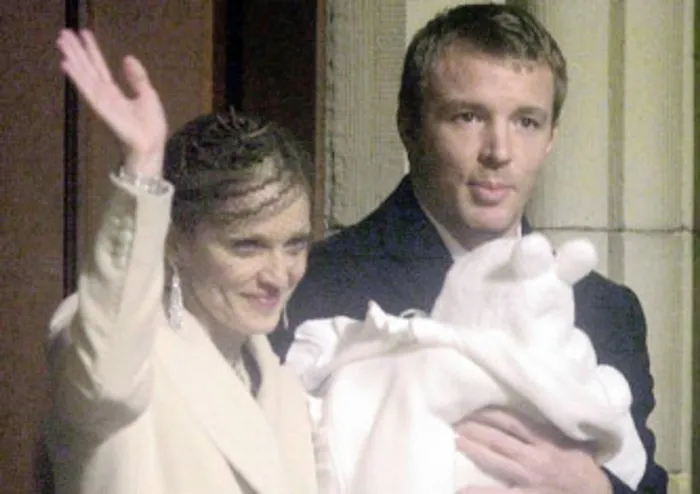
Pop singer Madonna was 41 when she and husband Guy Ritchie, now her ex, had their son Rocco. Pop singer Madonna was 41 when she and husband Guy Ritchie, now her ex, had their son Rocco.
Growing evidence that France’s First Lady, Carla Bruni, is pregnant makes her the latest in a long list of older celebrity moms.
Former supermodel Bruni, 43, joins famous faces including Madonna, who had her last child at 41, Cherie Blair, who had son Leo at 45, and Jo Brand, who gave birth to daughters at 43 and 45.
Putting off pregnancy seems to be a growing trend – births to women in their forties have soared by 90 percent and by 56 percent among over-35s in the past decade.
But having children later in life doesn’t come without its dangers, for both mother and baby alike, which can include high blood pressure and birth defects.
Bruni and her husband, President Nicolas Sarkozy, have remained tight-lipped about the pregnancy so far (it’s only been confirmed by relatives), so it’s not known whether she conceived the old-fashioned way or had fertility treatment.
But if it is a natural conception, medical evidence suggests that Bruni is lucky, because fertility drops dramatically after 35. By 40, women are half as fertile as they were at 35, according to the Human Fertilisation and Embryology Authority.
Author Claudia Spahr is one of the growing number of women who have defied the odds. She had her first baby at 40, and is now six months pregnant with her second child, which is due just before she turns 43.
Spahr has just written the book Right Time Baby, a guide to later motherhood in which she controversially insists that there is “no clear data proving that it’s harder to get pregnant when you’re older, even though most doctors will relay it as fact”.
Consultant obstetrician Dr Virginia Beckett is one such doctor, and she says the evidence for fertility declining with age is “indisputable”.
But Spahr counters: “Women haven’t been actively trying to get pregnant in their forties before – it’s quite a new phenomenon, and no proper studies have been done. It’s a very individual thing.”
She did a small survey for the book of 60 mothers aged between 35 and 50, asking them how quickly they got pregnant.
The results showed that 65 percent got pregnant faster than three months, and it took just 15 percent longer than eight months to conceive.
“That just goes to show that it can be easy,” she asserts.
However, Beckett, who’s based at Bradford Royal Infirmary, says that while some older women may get pregnant quickly, fertility certainly does decline dramatically with age for most women.
Beckett runs an IVF unit, and illustrates the drop in fertility with the fact that the chances of a woman in her twenties conceiving through IVF are 40 percent a cycle, but a woman in her forties has just a 10 percent chance, dropping to about three percent by the age of 43.
She says tests can assess a woman’s fertility, but warns: “My clinics are full of people who thought that they had time, and they didn’t.”
Ideally, the best time for getting pregnant is before the age of 35, she says.
This is because as well as it being more difficult for older women to conceive, later pregnancy also brings increased risk of complications.
These include high blood pressure, gestational diabetes, premature labour and bleeding disorders such as placental abruption (when the placenta detaches from the uterus).
Beckett points out that when a woman gets to her forties, “things are starting to wear out”.
This includes the pancreas, which means there’s an increased risk of diabetes in pregnancy, and blood vessels, which increase the risk of blood pressure problems and blood clots.
As well as potential maternal complications, pregnancy later in life brings an increased risk of foetal abnormalities, particularly chromosomal problems like Down syndrome.
Although about one in a thousand babies born to mothers under 30 have Down syndrome, the figure rises to one in 400 by the age of 35 and one in 105 by the age of 40.
Down syndrome pregnancies rose by more than 70 percent in the 20 years to 2008, seemingly driven by the trend among women of later motherhood.
But Spahr insists there’s plenty that prospective older mothers can do to improve the quality of their eggs, and thus reduce the risk of chromosomal abnormalities, or miscarriage, which is also a much higher risk for older mothers. She suggests a fruit and veg juice detox a few months before trying to conceive, to cleanse the body of accumulated toxins.
When not fasting, she recommends organic foods, including plenty of fruit and vegetables eaten raw, when possible, and lots of water, plus foods containing essential fatty acids, omega-rich oils and antioxidants. In addition, she says it’s important to exercise, and cut back on processed foods and caffeine.
Women and men who want to conceive should greatly reduce their alcohol intake and quit smoking. A good diet can help reduce problems like spina bifida, if folic acid supplements are taken.
Conversely, Beckett says there’s no evidence to show that improving diet and lifestyle makes a huge difference to the quality of a woman’s eggs, although smoking does irreversibly affect ovarian ageing. – Belfast Telegraph
Older celebrity mums
Singer Mariah Carey gave birth to twins this year at the age of 41.
Actress Nicole Kidman had a daughter in 2008 when she was 41.
Actress Geena Davis gave birth to twins in 2004 at the age of 47.
Jerry Hall, former wife of Rolling Stone Mick Jagger, gave birth to the youngest of their four children when she was 41. - Weekend Argus