

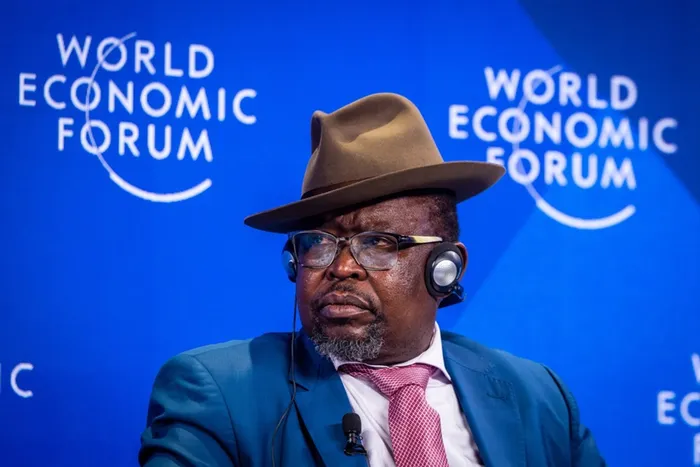
Finance Minister Enoch Godongwana at the World Economic Forum in Davos.
Image: World Economic Forum
THE World Economic Forum has signed agreements to establish five new Centres for the Fourth Industrial Revolution, expanding its global network focused on emerging technologies and technology governance.
The new centres will be located in France, the United Kingdom, the United Arab Emirates and India, and will focus on artificial intelligence, frontier technologies, the energy transition and cyber resilience.
The Forum said the centres will work with governments, researchers and industry partners to develop policy frameworks, pilot projects and regional initiatives linked to the development and deployment of new technologies.
The announcement was made during the Forum’s Annual Meeting in Davos-Klosters.
“The launch of five new Centres for the Fourth Industrial Revolution reflects the value of bringing governments, industry and experts together around shared technology challenges,” said Børge Brende, President and CEO of the World Economic Forum.
Paris: European centre for AI excellence
In France, the European Centre for AI Excellence will be launched in Paris in partnership with VivaTech. It will form part of the Forum’s Fourth Industrial Revolution Network and will focus on responsible AI innovation and adoption across Europe.
The centre will support projects aimed at strengthening the regional AI ecosystem and advancing AI development and deployment across sectors.
Maurice Lévy, chairman of the European Centre for AI Excellence and co-president of VivaTech, said the centre would promote “sovereign, trustworthy AI” and support Europe’s technological competitiveness.
London: Centre for AI-driven innovation
In the United Kingdom, the Centre for AI-Driven Innovation will be hosted by Imperial College London.
According to the Forum, the centre will focus on the development and adoption of AI across key UK sectors, and on the convergence of AI with frontier technologies including quantum computing, biotechnology and generative AI.
Professor Hugh Brady, president of Imperial College London, said the centre would bring together academic, industry and government partners to support the responsible adoption of AI.
Abu Dhabi: frontier technologies and intelligent future centres
Two centres will be established in Abu Dhabi.
The Centre for Frontier Technologies, hosted by the Technology Innovation Institute, will focus on quantum technologies, robotics and space, and on public-private collaboration around frontier technology development and deployment.
Dr Najwa Aaraj, chief executive of the Technology Innovation Institute, said the centre would support the translation of frontier research into real-world applications.
The second, the Centre for Intelligent Future, will be hosted by the Mohamed bin Zayed University of Artificial Intelligence (MBZUAI). It will focus on strengthening AI research, infrastructure, adoption and innovation, and convening leaders from government, business, civil society and academia around cross-sector initiatives.
Eric Xing, president of MBZUAI, said the centre would connect frontier AI research to economic and social challenges.
Andhra Pradesh: Centre for energy and cyber resilience
In India, the Centre for Energy and Cyber Resilience will be established in Andhra Pradesh in partnership with the state government.
The centre will focus on innovation linked to the energy transition, cyber resilience, and workforce development. It will develop pilot projects and consultations aimed at green energy systems and cybersecurity strategies.
“This partnership with the World Economic Forum echoes our commitment to building capacity where the world is most fragile: energy security, cyber resilience, trusted digital systems and talent at scale,” said N. Chandrababu Naidu, Chief Minister of Andhra Pradesh.
Expanding the global network
The new centres will become part of the Forum’s Fourth Industrial Revolution Network, launched in 2017 to support collaboration between governments and the private sector on emerging technologies.
The network includes centres across Europe, the Middle East, Asia and the Americas, including in South Africa, the United States, Germany, Saudi Arabia, Rwanda, Ukraine and Viet Nam.
The Forum said the expansion is intended to strengthen international cooperation around technology policy and the responsible development and deployment of emerging technologies.
The announcement coincides with the World Economic Forum’s 56th Annual Meeting, taking place from 19 to 23 January 2026 in Davos-Klosters.