

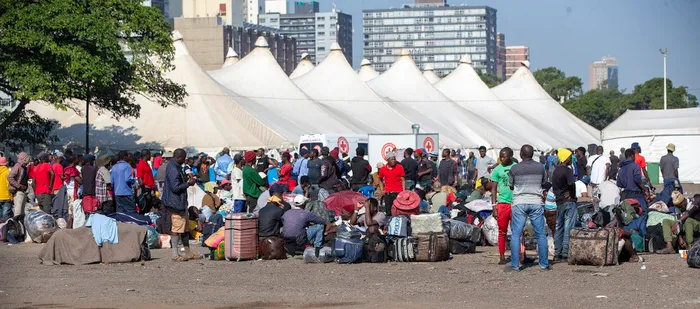
Thousands of Malawian nationals are currently displaced across KwaZulu-Natal, after fleeing targeted anti-immigration threats, protests, and localized violence. As of June 2026, the crisis has escalated into a major humanitarian emergency centered around the cities of Durban and Pietermaritzburg.
Image: Leon Lestrade
TENSION is rising ahead of June 30 following a warning by civil society group March and March that undocumented foreign nationals should leave South Africa by the deadline, setting the stage for a politically charged week marked by competing claims, legal action and heightened security.
While the government insists there is no shutdown planned and that Tuesday will be a normal working day, security agencies have been placed on high alert amid fears of possible unrest.
President Cyril Ramaphosa has reiterated that all people within South Africa must be in the country lawfully, saying government is intensifying enforcement of immigration, labour and related laws.
“We have made it clear that every person within our borders must be here lawfully,” he said, adding that authorities were strengthening deportation efforts and border management systems.
At the same time, he warned that migration must be managed in a way that avoids intolerance, saying there is “no place for racism, sexism, xenophobia, Afrophobia or any other form of intolerance”.
Months of protests and mobilisation linked to immigration enforcement have already seen foreign nationals displaced from some communities, children withdrawn from schools, and repatriation efforts stepped up across parts of the country.
In Durban, thousands of mainly Malawian nationals have gathered in various parts of the city, using temporary shelters as they prepare to return home. While government has been assisting repatriation efforts, countries including Nigeria and Ghana have also reportedly chartered flights to assist citizens wishing to return.
Labour federation Cosatu has warned that Tuesday remains a normal working day and that any participation in protest action would be unprotected, with workers risking dismissal and loss of income.
Cosatu spokesperson Matthew Parks said workers should ignore calls to stay away from work. “They must ignore this thing. This is a bunch of vigilante hooligans,” he said. “It’s an unprotected march. Workers risk their jobs and their salaries. Our unions are completely against it and we don’t support it.”
Acting Police Minister Firoz Cachalia has confirmed that R600 million has been redirected to bolster security operations ahead of the planned demonstrations, with police and private security structures on standby nationwide.
In eThekwini, authorities have moved to reassure residents that “comprehensive” safety and security measures are in place, urging the public to remain calm and continue with daily activities.
The Durban Metro Police Service said it is working with SAPS and other agencies to maintain a visible presence across townships, business districts, major transport routes and other strategic areas.
Legal pressure has also escalated, with civil society lawyer Zehir Omar confirming that an urgent court application will be filed on Monday seeking to compel government and police to act to prevent violence against foreign nationals.
Omar, acting on behalf of The Society for the Protection of our Constitution, said that a letter of demand had already been sent to the president, the minister of police and the Minister of Home Affairs.
The letter argues that the Constitution obliges the state to protect “everyone” in South Africa, including those who were not citizens of the country, and that recent incidents demonstrated the government's failure to prevent harm in some communities.
More than 8 200 foreign nationals have been processed for repatriation through the Beitbridge Port of Entry in less than two weeks, according to the Border Management Authority, amid rising tension ahead of the planned mobilisation.
The authority says the process has been conducted in co-ordination with embassies to verify identity and documentation, though pressure increased when buses arrived without required travel certificates and had to be redirected to ease congestion.
Justice Minister Mmamoloko Kubayi, who chairs the Inter-Ministerial Committee on Migration, has appealed for calm, saying migration management is a shared responsibility but enforcement remains the duty of the state.
She confirmed that 89 public order and incitement-related cases have been opened, with 164 arrests made, while authorities continue to monitor developments nationwide.
The South African National Taxi Council (SANTACO) has backed law enforcement efforts but warned that any disruption to transport systems could have wider economic consequences.
KwaZulu-Natal Premier Thamsanqa Ntuli has urged a balanced approach to migration, calling for enforcement of laws alongside respect for human dignity and constitutional protections.
Meanwhile, March and March leader Jacinta Ngobese-Zuma has insisted government, not civil society, should bear responsibility for any unrest linked to the planned protests.
“If anyone must shoulder responsibility for the planned June 30th protests, it’s the government. We cannot be expected to shoulder the blame for what is happening in the country,” she said.
Provincial police structures, including Gauteng’s joint operations command, say they are prepared for any eventuality, warning that enforcement action will extend to those found harbouring or employing undocumented foreign nationals unlawfully.
Across affected communities, uncertainty has deepened in recent days, with migrant families reporting anxiety and some choosing to relocate temporarily as they await developments. Community organisations say the atmosphere has been shaped by circulating messages and public mobilisation linked to the planned date. Late yesterday eThekwini Municipality said it is increasingly concerned about the continued arrival of foreign nationals at the Durban Drive-In site from outside the metro area. It says the voluntary repatriation programme is being placed under strain as people are transported from other municipalities, towns and provinces. Officials say the facility was never intended to function as a provincial reception or accommodation centre.
“The Durban Drive-In site is not a provincial reception centre, transit facility or accommodation site for foreign nationals from elsewhere in South Africa,” the municipality said.
Authorities maintain that immigration enforcement remains the responsibility of the state and warn against any form of vigilante action, saying any attempts to block services, intimidate individuals or incite violence will be treated as criminal offences.
Officials have also sought to separate lawful enforcement from protest mobilisation, arguing that ongoing operations against undocumented migration are part of routine state activity. However, increased security spending and inter-agency co-ordination have reinforced perceptions of a country preparing for a volatile week rather than an ordinary working day.