

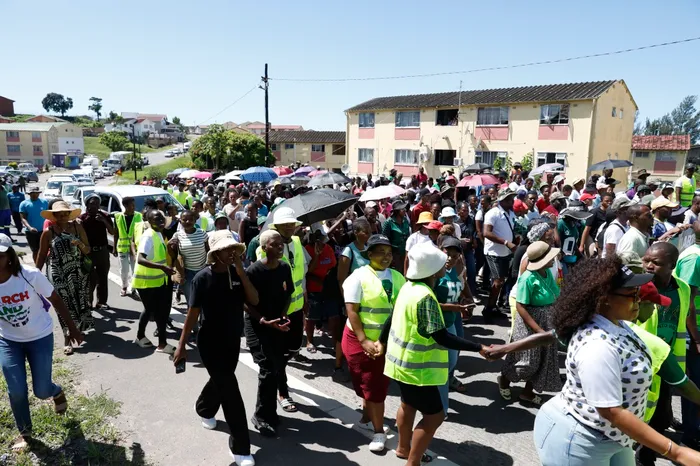
MK members and supporters confront businesses in Chatsworth which employ foreigners.
Image: Doctor Ngcobo /Independent Newspapers
ORGANISED business has called on the government to take decisive action to contain rising tensions and public debate over migration in South Africa, warning that the instability was starting to show economic and social risks.
In a joint statement, Business Unity South Africa (BUSA) and Business Leadership South Africa (BLSA) said they were “concerned” about escalating public discourse on immigration, urging “strong, steady leadership” to ensure that legitimate community concerns are addressed within the rule of law.
“At a time of heightened economic pressures, unemployment, high crime levels and social challenges, it is understandable that citizens seek solutions regarding economic inclusion, service delivery, border management and the rule of law,” the organisations said.
They added that these concerns must be addressed through lawful and constructive policy interventions, and called on the government to “take charge” of the situation.
The statement comes amid reports of rising anger in some communities, where foreign nationals have been told to leave by 30 June or face the consequences. Fears of countrywide riots and violence have already circulated on social media.
Last week at least 300 citizens of Ghana were repatriated by their government and more are expected to follow.
Nigeria is reportedly also planning to fetch 1 000 of its nationals from South Africa as the anti-migrant protests escalate.
Protesters led by various groups like March and March, and with the support of some politicians, have disrupted business activities or even “hijacked” businesses belonging to foreigners, like barber shops and salons, making it their own
Many foreigners, mainly in KwaZulu-Natal, have fled their homes, abandoned their businesses and stayed away from work and school out of fear and intimidation. Local organisations assisting the foreigners say in many instances the police have witnessed acts of intimidation against them but failed to step in.
South Africans have accused foreign nationals of competing for jobs and economic opportunities, and fuelling tension in already strained communities.
BUSA and BLSA stressed that migration pressures are not unique to South Africa, but a global governance challenge shaped by competing demands of labour mobility, economic integration, and national resource constraints.
They noted that South African companies operate across the continent, while African and international firms also operate within South Africa, employing thousands of local workers.
“South Africa benefits enormously from legal investments as well as genuine entrepreneurship, skills, and talents from other African countries.”
“When individuals target foreign nationals, they directly harm South Africa’s economic interests,” the statement said.
The organisations warned that hostility could disrupt corporate operations, strain diplomatic relations, and place cross-border trade corridors and personnel at risk.
While welcoming recent commitments by President Cyril Ramaphosa, organised business called for swift action to restore confidence and ensure the rule of law is enforced consistently.
The business organisations emphasised that managing migration is a legitimate policy priority but must be handled through legal frameworks. Violence or targeting people based on nationality, they said, cannot be justified.
Placing the issue in a broader African economic context, they linked migration management to continental integration efforts such as the African Continental Free Trade Area (AfCFTA) and the African Union’s Agenda 2063 vision.
This required the seamless and legal movement of ideas, capital, technology, and trade, they said.
Business argued that South Africa’s long-term economic growth is tied to regional mobility of skills, capital, and trade, and called for more harmonised migration and labour policies across African states.
Last week the South African Human Rights Commission held an online imbizo to examine the anti-migrant sentiments.
It warned that misinformation and the misuse of labels such as “undocumented migrant” are contributing to rising tensions in communities.
The Commission said no widespread evidence of escalating displacement or targeted attacks was presented during recent public engagements, but confirmed that it had received at least one complaint in KwaZulu-Natal.
It warned that false narratives circulating in communities and online exacerbated the prejudice and misunderstanding, particularly where assumptions are made about the nationality or legal status of individuals.
The SAHRC also emphasised that only authorised state authorities, including the Department of Home Affairs and the South African Police Service, have a legal mandate to enforce immigration law. It has also cautioned against any form of informal or vigilante enforcement. Violence, intimidation, or the targeting of individuals based on nationality, the Commission said, cannot be justified under any circumstances.