

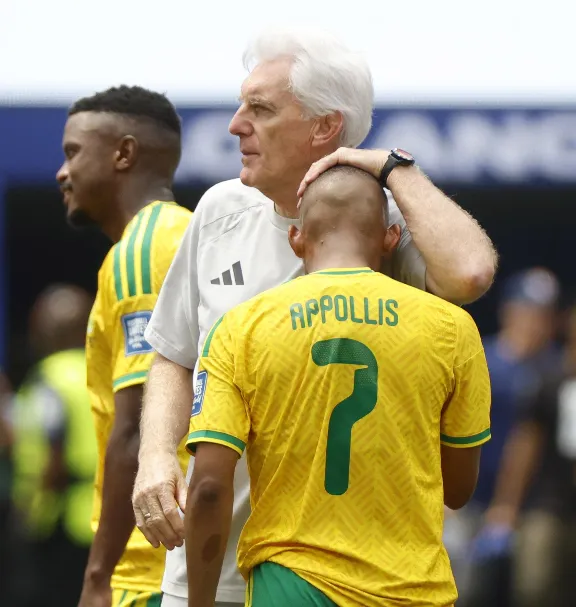
HUGO Broos seen comforting his Bafana Bafana players after their narrow stoppage time loss to Canada in the round of 32.
Image: Backpagepix
As African nations continue falling out of the FIFA World Cup knockout rounds, Hugo Broos believes the issue is no longer talent, tactical understanding or experience.
For the Bafana Bafana coach, the real problem is concentration.
Africa arrived at this tournament carrying unprecedented momentum.
Nine of the continent’s 10 representatives advanced from the group stages under the expanded 48-team format, a historic achievement that appeared to signal a major shift in global competitiveness.
But the Round of 32 has told a different story.
One after another, African teams have suffered painful eliminations — many of them after losing control of matches they seemed capable of winning or at least managing.
Broos believes there is a clear pattern emerging.
“I think it’s a matter of concentration and focus,” he said.
“When you see the way DRC is losing the game, when you see how Senegal is losing the game, it’s just losing the focus, losing the concentration.”
The Belgian tactician did not exclude his own side from that criticism either. Bafana themselves survived dangerous moments throughout the tournament and ultimately conceded a stoppage-time goal against Canada that ended their historic World Cup run.
“And we had also those moments, beginning of the game, the last game, end of the game,” Broos admitted.
For him, the issue goes beyond tactics. It is psychological endurance — the ability to maintain emotional control and tactical discipline for the entirety of elite-level knockout football.
“So this is something I think, yeah, a little bit, how could I say it, African teams are suffering from that. Keeping the focus for 90 minutes or for 120 minutes.”
That observation becomes even more striking when considering the profile of modern African squads.
Unlike previous eras, many of these teams are now built almost entirely around Europe-based players competing at elite clubs and high-intensity leagues every week.
“Even African teams with all players who play in Europe. Because we are talking here about teams who have no player, no player of the local competition in their selections,” Broos explained.
“So yeah, this is something to work on.”
The examples from this tournament only strengthen his argument.
Senegal surrendered a commanding position late in their knockout fixture, while Ivory Coast and DR Congo also suffered collapses after failing to manage decisive moments properly.
“Because yeah, if every time you will lose a game like Senegal 2-0, the lead is zero. And then in 10 minutes they lose the game. The last 10 minutes of the game,” Broos said.
“Ivory Coast 17 (the last 17 minutes of the game). So yeah, this is something to work on.”
For Broos, the frustration lies in the fact that these defeats were avoidable.
The quality gap is narrowing. African teams are competing physically, tactically and technically with the world’s strongest nations more consistently than ever before.
But the inability to sustain concentration in decisive moments continues to undermine progress.
“And yeah, if that is not going to disappear, then you will have those games that you lose, unnecessary,” he warned.
“Because not Senegal, not Ivory Coast, not DRC should have lost those games.”
That final point may be the most painful truth of all. Africa is no longer struggling to compete at the World Cup. It is struggling to finish the job.