

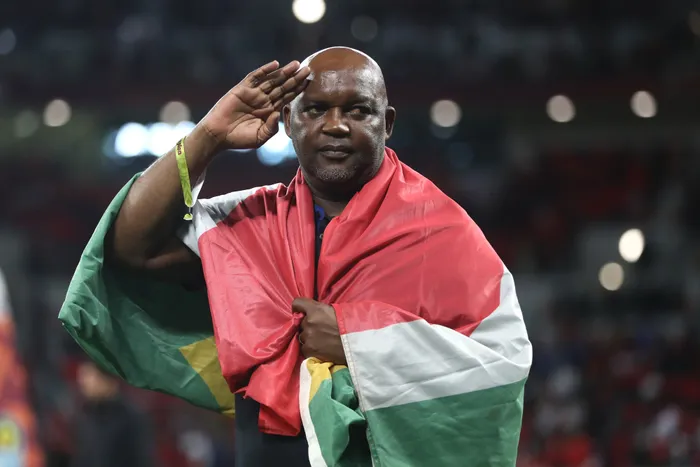
Pitso Mosimane is one of the favourites to succeed Hugo Broos as head coach of the national team.
Image: BackpagePix
The foundation that Bafana Bafana coach Hugo Broos has laid at the national team needs a successor who can hit the ground running with an intimate familiarity with South African football – and that person is none other than Pitso Mosimane.
That was the definitive view of Kwanele Kopo, Mosimane’s former understudy and a renowned South African youth development coach, when asked who he thought should replace Hugo Broos at the helm of Bafana.
Broos’ future with the national team remains uncertain. After guiding Bafana to a historic Fifa World Cup knockout stage berth recently, the Belgian tactician declared that he would make a final decision on his future upon returning to the country in the coming days.
The Belgian’s silence does not change the fact that his contract with Bafana expired at the end of the World Cup. As it stands, he will have to negotiate a renewal with Safa, likely competing alongside other applicants for the job.
Meanwhile, Safa is working tirelessly behind the scenes on the recruitment process. The technical director committee chairperson, Jack Maluleke, recently confirmed that they have received a host of applications, including one from Mosimane.
Because Safa publicly revealed Mosimane’s application, many already believe he is the frontrunner to succeed Broos. Kopo echoed this sentiment, endorsing Mosimane as the ideal candidate to lead the team forward due to the need for continuity and local expertise.
“I think South Africa is not at an age of restarting, but continuation,” Kopo said during an exclusive interview with Independent Media. “If you look at the squad, a lot of these players will still be young enough to play in another World Cup.
“When Relebohile Mofokeng is 21, Ime Okon is 22, and Mbekezeli Mbokazi is 20, these players can still play in one or two more World Cups.
“I think the most important thing is to get someone who is familiar with where these players are, and who is equally passionate. I don’t think anyone can doubt Pitso's passion for the game.”
Mosimane would bring immediate continuity to the setup. He has frequently praised Broos for reawakening a sleeping giant over the last five years through consistent tournament qualifications and competitiveness on the big stage.
Furthermore, his familiarity with local football is unmatched; he follows the PSL regularly, a league that remains the lifeblood of the national team. He also knows the national team environment well, having held the reins between 2010 and 2012 following the home World Cup.
Mosimane has previously expressed his desire to return to Bafana, noting that he wasn't given enough time to fully implement his philosophy during his first stint. Given the team’s progression over the last five years, alongside a newfound patience from both supporters and Safa management, Kopo backs Mosimane to thrive this time around.
“I think the way national team coaches are viewed now is different to when he was there the first time,” Kopo said. “Back then, there was an unhealthy emphasis on instant results.
“With Hugo Broos, patience allowed the process to unfold. I don’t think many coaches before him have had that opportunity. Coach Hugo has done well, but perhaps he also came in at the right time.
“As South Africa, we are now more patient with processes and projects. The fact that this group has done well is proof that if we invest properly, the results will come. For all the countries that are doing well, success didn't happen overnight.”
Broos and Mosimane may not share the same leadership style. Broos is often described as softer, embodying his “Madala” moniker by acting as a caring, nurturing grandfather figure. Mosimane, meanwhile, is known for his demanding, high-intensity approach. However, Kopo believes the duo share the same core values: the betterment of the team and its players.
“When I look at both of them, they both want holistic development,” Kopo said. “They aren't just looking at tactical abilities, but all-round qualities.
“Both coaches have shown a desire for our players to be in better environments. Sometimes Hugo has stepped on people's toes regarding which leagues our players should be playing in. I think all of that came from a place of passion and wanting what is absolutely best for the players.”