

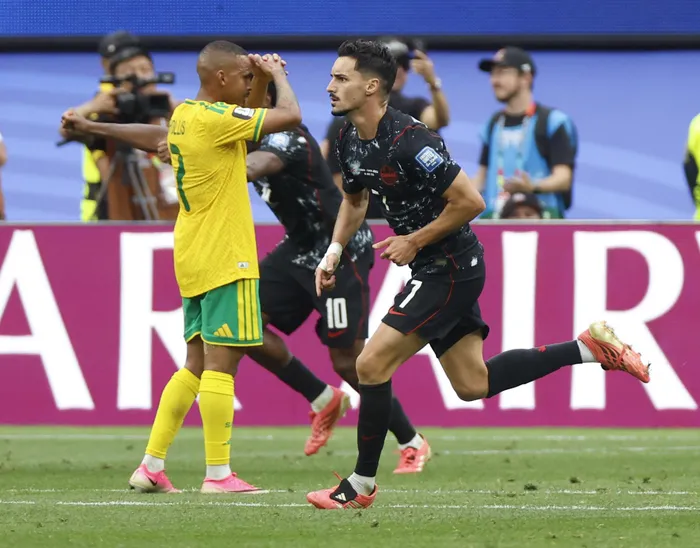
Bafana Bafana midfielder Oswin Appollis looks dejected after Canada's Stephen Eustáquio found the back of the next in stoppage time of their World Cup match.
Image: AFP
The mental fortitude of the Bafana Bafana players has been the primary driving force behind their impressive five-year resurgence, which recently culminated in reaching the FIFA World Cup knockout stage for the first time since their maiden qualification 28 years ago.
Bafana lost 1-0 to Canada in the World Cup round of 32 on Sunday night. While the defeat stung, they exited the tournament with their heads held high, having achieved the improbable by advancing past the group stage.
That progression underscores the team’s growth over the last five years under head coach Hugo Broos, the tactician having largely dismantled the foundations laid by his predecessors to rebuild the squad his own way.
The Belgian's approach didn’t please everyone, particularly his decision to anchor the team's structure around pitch and off-field discipline, sheer determination, and camaraderie, regardless of club allegiances. Broos maintains that elevating the team to its current level was no easy feat. He recalled a time when players treated national call-ups like all-expenses-paid holidays.
“I think, especially, the mentality of the team has changed a lot,” Broos said of the turnaround from failing to qualify for major events to actively competing in them. “When I came here five years ago and saw my first training session with the national team, I didn't believe my eyes.
"The mentality was not good. I had to stop training and tell them: ‘Hey guys, this is your job. You have to work. You are not coming here just to have a few days off and then return to your clubs.’ If something has changed in the national team, it is certainly the mentality."
He added: “You need to have that mentality if you want to achieve success. I think that’s what made us successful.”
Referencing his team’s never-say-die attitude against Canada on Sunday, Broos expressed pride in how far the squad has come.
“Like today, we fought for it,” Broos stated. “Until the 90th minute, I saw players going down every minute because the intensity was high. Those are things that you have to work on, but the mentality was there. They were willing to die on the pitch, and that’s a spirit that has to stay in this team.”
Broos has also built the squad around youth. More than 13 players — including Relebohile Mofokeng (21), Mbekezeli Mbokazi (20), Thapelo Maseko (22), Ime Okon (22), and Oswin Appollis (24) — still have their best years ahead of them.
Because of this, Broos insists that whether he stays or goes — as he remains undecided about stepping down when his contract expires in the coming weeks — the future of Bafana Bafana is in safe hands.
“I know there are some players who are 29 and 30 years of age, and we have to look to the future. There were several youngsters on the bench, so the future is being secured piece by piece,” Broos said.
“I am not saying that tomorrow we have to get rid of everyone else and only use youngsters. That won’t work. But for the future, I think we have to give them more chances, especially when we start the qualifiers for AFCON.”
The 2027 AFCON qualifiers are set to begin in September. Broos or his successor will need to hit the ground running to maintain their World Cup momentum and attempt to surpass the third-place finish achieved at the 2023 tournament.
“I think we learned a lot, and the players felt what it is like to play at that level. We did it three years ago during my first AFCON in Ivory Coast,” Broos said. “We lost the first game to Mali, and it was only after the following matches that people started believing in us. We beat Morocco and won bronze.
"This step was more difficult. We didn’t succeed 100%, but no one is to blame. It was crucial to play in this tournament so the players could gauge the level and realise what they still need to do to improve.”