

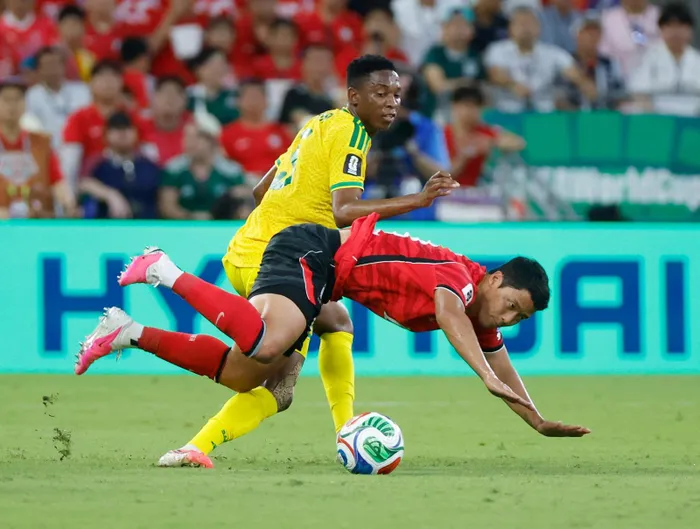
Bafana Bafana midfielder destroyer Thalente Mbatha is expected to play another influential role on Sunday.
Image: Backpagepix
Bafana Bafana's FIFA World Cup journey has already reached unknown territory as Hugo Broos sharpens his men for a last 32 encounter against host Canada on Sunday.
The Belgian's tactics have come under the spotlight in a positive and negative light and is expected to be dissected once more ahead of the country's biggest ever match.
Canada’s high-intensity, front-foot football under Jesse Marsch presents both opportunity and risk — and for Broos, the key opening has appeared in the most important area of the pitch.
The absence of Ismaël Koné through injury has left a structural gap in Canada’s midfield engine room, removing one of their most dynamic ball carriers and press-resistant profiles. In a system built on aggressive pressing and vertical transitions, that loss disrupts both balance and progression.
For Bafana Bafana, it changes the midfield equation completely — especially with Mokoena returning from suspension to restore balance, control and long-range distribution in the centre of the pitch.
The combination of Mokoena and Thalente Mbatha or even ‘Yaya’ Sithole gives Bafana a far more stable base than in their previous outing.
Mbatha’s role remains containment and ball recovery under pressure, while Mokoena adds the progressive passing range needed to break Canada’s first and second lines of press.
That balance becomes critical against a Canada side that thrives on chaos.
Jesse Marsch’s team press high, commit bodies forward, and force turnovers in advanced areas. At SoFi Stadium, with home crowd energy behind them, that intensity is expected to rise even further in the opening stages.
But that same approach creates space.
Canada’s defensive line remains extremely high, and when their press is bypassed, there is often vast space between centre-backs and goalkeeper — the exact zone Bafana are built to attack.
Relebohile Mofokeng becomes the connector. His ability to receive under pressure and turn quickly is essential in breaking Canada’s press. Once he turns, the game changes instantly.
Ahead of him, Thapelo Maseko provides the vertical threat — the runner who stretches Canada’s back line and forces constant defensive recovery sprints.
The tactical plan from Hugo Broos is expected to mirror the disciplined mid-block used against South Korea. Rather than engaging Canada in a pressing duel, Bafana will look to absorb pressure, stay compact, and strike in transition.
This is where the game will be decided.
If Mokoena can dictate tempo from deep, and Mbatha can survive Canada’s early pressure waves, Bafana will find moments to break forward into dangerous space.
And against a high line, one clean transition is often enough.
For Broos, the message is simple: stay compact, survive the press, and release the speed. Because knockout football is not about control — it is about timing.
And Bafana now have the weapons to punish it.