

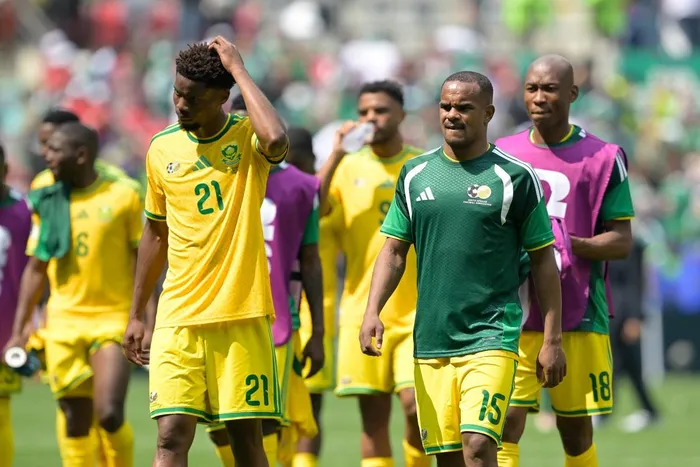
Bafana Bafana players leave dejected following their defeat at the hands of Mexico in their World Cup opener.
Image: AFP
The scoreboard will forever record that Bafana Bafana suffered a 2-0 defeat to Mexico in their opening match of the 2026 FIFA World Cup.
Football history will dutifully log the loss. It will detail the costly red cards, the defensive lapses, and the inevitable tactical debates that followed. It will register the goals, the statistics, and the ultimate outcome.
But a spreadsheet will never fully capture what Thursday night truly meant for the soul of South African football. Win, lose, or draw, the domestic game desperately needed this night.
For the first time in 24 years — entirely excluding the automatic host-nation qualification of 2010 — Bafana Bafana walked onto a World Cup stage having authentically earned their place among the global elite. They did not take the pitch because FIFA required a tournament host; they were there because they navigated a gruelling qualification campaign. They were there on raw merit.
That distinction matters immensely. An entire generation of South African football supporters has grown up without ever seeing the men's senior national team compete at a World Cup on sporting equity. In fact, many of the players wearing the green and gold against El Tri at a raucous Estadio Azteca were not even teenagers when South Africa last qualified for the tournament in South Korea and Japan in 2002./
For the better part of two decades, South African football has lived with a nagging existential crisis over whether it still belonged at the top table. The national team routinely drifted through failed qualifying cycles, abrupt coaching changes, and identity-sapping tournaments. The World Cup slowly morphed into a spectacle watched from a detached distance, rather than an event experienced from within.
That is precisely why the sight of Bafana Bafana standing in the tunnel in Mexico City carried a profound cultural significance that completely transcends the opening-day result. This was ultimate validation.
It was validation of the immense structural progress made under the disciplined stewardship of Hugo Broos. It was validation of a unified generation of players who have successfully restored tattered belief in the national jersey. It was validation that South Africa can, once again, stand shoulder-to-shoulder on the sport's grandest stage.
Of course, nobody in the camp is celebrating a defeat. The performance left plenty of room for critical analysis. The tactical approach will be fiercely questioned by analysts back home, the late decision to switch systems will be debated, and the catastrophic red cards and individual errors deserve strict journalistic scrutiny. That is the ruthless, unforgiving reality of elite international football.
Yet, there is an acute danger in becoming so utterly consumed by a single scoreline that the grander narrative is lost to the noise. South African football has spent a generation searching for global relevance. On Thursday night, it found it again.
Children across the country watched their national heroes walk out at a World Cup. Young academy players saw a tangible, realistic pathway stretching from local PSL pitches to the biggest tournament on Earth. A fractured fanbase was given a concrete reason to dream again.
The North American journey is far from complete. Bafana Bafana still have two crucial group fixtures remaining and a wide-open opportunity to write an even greater sporting script. But even if this campaign ultimately ends in group-stage disappointment, South African football crossed a monumental psychological threshold this week.
The result will be remembered for a while. The return will be remembered for much longer.