

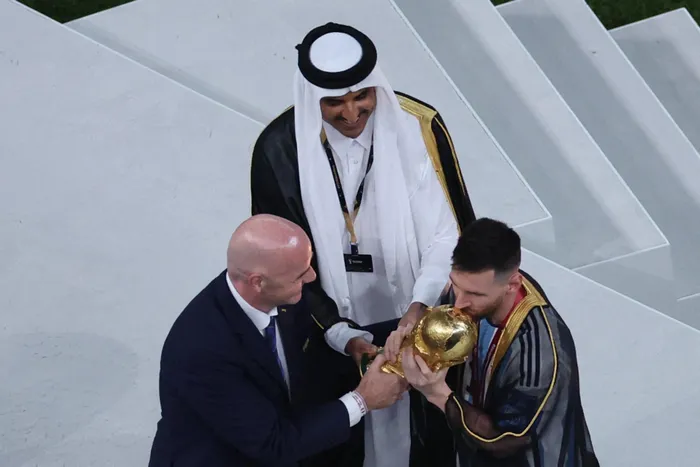
Argentina's forward #10 Lionel Messi kisses the World Cup trophy as FIFA President Gianni Infantino and Qatar's Emir Sheikh Tamim bin Hamad al-Thani look on during the Qatar 2022 World Cup trophy ceremony after the football final match between Argentina and France at Lusail Stadium in Lusail, north of Doha on December 18, 2022.
Image: BackpagePix
As the first World Cup hosted in the Middle East, Qatar 2022 offered a uniquely compact fan experience. With all stadiums located within a tight radius around Doha, the tournament lacked the sprawling travel fatigue of previous editions, creating an Olympic-style village atmosphere where fans from disparate cultures mingled daily.
While debates over sports-washing and the commercialization of the game remained a constant undertone in Western media, for millions across the region, the tournament was a proud, flawlessly organized celebration of hospitality and state-of-the-art infrastructure.
Africa: Cameroon, Ghana, Morocco, Senegal, Tunisia
Asia: Australia, Iran, Japan, Qatar (hosts) Saudi Arabia, South Korea
South America: Argentina, Brazil, Ecuador, Uruguay
North America: Canada, Costa Rica, Mexico, United States
Europe: Belgium, Croatia, Denmark, England, France, Germany, Netherlands, Poland, Portugal, Serbia, Spain, Switzerland, Wales
Eight stadiums in five Qatari cities were built or renovated for the FIFA World Cup. Of these eight stadiums, all but two have since been either dismantled, or have been moderately or heavily modified.
This tournament was the last with 32 participating teams, with the number of teams being increased to 48 for the 2026 World Cup. To avoid the extremes of Qatar's hot and humid climate in summers,the event was held in November and December, becoming the first one to take place in the end of the year and outside the traditional months of May, June, and July
Early shocks set the tone, none more stunning than Saudi Arabia’s opening-group-stage victory over eventual champions Argentina.
Japan topped a group featuring Spain and Germany, while teams like South Korea showed relentless spirit.
The defining story of the tournament’s middle chapters belonged to Morocco. Becoming the first African and Arab nation to reach a World Cup semi-final, the Atlas Lions galvanized an entire continent and the Arab world, proving that the gap between football’s traditional elite and the rest of the world had irrevocably closed.
*Croatia beat Morocco 2-1 in the third place playoff
France 3, Argentina 3 (Argentina won 4-2 on penalties)
Kylian Mbappé’s stunning hat-trick repeatedly dragged France back from the brink, but it was destiny that ultimately smiled on Argentina in the penalty shootout.
The image of Lionel Messi, draped in a traditional golden-trimmed bisht, finally hoisting the solid-gold trophy into the Doha night sky provided the perfect, definitive punctuation mark to his legendary career. It was a cinematic ending that even the most ambitious scriptwriters could not have manufactured.