

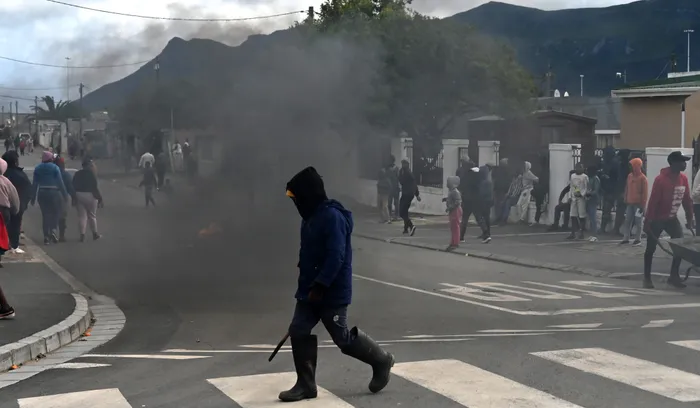
Explore the persistent issue of xenophobia in South Africa and its devastating economic impact, as revealed through a study of violence against foreign-owned spaza shops.
Image: Ayanda Ndamane/ Independent Newspapers.
When I completed my master’s dissertation in 2019 on violence against foreign-owned spaza shops in Soweto, one uncomfortable conclusion stayed with me long after the research was complete: South Africa had not solved xenophobia.
My study was prompted by a longer history of xenophobic violence in the country, particularly the 2008 attacks that drew national and international attention, followed by further outbreaks in 2015 and 2018.
What concerned me was that violence against foreign spaza shop owners remained under-examined, especially from the perspective of local residents who had witnessed these attacks but were not necessarily direct perpetrators or victims.
The violence of 30 June 2026, which saw businesses close, foreign nationals flee their homes, communities gripped by fear and police deployed across several provinces, confirms precisely that.
Xenophobia in South Africa is not an isolated event, nor is it a seasonal flare-up. It is a recurring feature of an economy that continues to fail millions.
In that research, I found that residents’ explanations for attacks against foreign-owned businesses were complex. Crime, unemployment and economic competition all featured prominently.
Yet these grievances repeatedly found expression through violence directed at one identifiable group: foreign nationals operating in the informal economy.
That distinction matters.
Because while economic hardship may explain some of the frustration that fuels these attacks, it does not justify turning migrants into targets of collective punishment.
We can't deny that the informal economy has become the battlefield where South Africa’s broader economic failures are fought, while simultaneously being, perhaps, the country’s most misunderstood economic sector.
Rather than viewing it as an ecosystem that generates livelihoods, creates employment and improves food security, it is treated as temporary, disorderly and largely invisible. Yet for millions of South Africans and migrants alike, informal trade is not a steppingstone -it is the economy.
Foreign-owned spaza shops, in particular, have often demonstrated remarkable resilience. Through collective buying networks, efficient supply chains and longer trading hours, many have built highly competitive businesses in townships where formal retail remains limited.
Their success has unfortunately become both their strength and their vulnerability.
When violence destroys these businesses, the damage extends far beyond the individual shop owner. Every looted store represents disrupted supply chains. Local landlords (who are South African) lose tenants. South African employees lose jobs.
Wholesalers lose customers. Municipalities lose economic activity.
Consumers lose affordable access to food and essential goods. Investor confidence weakens.
Xenophobia is therefore not merely a humanitarian crisis. It is an economic crisis.
South Africa is already contending with stagnant economic growth, persistently high unemployment and declining business confidence, which makes attacks on entrepreneurs, regardless of nationality, one of the most self-defeating responses imaginable.
Instead of addressing the pressures communities face, such violence destroys productive economic activity in places that need more investment, not less, and targets many of the very people doing what policymakers encourage: starting businesses, creating employment and generating income. This contradiction should not be ignored.
Legitimate concerns about undocumented migration and weak border management must be taken seriously, and every sovereign state has both the right and responsibility to regulate immigration; however, immigration management cannot become a substitute for economic policy.
The question, then, is not whether xenophobic violence will happen again, because if the structural drivers remain unchanged, it almost certainly will.
The more urgent question is whether South Africa is willing to confront the conditions that keep producing these cycles, including an under-supported informal economy, weak local economic development, poor policing, limited employment opportunities and declining trust in state institutions.
Addressing migration honestly is part of that work, but it cannot be separated from the broader economic failures that make communities vulnerable to fear, resentment and mobilisation.
Until xenophobia is treated not only as a security problem but as a symptom of deeper economic dysfunction, South Africa will continue to relive the same tragedy.
Boitshoko Shoke, Research and Impact Manager at 22 On Sloane and the GEC+Africa Content Lead.

Boitshoko Shoke, Research and Impact Manager at 22 On Sloane and the GEC+Africa Content Lead.
Image: Supplied.
Follow Business Report on Facebook, X and on LinkedIn for the latest Business and tech news.