

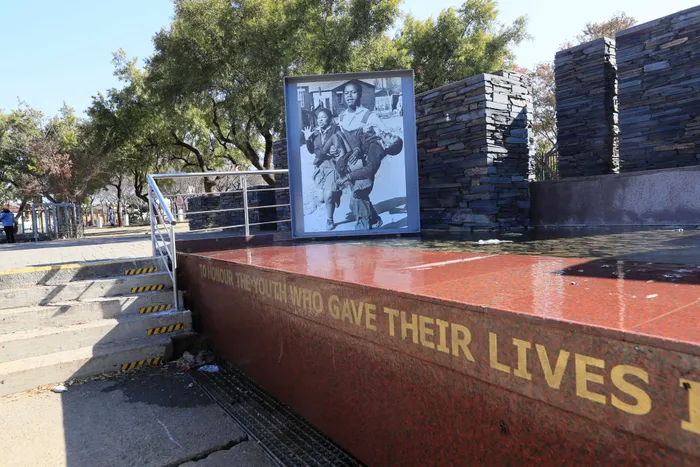
Exploring the legacy of the 1976 Soweto Uprising, this article examines how South African graduates are redefining success through entrepreneurship in the face of high unemployment.
Image: Simphiwe Mbokazi / Independent Newspapers
There is a version of the 1976 Soweto Uprising that has been told so many times it has acquired the smooth, untroubling quality of legend. Young people marched. They were met with violence.
They refused to stop. Their courage changed the trajectory of a country.
But there is a harder version of that story, one the RESET@50 framework is trying to raise. What exactly were those students marching toward? And fifty years on, how close are we?
The 1976 generation was not marching only against a language policy. They were marching against a system that had decided, with bureaucratic precision, what kind of economic life a Black South African child was entitled to aspire to.
Bantu Education was not merely an inferior curriculum. It was a pipeline designed to produce workers for a specific tier of the economy and to foreclose the possibility of ownership, professional life, and economic autonomy for a whole population.
Economic freedom, as that generation understood it, is not only the right to work in someone else's business. It is the right to build your own and to have the system make that possible.
Fifty years on, a different kind of recognition is arriving, not in a government office or a graduatio hall but in the quiet, delayed realisation of a generation of young South Africans who waited for employment that never came, and eventually built what they could not find.
I know this intimately. I have a few friends who graduated in the last three years, with bachelor's degrees, honours, and even at master's level yet remained unemployed long after finishing. Not by choice. Not by lack of ambition.
By a labour market that simply did not have room for them in the way they had been told it would.
What eventually emerged, after applications, waiting and the silence, was entrepreneurship. Not as a calling, initially.
As a conclusion. The degree they had spent years acquiring turned out to be exactly what they needed, not to get a job, but to run a business.
This is not an isolated story. South Africa's youth economy is undergoing a quiet but significant transformation. The traditional expectation that education should lead directly to formal employment is increasingly misaligned with labour market realities.
There is a particular kind of exhaustion that settles over a new graduate about three months after the ceremony.
The certificates sits in a frame; the applause has faded, the University WhatsApp groups have gone quiet. And the question, deceptively simple, impossibly heavy, has begun to follow them into every room: so, what are you doing now?
For the better part of South Africa's democratic project, the answer was supposed to be obvious. You studied, you graduated, you found a job. But that has changed. What new graduates are stepping into is not the economy their parents navigated. It is something faster, more fragmented, more indifferent to formal credentials, and if they know how to read it, the economy is generously full of opportunity than any moment before.
The RESET@50 framework is built on an honest admission: access alone is no longer enough. South Africa expanded its university enrolment from under 500 000 students in 1994 to over a million by 2022. And yet, the country's youth unemployment rate hovers above 45 percent. The pipeline is full.
The exits are not. What this means for the graduate standing at that fork in the road is that the degree, as valuable as it is, was never meant to be the finish line. It was always meant to be the foundation for practice, a business, a craft, a service, and a solution. When the degree is treated as a destination, its holder waits.
When it is treated as a foundation, its holder builds.
The graduates who are building are doing so across a dizzying range of sectors, leveraging a degree in Marketing into a paid content creation career, turning agriculture degrees into agri-tech ventures, using law qualifications to serve the economy's growing need for contract work.
The economy in the digital era has offered them entry in a way that is more accessible than any previous generation.
What has historically been missing is not necessarily infrastructure. What has been missing is cultural permission. The social legitimacy to see enterprise not as what you do when a job does not materialise, but as something you could have pursued the moment you graduated or even before.
My friends did not need to wait two or three years to discover they were capable of this. That realisation, in hindsight, could have arrived much earlier.
The obstacle was not ability. It was the narrative they had been sold; one that said formal employment was the measure of success, and everything else was a fallback. Unlearning that paradigm took longer than it should have.
The fifty years since 1976 have given South Africa’s youth more political freedom, greater access to education, and stronger institutional support than any generation before them.
Yet the next chapter requires a different kind of courage.
Not the courage to march, though that will always be honoured, but the courage to build, to launch, to fail publicly, and to begin again.
Londani Mpharalala, Research and Impact Coordinator at 22 On Sloane.

Londani Mpharalala, Research and Impact Coordinator at 22 On Sloane.
Image: Supplied.
Follow Business Report on Facebook, X and on LinkedIn for the latest Business and tech news.