

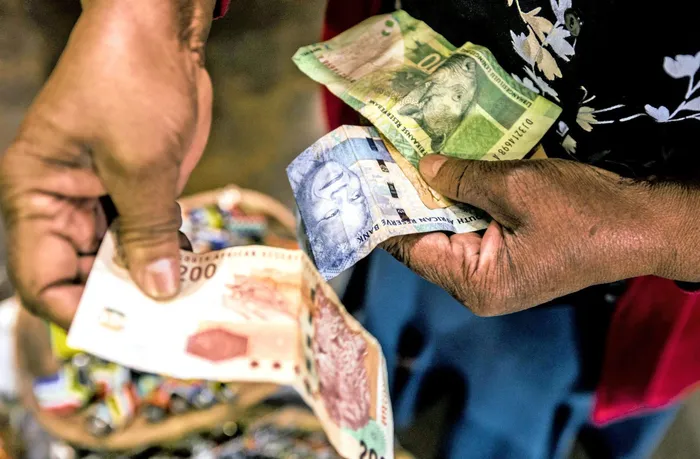
Government in partnership with the private sector seeks to establish a R100 billion aggregated Fund to support the ever-growing funding requirements for businesses owned and managed by black entrepreneurs.
Image: File.
SME empowerment organisation Unconventional CA (UCA) has raised concerns that the Transformation Fund offering big black economic empowerment points incentive reflects no meaningful shift from earlier drafts and is unlikely to serve the real needs and requirements of South Africa’s entrepreneurs and small, medium and micro enterprises (SMMEs).
This is in response to the news that the government is getting ready to move ahead with the revamped fund as soon as next week.
Government in partnership with the private sector seeks to establish a R100 billion aggregated Fund to support the ever-growing funding requirements for businesses owned and managed by black entrepreneurs to propel inclusive growth across various sectors of South Africa’s economy. The Transformation Fund is anticipated to be capitalised at R20 billion per annum over a five-year period.
Under the proposal, companies that contribute 3% of their net income to a so-called Transformation Fund will earn double the points currently available for a scorecard that measures businesses' support for greater economic inclusion.
Hiten Keshave, the CEO of UCA and an Enterprise & Supplier Development (ESD) specialist, said in a statement the latest version of the fund does little to address the fundamental questions around impact, accountability, and practical SME development.
“There are no material changes to what was first drafted,” said Keshave. “At its core, this remains a proposal to centralise capital, without any clear direction on how those funds will actually translate into sustainable SME growth or meaningful support for entrepreneurs on the ground.”
Keshave warns that the proposed governance structure, which places decision-making power in the hands of a minister-appointed board, raises serious concerns for SMMEs, particularly in an environment where public trust in state institutions is already fragile.
“Given the lack of confidence many South Africans already have in how state-owned entities and the broader economy are managed, concentrating this level of funding under a self-appointed board is a major red flag,” he says. “For entrepreneurs and small businesses, this raises real concerns about transparency, accountability and whether funding decisions will reflect their realities.”
He also questions whether the Transformation Fund is being positioned as a genuine solution to SME development, or as a mechanism to plug existing funding shortfalls within government itself.
“The Minister of Small Business Development, Stella Ndabeni-Abrahams, has acknowledged that African startups receive less than 3% of global venture capital and that her department faces budget constraints when it comes to supporting SMMEs,” says Keshave. “Entrepreneurs are entitled to ask whether this fund is truly designed to empower them — or to subsidise gaps in government’s own funding capacity.”
According to Keshave, the proposal further fails to recognise the diversity of the SME sector, treating small businesses as a single category despite vast differences in scale, sector, and maturity.
“You cannot generically bucket all businesses into one class,” he says. “SMMEs require targeted capital, mentorship, operational support and access to markets, not a once-off pooled solution designed primarily to simplify compliance.”
Keshave adds that meaningful economic transformation and SME-led growth will require far more than what he describes as a policy “quick fix.”
“If we are serious about supporting entrepreneurs and building a resilient SME economy, this will take more than a single fund,” he says. “It requires all political parties to put ego and politics aside and collectively rethink what effective, practical transformation should look like.”
Unconventional CA believes the proposal should prompt a broader national conversation focused on accountable, decentralised, and development-driven approaches that genuinely serve South Africa’s SMMEs.
Business Leadership South Africa (BLSA) has previously said questions remain around the fund.
"The obstacles that need to be managed in enterprise development are complex. An estimated 70% of all new businesses fail in South Africa. The reasons for this failure rate include a lack of skills, limited access to markets, and insufficient access to funding. Initiatives that have attempted to address these challenges, including the supplier and enterprise development component of B-BBEE, have had mixed success. While there are good examples where companies have fostered successful black-owned businesses and integrated them into their supply chains, many other companies have failed to gain traction despite significant funding. Access to funds alone is demonstrably not the answer," Busiswe Mavuso, the CEO of BLSA said.
"One of the questions that arises from the concept document is how the Fund proposes to improve on aspects related to ESD, over and above funding. The primary constraint on successful small business funding, for example, is the mentorship required to simultaneously develop capacity. Effective mentorship depends on a scarce and stretched skill set. The performance of the NEF and similar funding initiatives has been constrained precisely because of the lack of mentorship capacity in the country. Enterprise development is not easy, and several committed players have devoted significant time and resources to getting it right over many decades,:" she said.
BUSINESS REPORT