

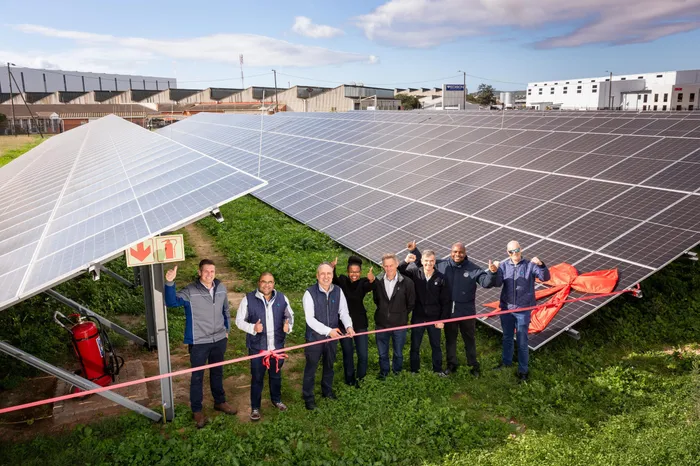
Regardt van Zyl, Ryan Katts, Ulrich Schwabe, Ntsapokazi Ningiza, Mike Petrie, Pano Mantatzis, Fhatuwani Mashau, Nick Chapman.
Image: Supplied.
Volkswagen Group Africa (VWGA) has strengthened its renewable energy programme with the completion of a new photovoltaic solar installation at its Component Plant in Kariega, marking another step towards its goal of achieving carbon neutral electricity across its production operations.
Completed in June 2026, the latest project comprises 1 410 solar panels installed across the roofs of the component plant, the car park and a ground mounted section.
The facility has a generation capacity of about 0.88 megawatt peak (MWp).
The investment builds on a series of renewable energy projects undertaken at the Eastern Cape manufacturing facility in recent years.
VWGA previously completed a multi phase solar installation over its employee car park, where 9 294 panels with a capacity of 5.2MWp are capable of generating about 7 125 megawatt hours of electricity annually.
Additional photovoltaic systems have also been installed on the roof of the Final Assembly building with a capacity of 1.7MWp and at the engine plant with a capacity of 1.0MWp.
The company said the projects form part of its long term sustainability roadmap aimed at reducing its environmental footprint and transitioning its manufacturing operations to cleaner energy sources.
In 2025, Plant Kariega sourced 40% of its electricity requirements from green energy.
Production Director at Volkswagen Group Africa, Ulrich Schwabe, said the company remained committed to expanding its renewable energy initiatives.
"We have made significant strides in recent years towards fully sustainable manufacturing," Schwabe said.
"As a company we remain committed towards practices that are responsible and sustainable, and our work in increasing our green footprint is never done."
The latest installation is expected to further reduce the plant's reliance on conventional electricity while supporting Volkswagen Group Africa's broader sustainability objectives.
While South African businesses may have moved beyond the worst periods of loadshedding, energy uncertainty remains a major challenge as rising electricity tariffs and infrastructure pressures continue to reshape supply chain decisions.
Manufacturers across South Africa have increasingly turned to renewable energy investments in response to electricity supply challenges, rising energy costs and growing environmental commitments.
Renewable energy solutions are becoming an increasingly important part of business continuity planning as companies look for greater control over energy costs and supply.
Solar installations have become a key component of industrial decarbonisation strategies as companies seek greater energy security while reducing carbon emissions.
For Volkswagen Group Africa, the continued expansion of solar generation capacity forms part of a broader strategy to modernise production while aligning with global sustainability targets.
The company said its ongoing investments demonstrate its commitment to responsible manufacturing and building a more resilient energy future for its operations in South Africa.
Meanwhile, Paul Vos, Regional Managing Director of the Chartered Institute of Procurement & Supply (CIPS) Southern Africa, said the nature of energy risk has changed.
“Energy uncertainty has not disappeared; it has evolved,” Vos said.
“Today, organisations are increasingly dealing with infrastructure failures, maintenance backlogs and localised network disruptions, particularly at municipal level, that are often less predictable than loadshedding itself. From a supply chain perspective, unpredictability creates significant operational risk.”
The impact is being felt throughout supplier networks as businesses face rising electricity costs alongside higher transport and logistics expenses.
“This creates a double cost pressure,” Vos said.
“Suppliers are facing higher energy costs and higher logistics costs simultaneously. As a result, procurement teams are seeing greater pricing volatility, more requests for contract adjustments and increased pressure on budgets.”
Energy intensive sectors including manufacturing, food production, cold chain logistics, mining, chemicals and water infrastructure remain among the most exposed industries due to their dependence on reliable and affordable power.
Follow Business Report on Facebook, X and on LinkedIn for the latest Business and tech news.