

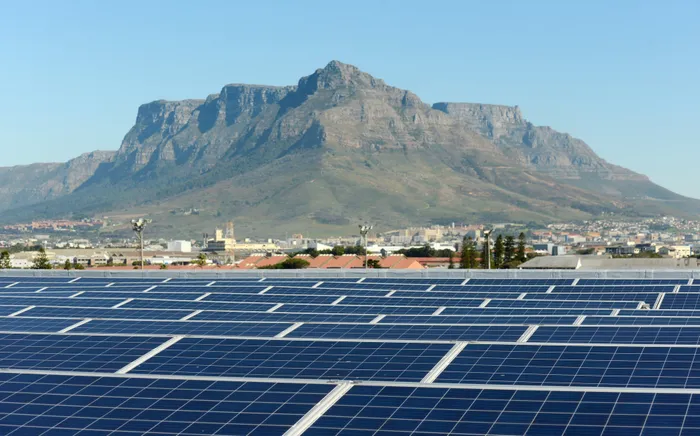
Discover why embedded generation is the key to cheaper, cleaner energy for businesses, and how wheeling fits into the renewable energy landscape.
Image: Armand Hough/Independent Newspapers
For Commercial and Industrial (C&I) energy users who want to secure cheaper, cleaner, and more resilient power, embedded generation, solar PV and battery storage installed on-site, is the strongest foundation.
Lately though, a misconception is taking hold.
Wheeling, the process of buying electricity from a remote renewable plant via the national grid, is being actively marketed and is increasingly pitched to C&I users as the ultimate route to lower costs and decarbonisation.
It is a valuable part of the energy mix but presenting it as the first move has created real uncertainty about which renewable solution to start with.
The answer is a sequencing question.
On almost every important measure, embedded is the superior product, so it should come first.
Wheeling works best as an addition to embedded, not a substitute for it.
Build the foundation behind the meter, maximise those savings, and then layer in wheeled power where the numbers make commercial sense.
The most important factor in any electricity strategy is the tariff you already pay.
With embedded generation, every kilowatt-hour (kWh) produced replaces electricity bought at the full Eskom or municipal time-of-use tariff.
This is the highest rate on an electricity bill, and it continues to rise above inflation.
Wheeling operates on a different principle.
The credit on an electricity bill for wheeled energy is the Eskom Wholesale Energy Purchase Structure (WEPS), a rate that is materially lower than retail costs.
So, for every unit generated, an embedded system delivers higher savings than a wheeled project. Embedded solar could save around R1.50 per kWh against roughly R0.72 for wheeling, as illustrated below.
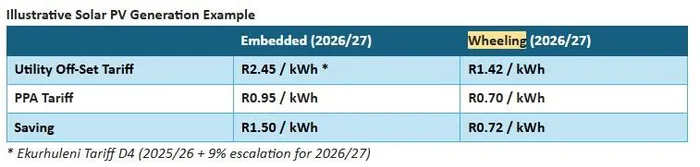
The credit on an electricity bill for wheeled energy is the Eskom Wholesale Energy Purchase Structure (WEPS), a rate that is materially lower than retail costs.
Image: Supplied.
Embedded generation does more than cut immediate costs.
With a battery system installed it reduces peak demand, lowering what is drawn from the grid when usage is highest.
Staying under your nominated maximum demand can save a great deal.
The same battery can also arbitrage the time-of-use tariff, charging cheaply during off-peak periods and discharging during expensive peak windows.
Wheeling cannot reduce these charges because it does not change a site’s grid demand profile.
Wheeled power remains dependent on the grid, so when the grid goes down, supply is interrupted.
A battery system acts as a power buffer, providing essential backup during load shedding while filtering the harmful voltage fluctuations and harmonics that now frequently plague the local grid. Insulating the site from grid instability protects a business against downtime and equipment damage.
Embedded generation functions at the point of consumption. This eliminates the 5–10% physical line losses inherent in wheeled energy and ensures that every electron produced is utilised on-site.
Timing matters too.
Embedded systems can be designed, permitted, and commissioned within a few months, cutting bills immediately. Many wheeling projects currently being marketed are still in the construction or funding phase, with commercial operation dates set for late 2026 or beyond.
Getting the sequence right
Wheeling is an excellent way to increase renewable penetration once a site is optimised.
Before signing a wheeling PPA, the foundation should be built at home and behind-the-meter savings maximised first.
Then, if the numbers still make commercial sense, wheeling can be layered in to take the next step in a sustainability journey.
Start with the solution that offers the best return, the most resilience, and the fastest path to energy independence.
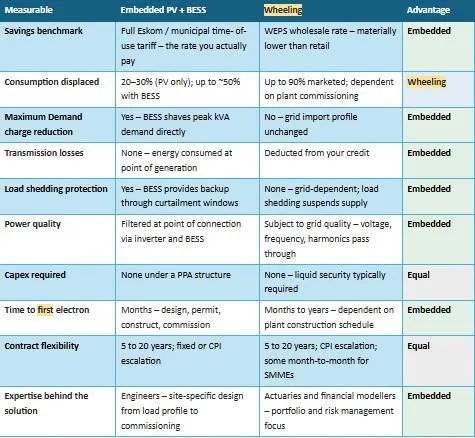
Embedded PV + BESS vs. Wheeling - A side-by-side comparison across 10 dimensions.
Image: Supplied.
Paul Mansour, Chief Executive Officer at Sustainable Power Solutions (SPS).

Paul Mansour, Chief Executive Officer at Sustainable Power Solutions (SPS).
Image: Supplied.
Follow Business Report on Facebook, X and on LinkedIn for the latest Business and tech news.