

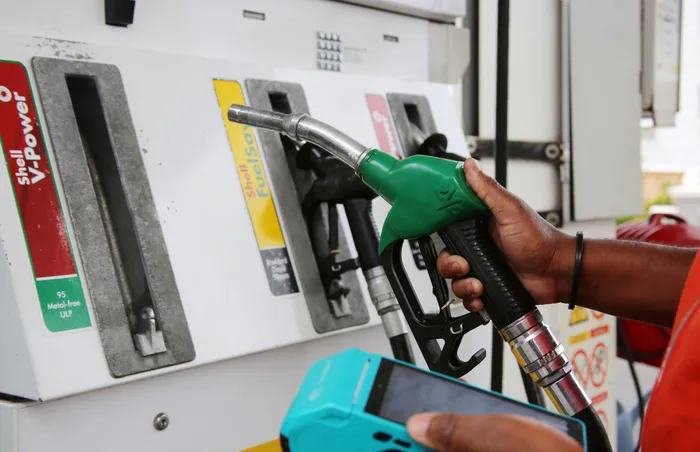
South Africans receive good news as fuel prices drop significantly in July, thanks to declining global oil prices and improved supply outlooks from recent US-Iran agreements.
Image: File/Tumi Pakkies/Independent Newspapers
With global oil prices in decline, following the re-opening of the Strait of Hormuz and the ongoing peace talks between the United States and Iran, the official fuel price adjustments for July brings some much-needed good news for South Africans.
The Department of Petroleum and Mineral Resources (DMPR) announced the official fuel price adjustments on Tuesday with petrol prices declining by R2,01 per litre for 93 Unleaded and R1,96 for 95 Unleaded. Diesel will decrease by R3,59 per litre for 50ppm and R3,14 for 500ppm. The wholesale price of illuminating paraffin will be reduced by R5,23 per litre.
Below is the fuel price adjustments that will take effect from 1 July:
The DMPR said the fuel price decreases could be credited to the average brent crude oil price decreasing from $104,59 to $86,53 during the period under review.
This was due to the signing of the Memorandum of Understanding (MOU) between the US and Iran, which improved the global supply outlook.
The department also said that the rand appreciated on average against the US Dollar, from R16,52 to R16,38 rand per dollar, during the period under review when compared to the previous month.
"This led to lower contributions to the Basic Fuel Prices of petrol, diesel and illuminating paraffin by 11,27 c/l, 13,75 c/l and 13,37 c/l, respectively," the DMPR stated.
Debt Rescue CEO, Neil Roets, said however the July petrol price cut will not rescue South Africans from soaring inflation and municipal utility bills.
He said that the decrease in fuel prices has been met with relief, however, consumers are still faced with difficulties.
"Compared to January 2026, motorists are still paying about R6,18 more per litre for inland 95 Unleaded petrol, highlighting that fuel prices remain substantially higher than they were at the start of the year despite the latest reduction," he said.
"Fuel prices influence far more than what motorists pay at the pumps. They filter through the entire economy, affecting transport costs, food prices, logistics, municipal service delivery and ultimately household cash flow. While the July reduction is welcome, it is simply too small to offset the cumulative inflationary pressure consumers have absorbed over recent months," Roets said.
He said consumers rarely experience inflation as isolated price increases. Instead, financial pressure builds cumulatively as multiple cost increases occur simultaneously, steadily reducing disposable income and increasing dependence on credit.
For many South Africans, the compounded effect of the resultant electricity, water, and property rate hikes will further erode their financial resilience and deepen their reliance on credit.
He said that there was also a real possibility that Governor of the South African Reserve Bank (Sarb), Lesetja Kganyago, will announce another repo rate hike in July.
"Consumers should not interpret lower fuel prices as a signal that broader inflationary pressures have eased. Monetary policy responds to underlying inflation trends, and those pressures remain present throughout the economy," Roets said.
"Fuel, electricity, municipal charges, transport and food costs rarely increase in isolation. Together they create a compounding affordability problem that places sustained pressure on household cash flow," said Roets.
Visit:www.businessreport.co.za