

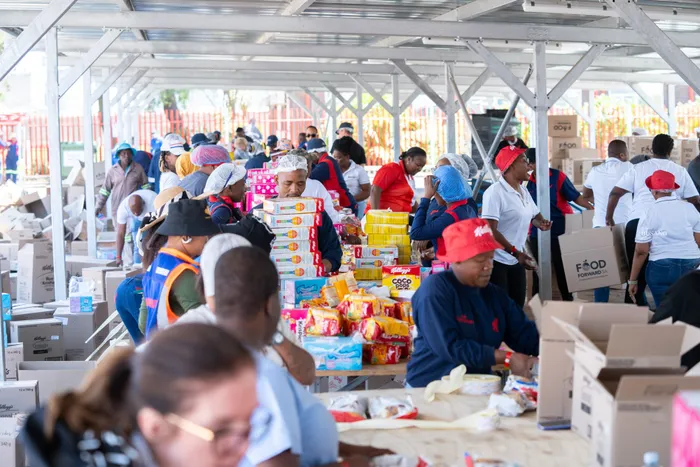
It is a challenge that is often measured in statistics but experienced in deeply human ways. A child who arrives at school hungry is not just facing a physical disadvantage, they are facing a barrier to learning, concentration and development that can shape their future long before they reach adulthood, the writer says.
Image: Supplied.
Every year, World Hunger Day serves as a global reminder of a crisis we know too well in South Africa: hunger is not caused by a lack of food. It is caused by systems that do not ensure equitable access to food, opportunity and dignity.
It is a challenge that is often measured in statistics but experienced in deeply human ways.
A child who arrives at school hungry is not just facing a physical disadvantage, they are facing a barrier to learning, concentration and development that can shape their future long before they reach adulthood.
In South Africa, the scale of food insecurity remains deeply concerning.
According to Statistics South Africa, approximately 22.2% of households experience inadequate or severely inadequate access to food, with rural provinces such as the Eastern Cape disproportionately affected.
Behind these figures are families navigating unemployment, rising living costs and limited access to reliable food systems.
This reality is further complicated by a contradiction that defines our national food landscape: while millions of people struggle with hunger, significant volumes of edible food are lost or wasted within the broader system.
This imbalance is not simply a logistical issue; it is a structural one. It reflects gaps in distribution, affordability, infrastructure and economic inclusion.
At Kellogg’s South Africa, we have worked for more than a decade to respond to this reality through our Better Days Promise programme, which has delivered over 68 million meals to learners across Gauteng, KwaZulu-Natal and the Eastern Cape since 2014.
These meals are more than nutrition, they are a daily intervention that supports school attendance, concentration and long-term educational outcomes.
However, experience has taught us an important truth: while food relief is essential, it is not enough on its own to resolve hunger at scale.
If we are to make lasting progress, we must also address the underlying systems that create vulnerability in the first place.
The global conversation on food security is shifting and rightly so.
There is growing recognition that hunger cannot be solved through emergency response alone. It requires sustained investment in local food systems, skills development and community resilience.
This thinking is at the heart of our Better Days Gardens programme, which represents an evolution in how we approach food insecurity in South Africa.
Launched in Gauteng in 2024, the programme was designed not only to provide access to fresh produce, but to build practical, transferable skills in food production, nutrition and sustainability.
In many communities, particularly those affected by unemployment and rural isolation, these skills are as valuable as the food itself.
To date, the initiative has supported more than 2,400 learners and 300 households, demonstrating that when communities are given tools and knowledge, they are able to actively participate in improving their own food security.
Importantly, school food gardens do more than supplement meals.
They create learning environments where children engage directly with food systems, understanding where food comes from, how it is grown and how it can be sustained. This connection between education and food security is critical in addressing long-term resilience.
The expansion of the Better Days Gardens programme into the Eastern Cape is both a continuation and a deepening of this work.
The province remains one of the most food-insecure regions in South Africa, shaped by long-standing structural challenges including rural poverty, unemployment and uneven access to infrastructure and services.
In many communities, households rely heavily on school nutrition programmes as a primary source of daily meals for children.
While these programmes are essential, they must be supported by complementary interventions that build self-sufficiency and reduce long-term vulnerability.
The introduction of five new school food gardens in the Eastern Cape, reaching approximately 2,400 learners, is designed to strengthen this ecosystem of support.
These gardens will not replace existing feeding programmes; rather, they will enhance them by providing fresh produce, improving dietary diversity and embedding agricultural learning into the school environment.
Just as importantly, they serve as platforms for community participation. Parents, educators and local partners all play a role in sustaining these gardens, reinforcing the idea that food security is a shared responsibility.
One of the most important lessons in addressing hunger is that no single sector can solve it alone. Governments, private sector actors, NGOs and communities each play distinct but interconnected roles.
Government-led programmes such as school nutrition schemes provide critical safety nets. NGOs often bring implementation expertise and community-level trust. The private sector can contribute resources, innovation and long-term investment capacity. But none of these efforts are sufficient in isolation.
The real opportunity lies in alignment, ensuring that interventions reinforce rather than duplicate each other and that communities remain at the centre of design and implementation.
This approach is particularly important in the context of climate change, water scarcity, and rising food prices, all of which place additional pressure on already vulnerable households. Sustainable food systems must therefore be both resilient and locally adaptable.
As we reflect on World Hunger Day, it is important to recognise that hunger is not an isolated issue, it is deeply connected to education, health, gender equality and economic opportunity.
Children who are hungry today are more likely to face barriers in education tomorrow.
Communities without access to food security are more likely to remain trapped in cycles of poverty. And nations that fail to address hunger holistically risk undermining their long-term development potential.
At Kellogg’s, we remain committed to playing our part in addressing this challenge—not only through immediate food support, but through long-term investments in food systems that empower communities to sustain themselves.
Our responsibility is not simply to respond to hunger, but to help build conditions in which hunger becomes increasingly rare.
This requires patience, collaboration and a willingness to think beyond short-term solutions. But most importantly, it requires a shared belief that every child deserves not only to eat, but to thrive.
Because addressing hunger requires more than relief—it requires resilience, dignity and long-term action.
Philip Nieman, General Manager & Executive Director, Kellogg’s South Africa.

Philip Nieman, General Manager & Executive Director, Kellogg’s South Africa.
Image: Supplied.
Follow Business Report on Facebook, X and on LinkedIn for the latest Business and tech news.