

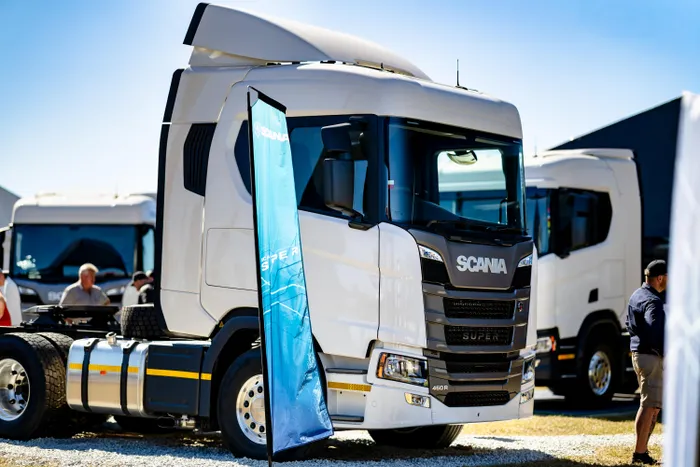
Scania South Africa showcased the Scania Super at NAMPO Harvest Day 2026, in Bothaville in the Free State.
Image: Supplied
Scania South Africa showcased its new Super truck at the NAMPO Harvest Day 2026 in Bothaville, Free State, highlighting the transport solution’s focus on fuel efficiency, operational performance and sustainability.
The company said the Scania Super was developed as a next-generation transport solution designed to help operators lower costs due to fuel efficiency while maintaining productivity, reliability and uptime in demanding operating environments.
“Presented at South Africa’s premier agricultural exhibition, the Scania Super responds directly to the growing pressure on transport operators to reduce operating costs while maintaining reliability, productivity, and uptime in demanding operating conditions,” the company said.
Scania noted that road transport remains the dominant mode of moving goods across South Africa, with fuel accounting for between 30% and 50% of operating costs in heavy-duty transport fleets.
“In heavy-duty transport operations, fuel can account for between 30% and 50% of total operating costs, making every efficiency gain commercially significant.”
According to Scania, the new 13-litre Super engine delivers up to 50% brake thermal efficiency and can reduce fuel consumption by as much as 8% compared with the previous generation.
The company said these gains are supported by improvements to the Scania Opticruise gearbox, rear axle and modular chassis architecture, which together enhance durability, payload capacity and operating economy.
Erik Bergvall, managing sirector at Scania Southern Africa, said efficiency has become a critical business requirement for transport operators.
“It has become a key driver of both profitability and sustainability. Customers are increasingly focused on what efficiency delivers per kilometre, per load, and across the full lifecycle of the vehicle,” Bergvall said.
Scania added that transport operators continue to face pressure from inefficiencies such as unnecessary idling, poor route planning, unplanned downtime and weak load optimisation.
“Technologies that improve predictability, efficiency, and uptime are becoming increasingly critical to maintaining competitiveness in a challenging economic environment.”
The company also stressed that meaningful environmental gains can still be achieved through improving the efficiency of internal combustion engine technology, even as the industry gradually transitions toward lower-emission transport solutions.
“Lower fuel consumption, improved payload efficiency, and maximised uptime all contribute toward reducing emissions intensity while supporting commercially viable transport operations.”
Mark Templeton, sustainability manager at Scania South Africa, said that sustainability in transport is determined by how efficiently goods are moved today, not only by future energy transitions.
“Improving efficiency within current fleets is one of the most immediate and scalable ways to reduce environmental impact and lower fuel costs.”
Meanwhile, Bergvall said the company was eager to engage with logistics and agricultural stakeholders during NAMPO, where efficiency formed the core theme of Scania’s exhibition presence.
Scania said its participation at NAMPO 2026 reinforces the company’s long-term commitment to South Africa’s agricultural and transport sectors.
“As South Africa’s logistics ecosystem balances economic pressures with evolving sustainability expectations, the Scania Super offers a trusted and locally relevant solution built around lower fuel consumption, higher uptime, and improved operational performance.
BUSINESS REPORT