

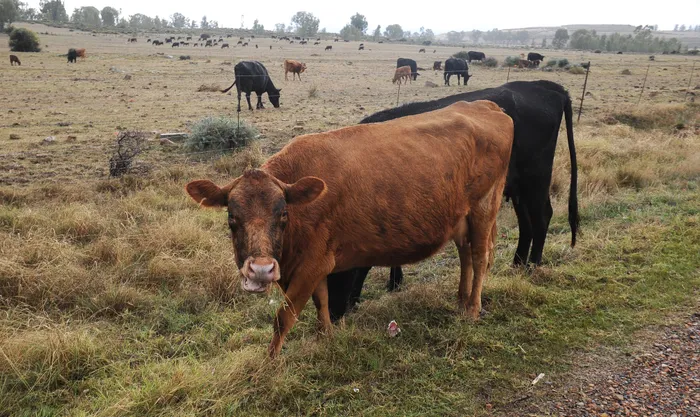
Following Minister of Agriculture John Steenhuisen announcing last week the lifting of Foot and Mouth Disease (FMD) Disease Management Area (DMA) restrictions in KZN, the KwaZulu-Natal KZN Agricultural Union (KWANALU) called on the relevant authorities to urgently finalise and publish the official Gazette
Image: Courtney Africa / independent Newspapers
FMD Response SA has warned that the detection of Foot and Mouth Disease (FMD) in vaccinated cattle in KwaZulu-Natal highlights the urgent need for a faster and more coordinated national vaccination programme to stop the spread of the virus.
The industry body on Monday said some cattle in two dairy herds in KwaZulu-Natal were infected with FMD after being vaccinated against the virus in March, raising concerns about waning immunity and continued transmission of the disease.
Andrew Morphew, FMD Response SA spokesperson and commercial farmer, said the latest infections demonstrated why South Africa needed to vaccinate cattle within a tightly coordinated six-to-eight-week window.
“The infection of vaccinated cattle shows that immunity wanes, and underscores that to eradicate FMD, all cattle need to be vaccinated within a tight window of six-to-eight weeks so that the virus stops spreading,” Morphew said.
“Only simultaneous immunity will stop disease transmission. We need a wall of vaccination that will stop the disease. Without it, the virus will continue spreading, including to previously vaccinated cows.”
Morphew said the organisation was encouraged by reports that Minister of Agriculture John Steenhuisen recognised the need for an accelerated vaccination response.
“We hope that this means that the government's stated plan to vaccinate 80% of the country's cattle only by December will be replaced with a focused strategy to vaccinate in tight windows of six-to-eight weeks,” he said.
FMD Response SA argued that South Africa had the capacity to vaccinate the country’s cattle population within a short period if private sector veterinarians were allowed greater involvement in the procurement, distribution and administration of vaccines.
“Past experience from KwaZulu-Natal shows 34 private sector veterinarians could vaccinate 50 000 cattle in a day,” Morphew said.
“This means all cattle in South Africa can be vaccinated within eight weeks, if there are the highest levels of public and private sector cooperation.”
He added that South Africa should learn from countries that had successfully eliminated the disease through rapid and coordinated vaccination campaigns.
“For example, Argentina vaccinated 60 million cattle during two targeted windows, eradicating the disease. Brazil similarly achieved success, using the private and state sectors, to vaccinate in tight time frames, resulting in simultaneous immunity among cattle,” Morphew said.
The renewed concerns over the spread of FMD come as the KwaZulu-Natal Agricultural Union (Kwanalu) called on authorities to urgently finalise and publish the official government gazette confirming the lifting of the Foot and Mouth Disease Management Area restrictions in KwaZulu-Natal.
Last week, Steenhuisen announced the lifting of the Disease Management Area restrictions in the province, a move widely welcomed by the agricultural sector after years of disruption caused by the outbreak.
However, Kwanalu chief executive Sandy La Marque said uncertainty remained because the circulated notice did not contain the standard verification details required for an official government gazette.
“Until the notice is properly gazetted and promulgated, uncertainty remains regarding the legal and operational status of the DMA lifting,” La Marque said.
She said the prolonged restrictions had inflicted severe economic damage on the livestock industry and broader agricultural value chain.
“The DMA restrictions have had a severe and far-reaching impact across livestock producers and agricultural value chains, with losses running into hundreds of millions of rand, affecting employment, product supply and ultimately the cost of living,” she said.
Kwanalu chairperson and beef farmer, PJ Hassard, warned that misinformation around the restrictions was creating additional pressure for already struggling producers.
“The livestock industry, already plagued with significant existential losses, cannot afford uncertainty driven by misinformation,” Hassard said.
He added that farmers and agri-businesses had endured prolonged operational and financial strain while attempting to remain compliant with disease control measures.
La Marque said Kwanalu had spent years engaging government and industry stakeholders to push for practical and science-based solutions to the outbreak.
“This has been a long and deliberate process involving years of engagement with the Minister, government role players and agricultural stakeholders,” she said.
The Department of Agriculture said it would provide comment in due course.
BUSINESS REPORT